28/6/20
Before I approached this particular part of the research task I took a further look at semiotics and its meaning, particularly with the reading and understanding of photography.
Being the so-called father of semiotics in the world of photography, I ventured into the Roland Barthes essay “Rhetoric of the image” with gusto. I soon had the wind knocked out of my contextualising sails…. Whilst I am familiar with the work of Barthes to some exempt (Camera Lucida which I am still reading) I do struggle to fully decipher the text and its information. A lot of the wording I find compacted and difficult to follow, and I am left continually resting to the Oxford dictionary.
I persevered as best I could and gathered as much as I could from the essay. It has to be said that I had not looked at images in this manner and it was a valuable lesson to learn about semiotics, a term also I had not heard of previously.
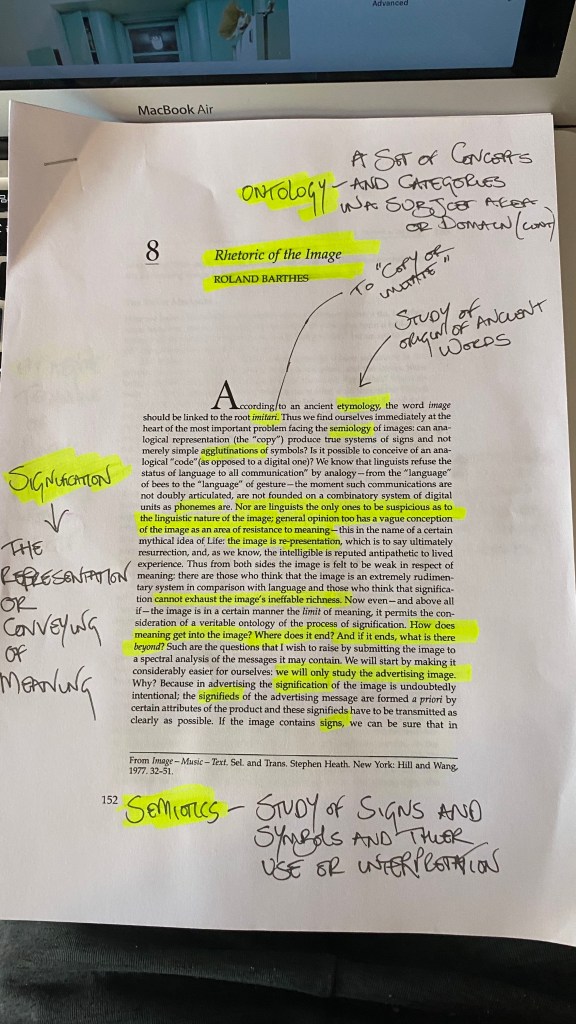
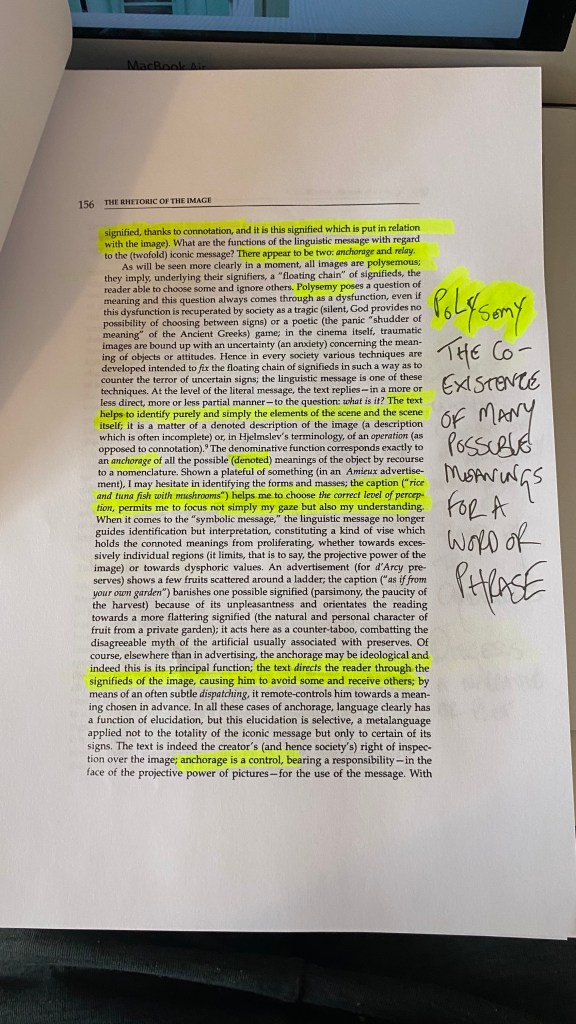
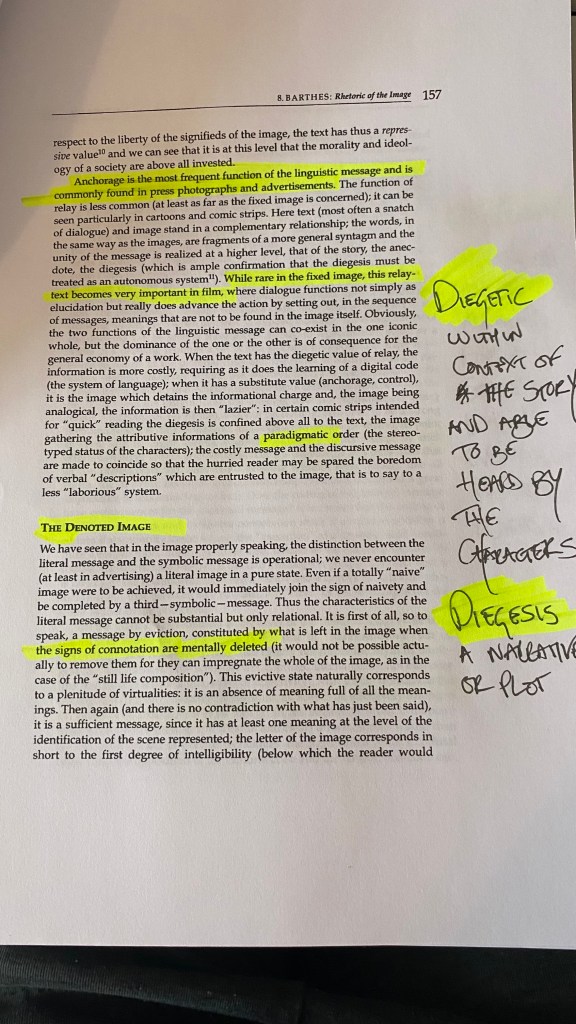
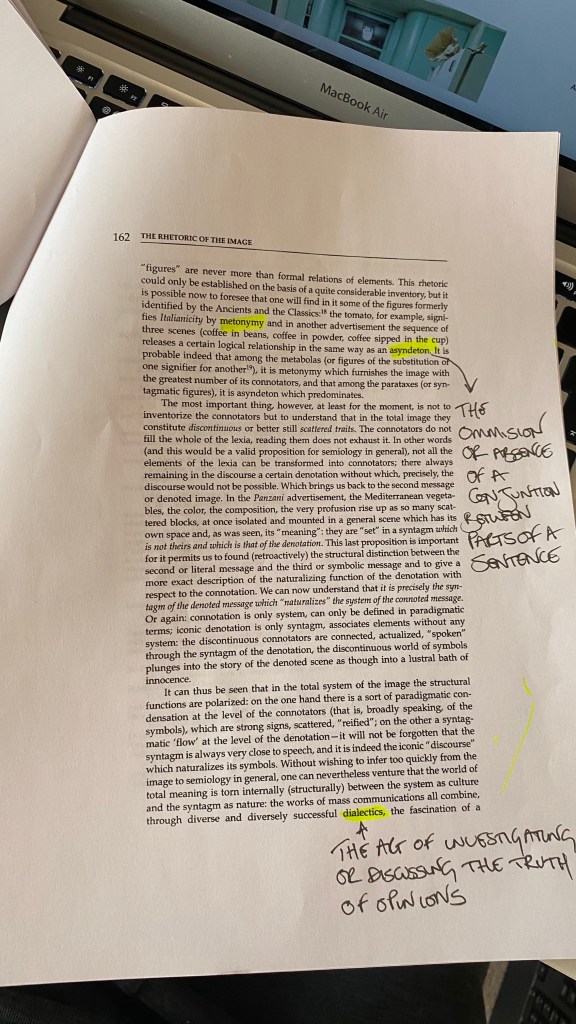
As you can see from above, I dissected the essay as well as I could and extracted what I felt was important and relevant to me and my further progression. I also used the opportunity to watch some videos on semiotics which are referenced below. This helped me underpin the essay of Barthes and help me put it into a more coherent manner.
Bibliography
(ONLINE) https://www.youtube.com/watch?v=4CM9AuKNHxI&feature=fvst (accessed 28/6/20)
(ONLINE) https://vimeo.com/26765792 (accessed 28/6/20)
(ONLINE) https://www.oca-student.com/book/export/html/95988 (accessed 28/6/20)
Jeff Wall – Insomnia
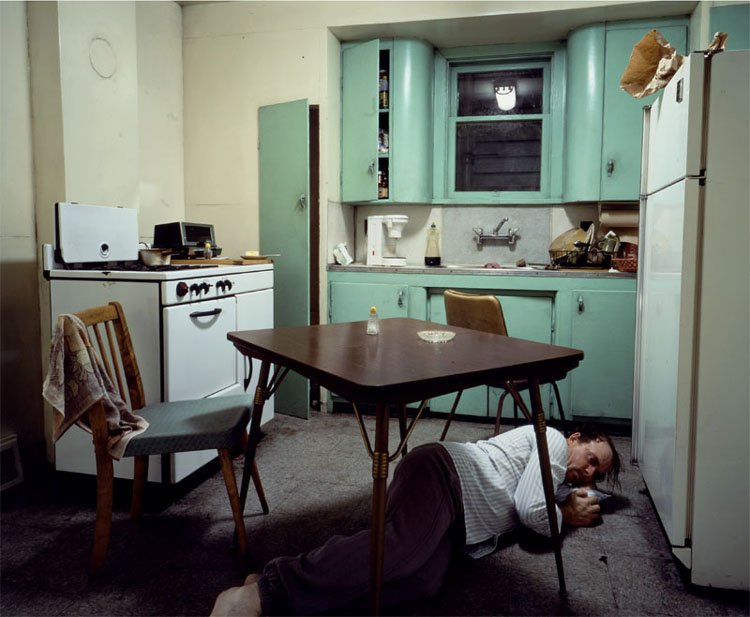
While looking at this image I felt best to bullet point some of the observations I made myself.
- cold harsh lighting
- no curtains / blind
- reflection of light in window
- feet o man cropped slightly
- tight composition
- bare table with only two items
- dirty used detail adds depth
- man under the table adds depth / tension to the scene
- man expression / partial view of face
- doors ajar suggest movement / searching
- cold feel of fittings in side kitchen
- Why kitchen? associated / connotations drawn up by insomnia
- Bare walls
- angled appearance of ceiling
- minimal content
- brown bag above fridge
Overall a very tightly and well thought composition. The use of open doors, cold colours, harsh light, angled walls / cropping all add tension to the connotations drawn from the scene.
I would also suggest that Wall’s image is a great example of tableau photography and I took sometime to try and investigate this term further. The term was first coined in the 18th century and was used to describe composition pinpointing that was true to life and natural. The resurgence of this type of work in photography began in the 1979s with photographs created with the intention of being “hung” on a wall much like a painting. This in turn led to photographers engaging with much the same issues as painters when creating their work. “Tableau vivant” is French for “living picture” and it seems to describe its being perfectly well.
Beneath the surface
Whilst reading the blog post provided by the oca – https://www.oca.ac.uk/weareoca/photography/beneath-the-surface/ (accessed 29/6/20) I began by sketch booking some of the terminology and phrasing to give myself a better understanding of the topic.
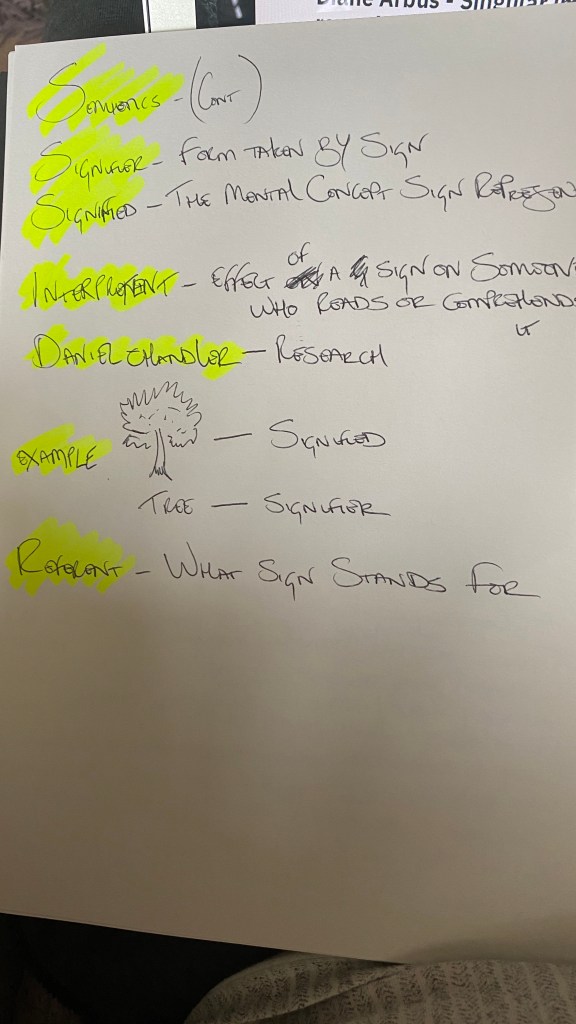
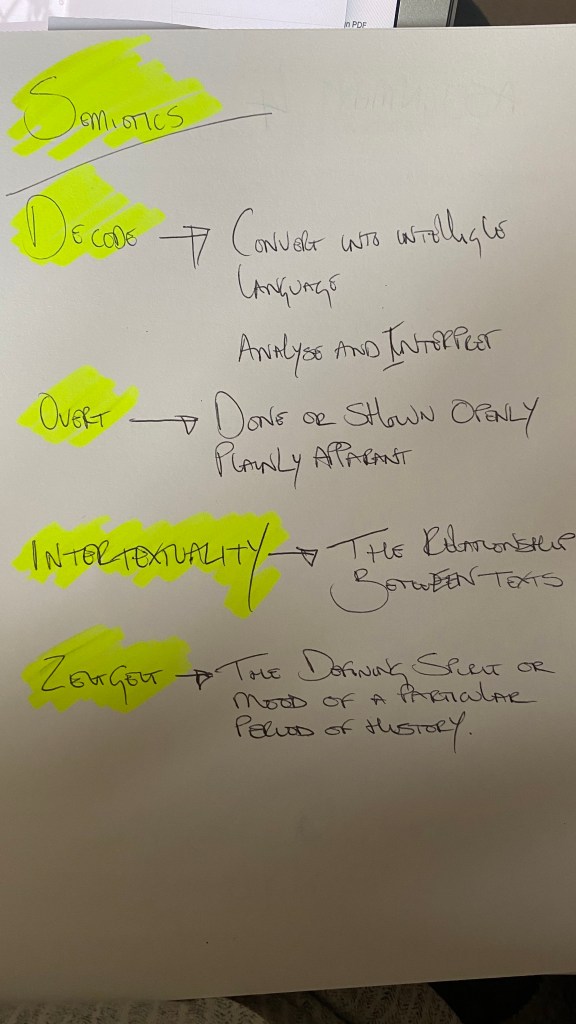
The blog post gave myself a great insight in how to conduct the deconstruction of an image, by looking at the studium, punctual and the signifier and the signified. I found the blog post much easier to digest than the work of Barthes, although I believe in the context of learning they are both as equally valuable. I began to understand that a complete picture behind the image should be investigated, for example the interests, career, objections of the photographer as as equally important in deconstructing an image as the image itself.
I also decided to look more closely at the work of Jeff Wall and found some useful documentaries on YouTube where he spoke about his work, how he plans a shoot and his theory on photography. It is clear that there is a vast amount of Jeff Walls work to digest, but perhaps the most important thing for me is the term “cinematic” photography. I can honestly say I had not come across this before and it is something that is completely new to myself. Also I found it interesting how Wall suggests that reading an image should be like reading a poem, that ultimately a picture is a visual poem, with the same connotations and denotations.
Bibliography
(ONLINE) – Jeff Wall – https://www.tate.org.uk/whats-on/tate-modern/exhibition/jeff-wall/jeff-wall-room-guide/jeff-wall-room-guide-room-6 (accessed 29/6/20)
(ONLINE) Jeff Wall – https://www.oca.ac.uk/weareoca/photography/beneath-the-surface/?cn-reloaded=1 (accessed 29/6/20)
(ONLINE) Jeff Wall – https://www.youtube.com/watch?v=HkVSEVlqYUw&t=650s (accessed 29/06/20)
(ONLINE) – https://www.tate.org.uk/art/art-terms/t/tableau (accessed 30/6/20)
(ONLINE) – https://en.wikipedia.org/wiki/Tableau_vivant (accessed 30/6/20)
Diane Arbus – Singular images: Essays on remarkable photographs by Sophie Howarth (2006)
After reflecting on the image assessed singularly in “…remarkable photographs” I certainly feel more confident in attempting to deconstruct my chosen image in assignment 4. The essay overall had a well rounded feel with the correct weight added to the information of the photographer and the signifier and signified within the image. It was interesting how the author analysed the image and drew many connotations from seemingly subtle and perhaps overlooked aesthetics. The importance of gaining understanding of the photographer and the photograph was also reiterated by the author, both adding and contributing to the conclusions drawn. From some of the reading I understood from Barthes is that we ultimately may not know the real truths captured within an image but we do need enough information provided by the correct research to attain an informed decision. I believe this has been well evidence here by the author and it is an ideal piece from which to draw my own ideas when I deconstruct my chosen image.
Judith Williamson
I took an earlier look at Judith Williamson in the course, link here https://danieltowellocacontextandnarrative.photo.blog/judith-williamson/ I have also signed up to the SOURCE newsletter which we give me the opportunity to look at her work more regularly and closely.
I do find it interesting that these works by Barthes etc, seem to deal with the dissection of the advertising image. I see the importance and relevance of this now, as they all clearly contain the sign, signifier, signified and from these we can draw the denotation and connotations quite easily. This then feeds into how we dissect any image for example.
I also looked at this article – https://www.source.ie/archive/issue83/is83column_Judith_Williamson_11_58_13_03-08-18.php (accessed 30/6/20)
 Dan Towell OCA Context and Narrative