June 8th 2020
I have decided to take a closer look at some artists along my journey through the coursework and document by date in my learning log. This was suggested to me by my tutor and it seems like a logical idea and perhaps one I should have though of earlier.
I will also use these entires to document any other learning undertaken alongside this, where it may be video, exhibitions or OCA tutorials.
My current photographic practices seem to be very much drawn to black and white landscape, so I decided, amongst others, to look at the work of Fay Godwin, whose work seems to connect well to my current mental model. It is interesting firstly to note that Godwin did not have any reputable photography training. It was an interest that grew quite organically from photographing her own children. Apparently her husband was not much of a photographer, so this role of family archivist fell to Godwin herself. Her work was predominantly exploring images of the British coastline and countryside, but she also produced portraits of well known British and foreign authors. These portraits had an undeniable character and one that is easily identifiable with Godwins style of work. She photographed predominantly in black and white and her portraits were often shot in the home of the subjects, which generally leads to much more candid and honest form of portrait imagery. A lot of her landscape work was drawn toward the ecological crisis of the 70s and 80s in Britain, Godwin had a real connection and inherent passion for the land and all that it stood for. It seems from watching some documentaries on Godwin, that she was fundamentally drawn to these crisis of the land firstly as a mother, whom worried about how these catastrophes would impact her children and indeed theirs. It was a combination of concern and passion that led her to type of landscape photography. She also had a great love of walking and after some years of portrait work and reportage, she produced some of the most acclaimed landscape work by a british photographer in the 70’s and 80’s.
By looking at Godwins work and listening to her put in into her own context, it is clear she worked very closely with light. It was a fundamental aspect in how she worked. She was aware that bad light did not mean bad photography, but she manipulated the light to create mood, tension, intrigue and depth. It is also often seen in her work that she creates further aesthetic tension by use of perspective and detail, placing small objects in between vast rocks, cropping skyline, intensifying foregrounds and enhancing a sense of struggle that is so abundant in the natural world. She produced a rich body of landscape work which has a very unique and personal voice, a sense of whispering behind the camera, letting the images do the talking or rather shout quite profoundly. In her later years worked more in colour with the National Museum of Photography in Bradford, adopting a very different approach to her landscape work. In this instance I won’t be discussing her later work in this particular post.
Below is an image for artistic reference only.
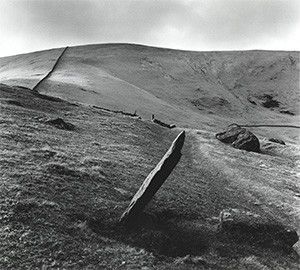
This picture I probably one of Godwin’s must famous and is quite an intriguing and striking composition. I think this really demonstrates how Godwin had a great eye for detail and that she would often see things that other photographers may not. It is quite amazing how she captures the natural Z or S curve that flows through the image, leading the eye to the top of the hill where the wall leaves the top of the hill. A stricken angled post some distance from the wall completes the curve in quite a fascinating, encompassing manner. A small fragment of sky completes the frame and does much to emphasise the grand context of the sprawling landscape and the emphatic foreground. It is quite compelling that such a small amount of subject matter can be so captivating, but this really highlights the importance of a subject but that does not mean it has to dominate the frame. This image relies on a balance of space, to much skyline and the natural curve would be lost on the viewer, as would its majesty and power.
Reference
Reference – (ONLINE) http://www.faygodwin.com/obit.htm (accessed 11.06.20)
Reference – (ONLINE) https://www.youtube.com/watch?v=XqwOpkOkuzE (accessed 15.06.20)
Reference – (ONLINE) https://www.youtube.com/watch?v=YSpq3h7M1AM (accessed 15.06.20)
Reference – (ONLINE) https://www.artrabbit.com/events/fay-godwin-the-drovers-roads-of-wales-and-other-photograph (accessed 15.06.20)
Response
In response to Fay Godwin and her portrayal of the British landscape, I decided to use the surrounding New Forest to further investigate the black and white aesthetic when shooting this type of imagery. I wanted to explore further how the monochrome edit and sense of scale can contextualise landscape imagery in a very different way to that of a colour photograph.
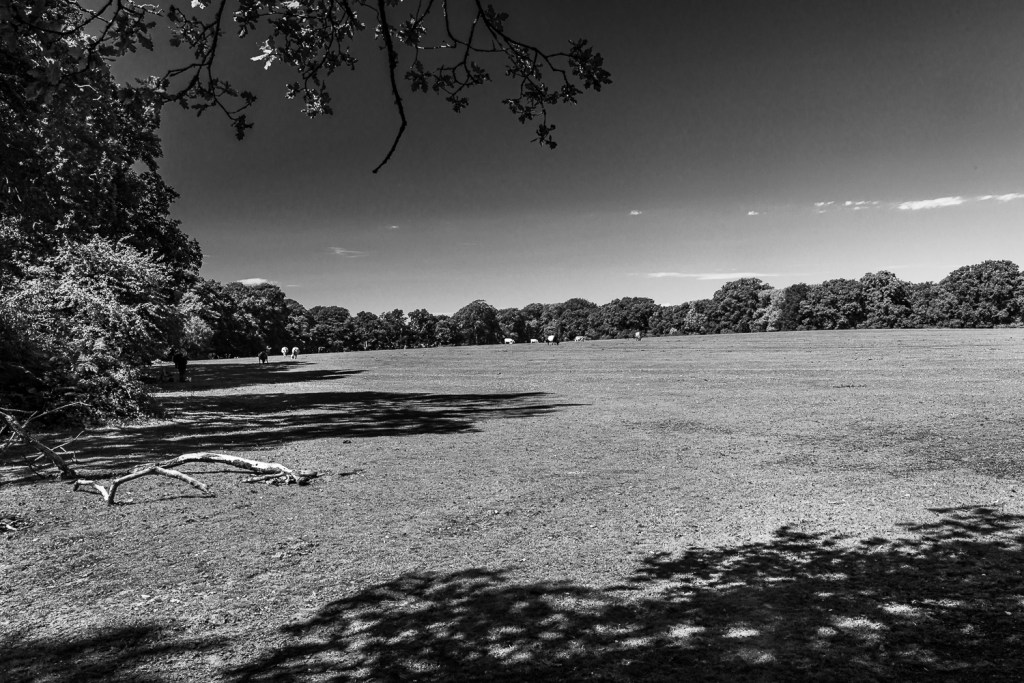
The above image certainly resonates with the image below, and it was another scene that struck me upon coming across it whilst shooting in the New Forest, Denny Wood to be exact. I was again armed with my d800 and 24-70mm lens, UV and polarising filters also. As I walked the scene and took numerous images, I toyed with composition, vantage points and camera angles. I then came across some cows in a field that were a good way away in the distance before me. It immediately came to my mind that this was a scene of real photographic perspective, dynamic and subtle in equal measure. I hid myself under a tree to compose the frame further, knowing I wanted the shadow of the tree in the foreground to add depth, the fallen branch to the left equally important. I also love the way some overhanging branches from the tree jut into the top of frame, this being a visual aesthetic that has now become a common theme in much of my work. I composed the image this time not intent on a particularly emphatic skyline, tbut more intent on the foreground and its heavy shadows to the front and side of the frame. If you look closely there is a couple walking in these shadows towards the animals in the background, their inclusion adding a sense of scale, depth and mystery. One could argue that the animals themselves could be larger, more prominent, but to move closer or zoom in would have adversely affected the image in also equal measure. I wanted a sense of scale and space, much like the image by Fay Godwin, which I have highlighted above. The image is finalised with some demure clouds that sit quite passively, adding natural contrast in the black and white process, their size seemingly twinned with the “petit” appearance of the grazing animals below.
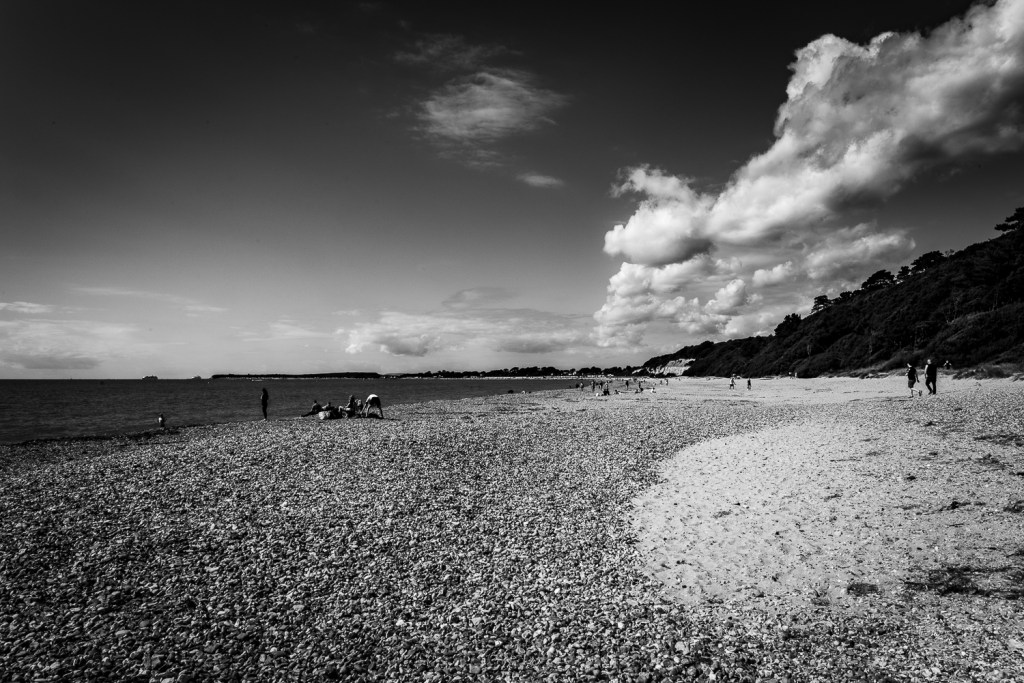
This image was taken at Highcliffe Beach in midday light with my d800 and 24-70mm lens. As I rested against some rocks to take in the view, I immediately saw quite a dynamic scene. I had a circular polarising filter on the front of my lens which does cause some vignetting so I could only push to around 28mm focal length. What struck me was the low lying cloud which was completely motionless, sitting what seemed like only a few feet from the hilly terrain above the beach. I saw a natural curve in the frame when I raised the camera to my eye which ed me across the vast horizon. I knew the figures in the frame would become isolated and insignificant within the scale of the frame, yet they are of utmost importance in relation to the scene. A man bending over to communicate with his family add intrigue, while the viewer can also ponder the two figures thoughts as they meander down the right of the frame. In process I wanted to accentuate the dynamism of the image by increasing the whites, but reducing the highlights. I brought contrast back into the frame by means of deepening the blacks and adjusting the tone curve. On reflection on the image I also reduce the clarity just slightly, which seems to add to the ethereal character. I do feel this image embodies my progress so far and can be linked to my historical research into practitioners as Daguerre and more contemporary figures such as Godwin or Brandt.
 Dan Towell OCA Context and Narrative