Looking at Gregory Crewdson’s work its clear that he has quite unique style. Very much in the vein of “tableau” he creates cinematic images that are in the vein of Stephen Speilberg or David Lynch. What makes the work unique is that Crewdson combines it with the documentary photography of Walker Evens and William Eccleston. The images are staged everyday suburban American settings and often evoke feelings of alienation with haunting, dramatic and surreal narratives.
Is there more to Crewdson’s work that aesthetic beauty is open for much debate. Some of his work, like the image below, is untitled and there doesn’t seem to be any accompanying text with the images. They are cleverly crafted and purposely lit to create very definite aesthetic feel. The feel of this is obviously rooted in film and cinema, but hey do suggest a very different visual experience to that of Jeff Wall. Whereas Walls images are more often than not based on a more “everyday” scene, Crewdson’s images seem to directly relate to fantasy and fiction. This is where the contradiction comes in, they are not pictured like a alien abduction, yet they seem to connote the same sort of atmospherics. This almost certainly where Crewdson succeeds in making his work “psychological” as they clearly arouse thoughts of another world, theories of life, death and other rather dark places in society.
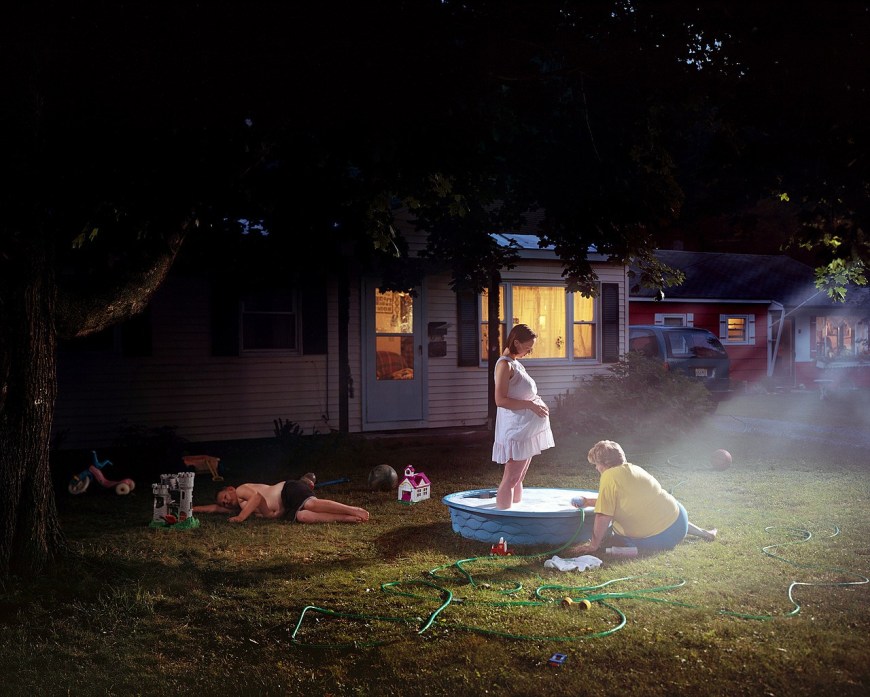
Quite startling lighting here directs the eye to a pregnant lady standing alone in a paddling pool. One can only wonder that this was some sort of pregnancy comfort, as she seems very content with one hand gently nestled on her bump. Another lady seems to be directing water into the pool, as another person (child?) lies sleeping to the left of the said “paddling” pool. To my mind the only real attention on the pregnant lady comes from the almost divine light, sharing only the location with the other subjects, no emotional or physical contact seems to be taking place. She seems separated, almost alone. A warm glow from a window also illuminates what otherwise would be quite a cold scene, yet the whole image seems eerily quiet.
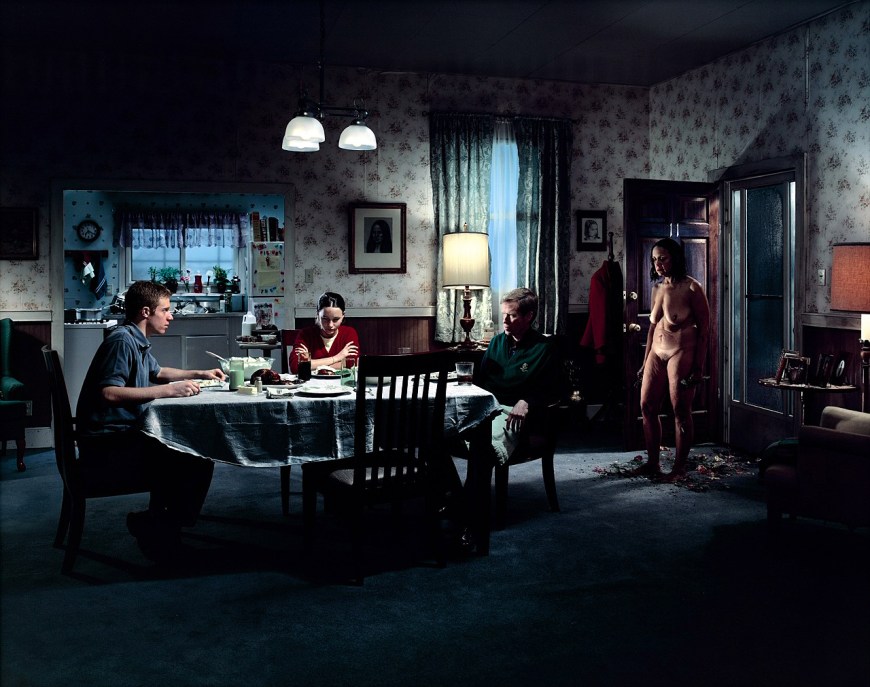
Again here their seems to be genuine separation from the main subject in the scene and the rest of the people inhabiting the frame. A naked woman approaches the dinner table, yet does not seem to attract the gaze of the three people sat at the table. The nakedness of the woman, dramatic lighting and emotional separation lead to connotations of something quite frightening, eerie and mysterious, otherworldly even. There is a clear separation of any sense of relationship between the two sets of individuals, enhanced by dramatic studio lighting and a obliquely darkened foreground.
References
(ONLINE) https://www.guggenheim.org/blogs/map/one-size-fits-all-oder-wem-gehort-der-offentliche-raum/attachment/map_radulovic_defendbeautifulart_490-2 (accessed 1/7/20
(ONLINE) https://en.wikipedia.org/w/index.php?title=Gregory_Crewdson&oldid=950830610 (accessed 1/7/20)
(ONLINE) https://www.artsy.net/artist/gregory-crewdson?utm_medium=p-search&utm_source=adwords&utm_campaign=dsa-artist&gclid=EAIaIQobChMIy5fx9J6s6gIVF-DtCh10lQcREAAYAiAAEgKX5vD_BwE (accessed 1/7/20)
Beauty or not?
I find it difficult to raise the analogy of beauty when considering my own images currently, yes I want to make something aesthetically pleasing but I have never adopted such a cinematic approach as Crewdson or Jeff Wall. Is making images without having a stonewall “studium” (as it were) wrong? No, certainly not, and I am now in some ways questioning everything about photography. Does the meaning behind such images tell us more about the photographer than anything else? The conclusion I can draw is that both Crewdson’s and Wall’s work are both very rooted in the real, the present, the here and now. Yet they grow into very different siblings, arguing with each other over how they feel and what they want to say. Both heavily influenced by documentary, film, the abstract and the unreal. This type of art is perhaps so closely linked to film it can only really be viewed as such, “entertainment photography” perhaps. What is clear is that both artists want to take the viewer on a journey into places where we can free the mind and awaken the senses. Whether an image is inherently “beautiful” is obviously open to discourse, but in this instance it will go a long way to placing the work into a photographic category. What Wall and Crewdson do so brilliantly is blur those lines, challenge those boundaries that they knowingly or unknowingly find themselves in. I don’t see these photographers being particularly obsessed with aesthetics, beauty even, rather a case of expressing their individual vision.
 Dan Towell OCA Context and Narrative