Thoughts and learnings
After looking at Paul Seawright’s work, “Sectarian Murders” I personally agree with his argument entirely. His work challenges the boundaries between documentary and art as they adhere to the fundamentals of both. But this does not distract from the meaning. His images are artistic as they take the viewer on a journey through the scene using subjects within the landscape to compose the scene. The use of angle, camera level and focus point are for artistic licence but ultimately they document the scene where these frightening scenes took place. This does not change the meaning, but perhaps add to only enhance it. Paul’s argument seems to be that as long as the meaning is given to the viewer along with its context then the narrative can be clearly defined. I can only agree with this. As Paul states these are not in the context of a magazine where cropping and page flicking would deaden the impact. Perhaps this style of photograph would not sit well in a documentary magazine, but that is why the external context of the images is so important. It gives the image another meaning, an identity it where it belongs. But does that mean a more vernacular style of images used in a magazine is not art? This is where the grey area lays. It cannot be argued that this set of images in not documentary and they blur the lines between this and photography as an art. But this in turn makes only for discourse, what is important is that the message is conveyed. That is the core of Paul’s argument. Photography is its artistic sense give opportunity to portray such surreal acts of violence or anything for that matter in the way it needs to be seen to give pure unadulterated realism. It can give a childlike view of looking at a scene from the top of a slide, fractions of a second we enjoy but are gone in a flash (no pun intended). One could imagine the scene of murder being played out in waste ground, chronicling a dose of humanity that is so absurd, unsettling and devoid of reality to most. To portray the scenes in this way bring them closer to what is real, closer to what is our reality as we mingle through the passage of time. If we did not look at documentary in this fashion how could we actually relate? It would in fact be meaningless or separate from what we know. There is no vagueness here in this set of pictures, its somewhat hidden meaning is only enhanced by the discerning eye and skill of the photographer. Imagination is not just about what is not real, it is also about recalling and revisiting, the ability to picture things as we remember. The camera has the infinite ability to do this in almost unbelievable fashion. Nothing can clutch a moment so purely as the camera. It has finite opportunity to see what we see, see what we have seen and to show us what we saw but in fact did not see. And we can see it, visualise it again and again forever and a day. Documentary photography at perhaps its most compelling. Below are two images used for artistic reference only.
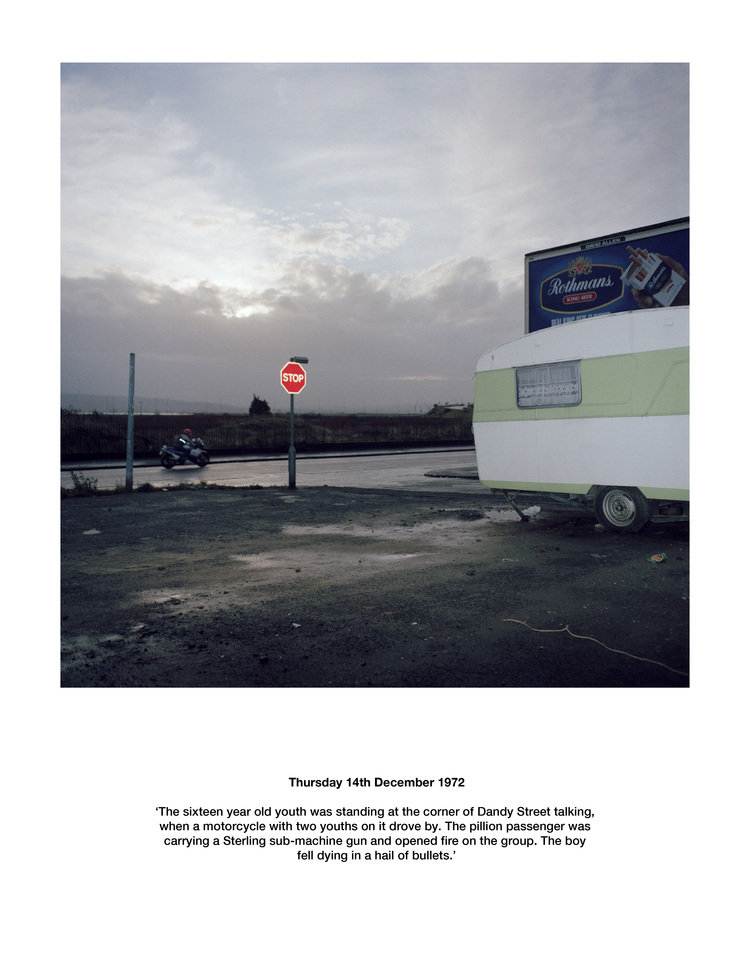
It is interesting here how Paul has highlighted the “Stop” sign, which obviously has some significance. Use of negative space and framing also capture a moving motorcycle and a lorry brandishing a cigarette advertisement.
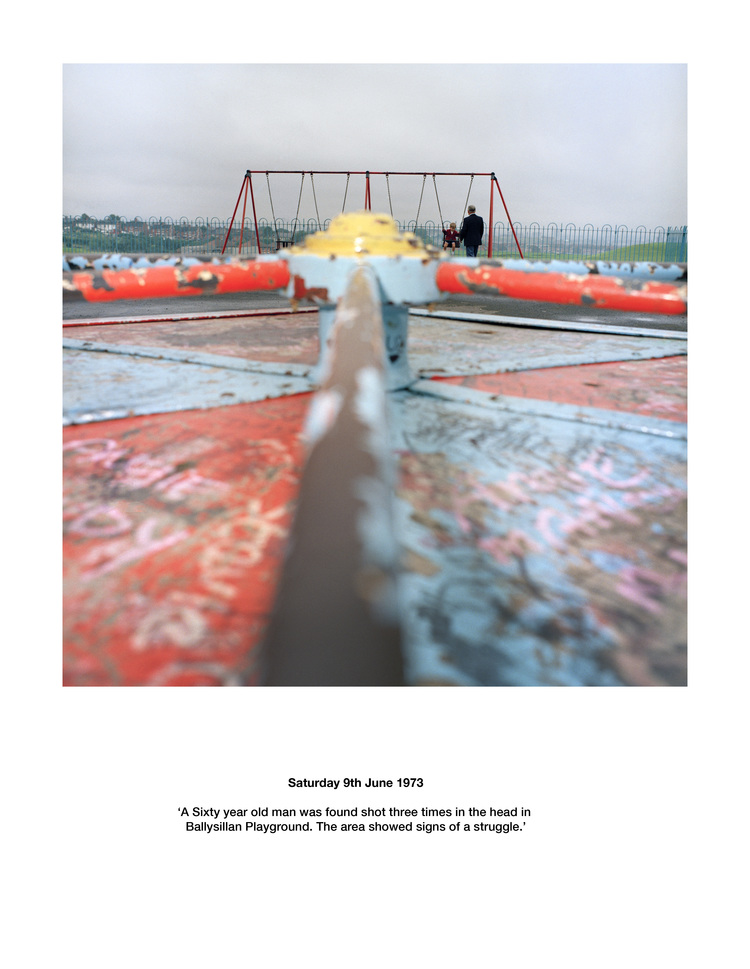
Use of perspective and scale here emphasis the size of the roundabout and lead the eye to the small child on a swing in the distance. A small amount of skyline and a man looking out toward the scene and to the tense nature of the frame. It is almost like something is about to happen.
It is noteworthy to see that Paul uses text to accompany his images, in this instance it is absolutely necessary. The images in most part could be taken anywhere, but the text links the images to the scenes where the sectarian murders took place.
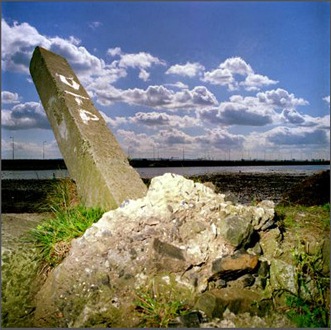
A quite breath taking image above denotes quite a macabre scene, The death of a young 17 year boy who was shot by four men. The boy was hunting ducks on the lough with a shotgun, the murderers also left with his weapon. The slanted nature of the graffiti stricken lump of concrete suggest the fragile state the country was in at the time of the shooting.
Reference
Reference – (ONLINE) Paul Seawright – http://www.paulseawright.com/sectarian (last accessed 10/4/2020)
(ONLINE) http://www.paulseawright.com (accessed 10/4/20)
(ONLINE) https://en.wikipedia.org/wiki/Paul_Seawright (accessed 10/4/20)
(ONLINE) http://www.britishphotography.org/artists/17199/ei/1739/paul-seawright-paul-seawright-sectarian-murder-1988 (accessed 12/4/20)
 Dan Towell OCA Context and Narrative