Findings
Whilst Bryony Campbell’s work in The Dad project differs in narrative to the Country Doctor (Walter Eugene Smith), there are perhaps a few similarities that can drawn from digesting both sets of images. Obviously the first is that they both deal largely with a “medical” topic and both portray images of illness and the emotion that this brings. The stories though are entirely different but both share the fact they narrate a man’s struggles and tribulations, albeit for very different reasons. Campbell’s work in particular is quite startling for number of reasons, firstly the fact she was drawn as a photographer to document the dying days of her father, but also in the stark and sad way she captures her relationship, personal struggles and final goodbyes to the father she so clearly loved. It can only be celebrated not only that he was a willing contributor to the series but also became heavily involved in what they would shoot together. Looking at the work of Smith and comparing the sets of images, if anything it is the emotional content that could be compared similarly to Campbell’s. The narrative itself is entirely different, with Smith working on magazine assignment that was to highlight the shortage of country doctors in the US, where the subject (Dr Ernest Guy Ceriani) had to look after around 2000 patients in the small town of Kremmling, located in the Rocky Mountains. This context of the series immediately puts it into different light, as Smith tries to pinpoint the struggle the doctor has and the obvious stress he encounters along the way. Whilst Campbell admits in her essay presented on her website (reference below) that she had altered the edits of her project depending on the context of its appearance, the outset is entirely different to Smiths. Whilst we are subjected to two compelling narratives, Campbells initial quest for these images was perhaps as subject work for her Ma in documentary photography, which she was studying at the London College of Communication. Whilst this can surely not be the only catalyst for such an emotional subject, they are both entirely different contexts, which would lead to shooting the series quite differently. Campbell obviously struggles in the initial part of shooting the project, but began to find what or why she was actually shooting the death of her father, whilst being true to herself as daughter and father. Both sets of work are touching, emanational and quite disturbing, the narratives are vastly different, largely down to the context in which there are approached. The black and white film aesthetics of Smiths work creates a very different artistic look, but sets the tone of the desperation the Doctor so clearly demonstrates. But this is entirely different documentary photography which to me leaves the viewer asking very little questions. Its gives a vast amount of information, is emphatic and to the point, it most certainly does its job. Perhaps stigma adds to the intrigue disposed in Campbells set, but the viewer is left asking so many more questions, trying to understand thoughts, feelings and how the photograph can so vividly portray the pain of both the father and daughter.
“An ending without an ending”
There are many reasons that this set of work by Bryony Campbell does not have an ending, albeit the most obvious one, which ultimately is the saddening death of her beloved father. But there never can be an ending to this type of work, because we will always be able to draw from it, relate it to our own circumstances and continue to explore the very ambiguous nature of these images and its topic. Perhaps the viewer will draw the series to a visual and emotional closing, but I doubt this will be the case for anyone with a keen interest in art, photography or life for that matter. Work like this is like a novel, it clearly has a start, a middle and an end, yet the very soul of the work lives on and on, continually changing and evolving with time and sociological transformation. They are like a song that resonates so deeply, that captures the heart of the masses, yet we interpret it as we wish and make it our own. Because the true meaning is hidden, so very ambiguous, the song carries so many thoughts and emotions that it strikes us individually. We can never look at this type of work exactly the same as another does. It may resonate with thousands of people, but ultimately it’s this that makes it so very personal. People will continue the search to find that song, that poem, that book, that photograph, and upon grasping it they become true and emotionally tied to them. How can anything with this unlimited power have an ending? It can’t, it will only continue to evolve, reinvent, and be a source of learning that we will continue to revert back to for years to come. Death and it portrayal is something so very poignant and graphic that it can only be a source of constant fascination in our search for understanding. I’m sure Campbell will continue to evaluate and learn for this body of work that has most probably become much bigger that she or her father would have dreamt of. That in itself is great testimony to them both in documenting so bravely a quite disturbing topic that will certainly live on for many, many years to come. Whilst we as students and art exhibition goers continue to draw much from The Dad Project, it became so relevant because it is such a personal journey, it set out to ease pain, to foster better relations, to nullify grief, to benefit both father and daughter, if only momentarily. Yet it became so much more for both, and the life of her father and the portrayal of his death will live long after. I suggest Campbell will continue to learn much about herself and indeed her father from this truly startling body of work. Below are two images used for artistic reference only.

Deliberate use of lans flare here seems to suggest movement and fragments of time. A line of a plane running through the frame out of sight into the clouds could be linked to a final destination.
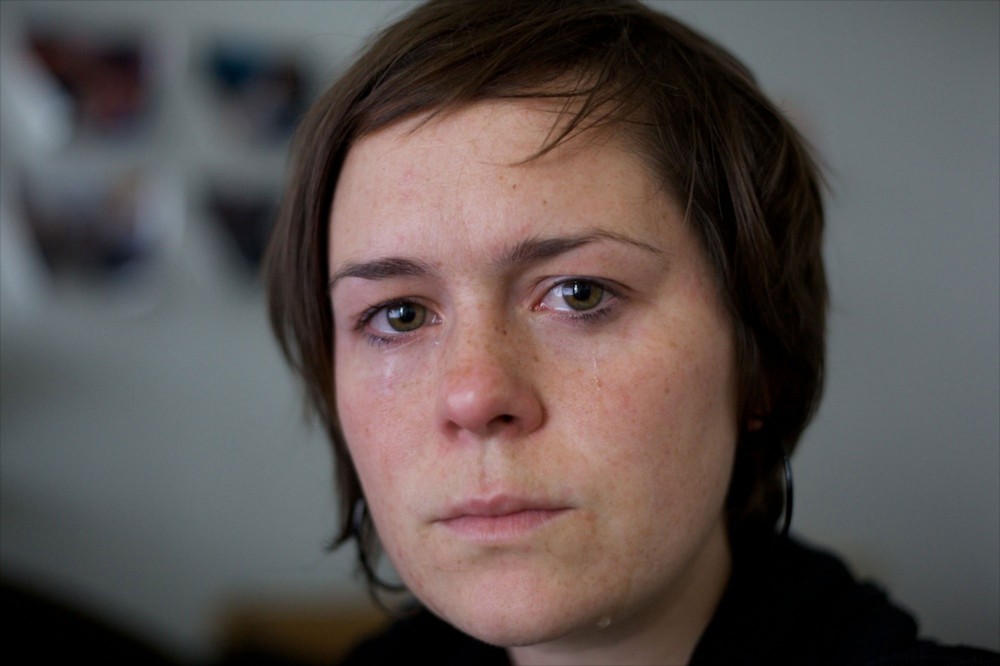
A wonderfully isolated self portrait here in essence is perhaps the most defining image within the set. The struggle of grief is perfectly portrayed as tears run down the face of the daughter a loving father will leave behind. I am sure this would have been an extremely difficult series to photograph, but technically this image is superb. A close crop into the face hides no emotion from the viewer as the eyes well with tears. The details on the face of Campbell are in sharp focus, except the background, which is beautifully softened adding depth and poignancy to the sadness of the scene.
References
Reference – (ONLINE) – Briony Campbell – http://www.brionycampbell.com/projects/the-dad-project/ (last accessed 7/5/2020)
Reference – (ONLINE) Briony Campbell – http://www.brionycampbell.com/wp-content/uploads/2013/03/The_Dad_Project_Briony_Campbell.pdf (accessed 08/05/20)
 Dan Towell OCA Context and Narrative