Thoughts / Findings
I watched the film Goodfellas a good few years ago and I must say I should revisit it again. I hadn’t isolated the scene the “Long take” and it was highly interesting to do so. A quite remarkable scene, I do wonder how many takes it took to get that right. I would also say it is a perfect example of a “constructed reality”.
It soon becomes apparent that the male in the scene is a very important person. The cohesion of the scene and its dialogue lead you to believe that he is part of a mafia type underworld, and also that he is a very prominent figure within his subculture.
Listed below are some of the parts of the scene which help to depict this;
- the male has his car looked after whilst in the club
- he seems to know a lot of people
- he has a table put in a specific location just for him and his partner
- another table buys him a bottle of wine
- he seems to have pockets full of cash
- the couple arrive at the club and make their way to a back entry which leads him through the kitchen. This seems to be regular occurrence as the people working in the kitchen largely pay no attention to the couple
- tips large amounts to doormen etc
A fantastic scene which when looked at individually offers an insight into how messages and information within film are conveyed in this way.
Reference – http://www.youtube.com/watch?v=OJEEVtqXdK8 (accessed 30/6/20)
Jeff Wall
Being vaguely familiar with the work of Jeff Wall, I thought a good place to start to reinforce my understanding was a film “Retrospect” which was made in conjunction with an exhibition at the Museum of Modern Art in 2007. The film centres on a walk through of the exhibition with curator Peter Galassi, which surveys Walls work from the late 1970s to 2007. The film gets up close with Wall as he directly describes his thought process on photography and art, he also describes how he created some of his most well known photographs.
It was interesting to note that Wall was predominantly a painter and a drawer up until the late 60’s when his working relationship with photography began. Wall felt that photography was the best way for him to express his conceptual ideas. Wall cites Steve Liss, Walker Evans, Eugene Atget and August Sander as major photographic influences in his career. His work was also affected greatly by cinema where Wall cites film as an “art form”. Wall also sees a direct kinship with painting and photography and this is evidenced by many of his images. Wall is known as a pioneer of what has been termed “tableau photography” his images are presented in large scale, in much the same way as a painting would hang on a wall. A lot of Wall’s work went against the grain of what photography was in the early 70s, where a black and white style and small scale images were the “norm”. Wall’s work to my mind was pretty ground breaking and I sum up his style as being directly influence by film for its cinematic value and painting for its use of story telling. The below image is one of Walls most famous and he almost is directly influence by the famous painting by Edouard Manet, which is also pictured below for artistic reference only.
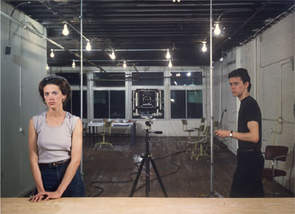
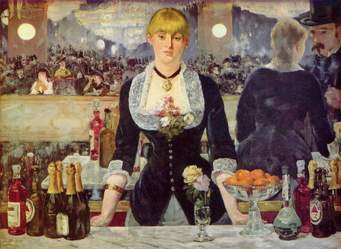
Wall replicates the use of projecting an image by way of reflection in a mirror. Mirrors were commonly used by artists when working on self portraiture, whilst in this instance Manet uses the enigmatic tool to convey the scene in a busy cafe in Paris, the “Bar at the Folies Bergere” 1885. Wall in his image actually stars in the set, but only as an accomplice, the subject of the image is the absorbed gaze of the woman to the left of the frame. The fact that we are looking at aa reflection is intriguing because it gives the appearance of the woman looking directly at the spectator but in fact she is looking into a mirror at the lens of the camera.
Wall cites the “The Destroyed Room” 1978 as his first complete work or at least one that met his standard of approval. This is another of Walls carefully staged scene which also heralded his first use of advertisement hoarding light boxes backlighting a transparent image.
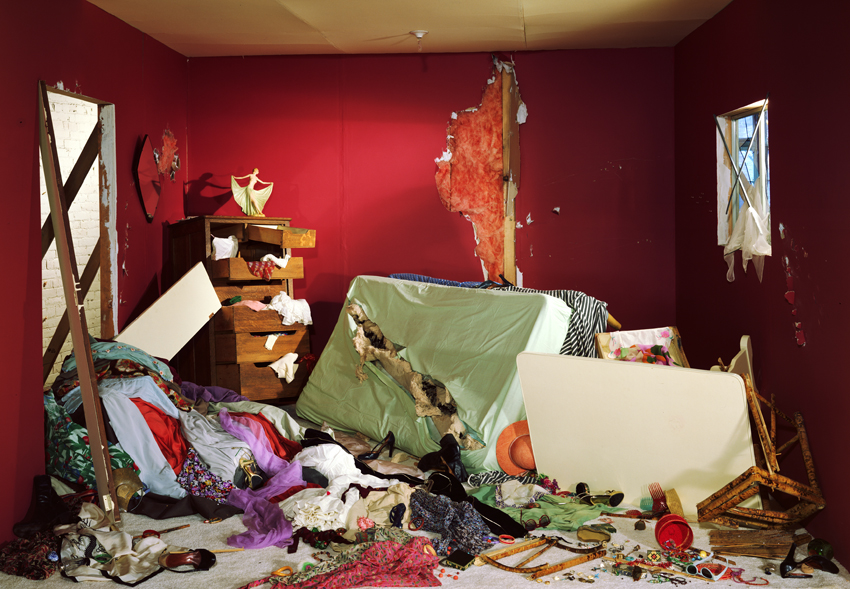
The image depicts a ravaged room, a torn mattress accompanied by various items of women clothing, jewellery and shoes. What happened in the room is left to the connotations of the viewer which are also heightened by hole in the wall to the left of the frame. This in itself does not hide the fact that we are actually looking at a studio set up, but Wall uses this to create yet another layer in his work. His images are full of reference to artistic history, criticism and theory but are also very accessible in what they depict, often everyday scenes that are part and parcel of everyday life.
Some of Walls other work have the aesthetics of photography in the 70s and 80s, such as the image below. Wall recreates a scene he came across one day and uses a rough film like style with hard light and grain. This adds great depth to the scene of a passerby seemingly making a derogatory face toward another individual.
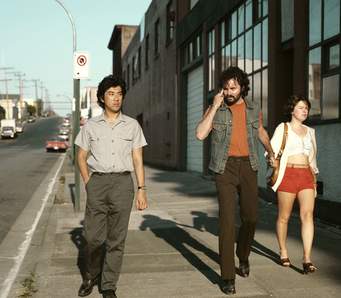
This image also shows another side to Walls work where he take on much more “street photography” style. Wall remarks in the film that photography is steeped in the tradition of the street and as photographer he felt compelled to try this genre of photography. An interesting idea and one that I would like to explore further myself, I can also empathise with his views as many of the great photographers by whom we are influenced made their name with street style imagery.
Wall also suggests that painting gave him the scale for him to produce his work and many of his images are compromised by a line where the two transparencies meet to create their large size. Wall though often does not hide this, referring to it as a “dialectic”, investigating the flatness and depth of photography which reiterates that we are indeed looking at a photograph in a painting like fashion. Most of Walls work take weeks to complete, other take up to or over a year. This was true of his image “A sudden gust of wind” 1998, which was based on the work Travelers caught in a sudden breeze at Ejiri by Japanese painter and printmaker Katsushika Hokusai.
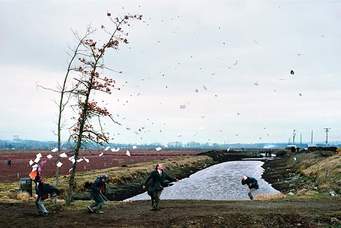
The work is a composition of around 50 images taken over a number of months, scanned and digitally processed Wall used various props in the image including wind machines and poles with prices of paper attached by string. Wall also notes that they had to be ready to photograph at any given time as they could only shoot when they had the right weather and conditions. Wall challenges assumed narratives in the composition, challenging the way we interpret or represent people, certain times and places. The shot required a constant point of view and aperture and was also displayed by backlighting in a lightbox. This became a Walls signature medium.
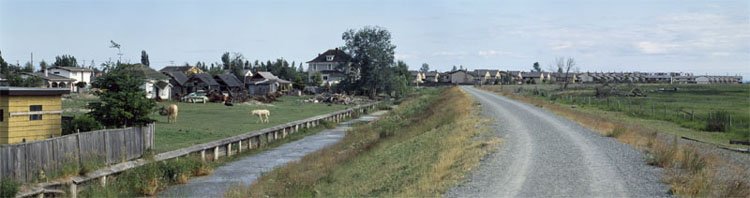
Wall also created some documentary panoramas which study the landscape and the relationship between modern form and the environment. They often include the point where urban life reconciles with nature. These works are also carefully staged and Wall often edits his images quite profoundly removing and adding people or objects to areas of the scene. The below image though recreates a scene nearby to where Wall resided in Vancouver. The image references the classical landscape painting, yet the other elements within the frame seem to conflict the connotations we would normally associate with the pastoral landscape.
It may be worth finally noting that Wall played a key role establishing photography as a contemporary art form.
Bibliography
(ONLINE) https://www.tate.org.uk/tate-etc/issue-4-summer-2005/beyond-threshold (accessed 30/6/20)
(ONLINE) https://www.tate.org.uk/whats-on/tate-modern/exhibition/jeff-wall (accessed 30/6/20)
(ONLINE) https://www.youtube.com/watch?v=tNWWrKXNeBA (accessed 30/6/20)
(ONLINE) https://www.tate.org.uk/whats-on/tate-modern/exhibition/jeff-wall/jeff-wall-room-guide (accessed 1/7/20)
(ONLINE) http://www.theartwolf.com/articles/50-impressionist-paintings.htm (accessed 1/7/20)
(ONLINE) https://artlead.net/content/journal/modern-classics-jeff-wall-destroyed-room-1978/ (accessed 1/7/20)
(ONLINE) https://www.tate.org.uk/art/artworks/wall-study-for-a-sudden-gust-of-wind-after-hokusai-t07235 (accessed 1/7/20)
(ONLINE) https://publicdelivery.org/jeff-wall-gust-of-wind/ (accessed 1/7/20)
 Dan Towell OCA Context and Narrative