Research
Elina Brotherus
I firstly took a look at the work of Elina Brotherus and in particular her work in “Annonciation” which deals with the rather bleak reality of unsuccessful IVF treatment. The first thing that strikes me with all of Elina’s work is her startling honesty. In contradiction to the often blurry and chaotic work of Francesca Woodman, Brotherus if more often that not stationery and in full view of the camera, sometimes up close, sometimes from behind but always win a very personal way. Below is an image for artistic reference only.
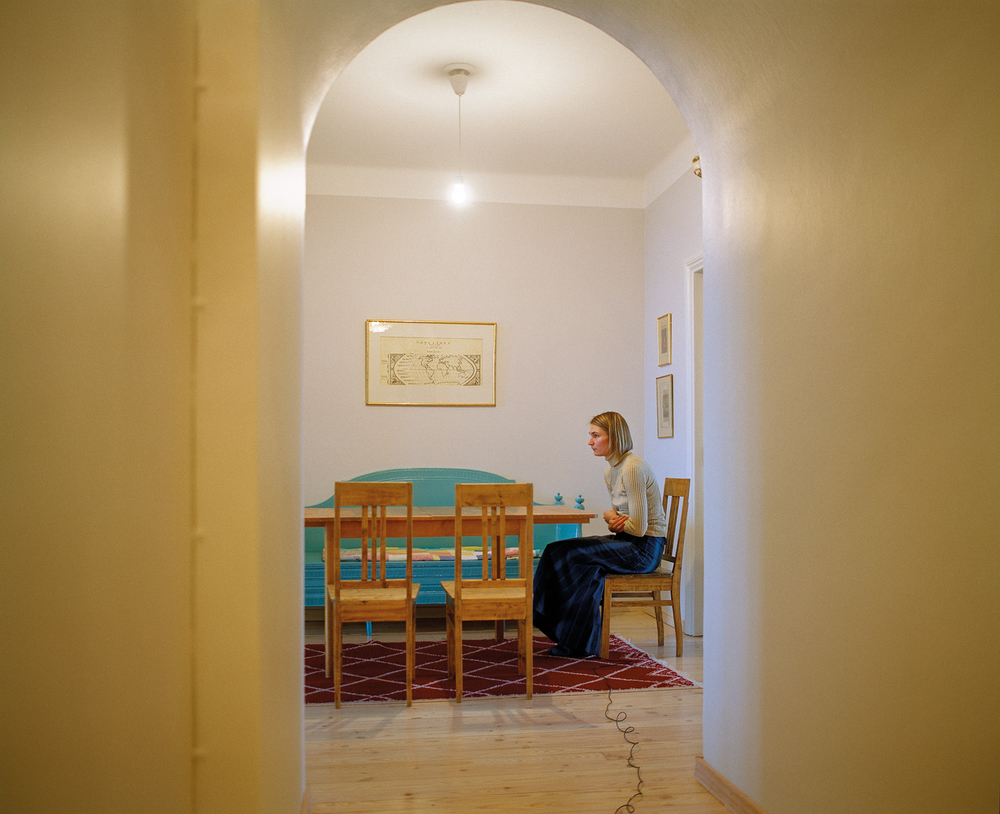
The series of images Brotherus follows a four year period between 2009 and 2013 where she received the treatment. I have decided to address my portray some of my contextualisation in a slightly different manner and add points in bullet fashion, this way I find it easier to analyse the images and try to piece them together in terms of composition etc.
- The above image seems to have a frame within a frame, almost bathing her in a protective shell as she holds her stomach almost willing herself to become pregnant.
- A fairly cold light I the room with no lampshade adds to a feeling of despair and the archway could also be perceived as enhancing feelings of isolation and withdrawal.
- Brotherus is alone in the frame and this is very much about her and the feelings of not being able to be a mother. There is no accompaniment and no space for it. She sits alone in an empty room silent and still in a cold, hard light.
- A cable trails from the hand of Brotherus and leaves the frame. I am not entirely sure of the context of this cable, but could it be a umbilical cord that is not connected or connecting?
- The positioning of the camera gives just enough angle to see enough information of what looks to be a doorway behind Brotherus, this could be meaningless but I believe that every element in most of her work is certainly intentional.
- A rather brightly lit picture seems to be in contrast with the feelings of sadness, and perhaps you would expect a darker tone to the image. But I feel this lighting adds to the “this is what I am going through everyday” notion, a feeling of daytime, which can be overlooked when we think of mental issues. We always seem to couple the worst pints as nighttime, or morning, when we suffer most mentally, but the image seems to contradict this idea.
There is a feeling of great sadness in this set of images by Brotherus and considering the topic and its finality, this is entirely reasonable. But the nature of documentary photography like this is indeed taboo and not often in the media spotlight, and I find it quite fascinating that photography can be a successful medium in highlighting these social issues. I find the set of images to be a perfect marriage of context and narrative, she tells her story and declares it so starkly that I quite simply can’t be ignored. I am not sure if I would call the nature of this body of work narcissistic, but in looking at various sets of self portrait work, there is a level of self indulgence. But perhaps this is mainly for personal reasons, rather than arrogance or vanity, it seems to be an eternal quest to find the real person beneath the skin. A vehicle to describe how a person feels and see the world without words, which is often extremely powerful if not more so.
Looking closer at these images and their content its clear that they are in sharp contrast to paintings of the Annunciation, and while Brotherus uses many historical art references, the pictures seem to question the very nature of motherhood. It is difficult to my mind to diagnose the relevance of nudity by Brotherus, but one can only feel that it is to add impact, to question taboo, and almost certainly grab the attention of the viewer. Maybe in some ways it is cathartic as Brotherus lets the viewer interrogate her mind and body in such a stripped down and powerful way. It certainly adds to the feeling of isolation and the raw aesthetic of the narrative portrayed. It is also clear that Brotherus is tackling a bigger issue here than just her own, questioning the other side of IVF and the untold story of its impact when the treatment fails. It seems Brotherus is actually portraying motherhood in terms of feelings and emotions, questioning the reality of what failure of such drastic measure actually feels like. It was interesting to hear Brotherus describe herself in a YouTube video I watched a quite a “serious” person, although a “happy” one, and often in her work this is how she looks when she is alone. I do feel that any type of self portraiture seems to lack that charismatic smile we associate with “normal” portraiture, it seems to question its own identity, and perhaps the reasons for it will be of continual discourse and fascination. The question of these images working without text is an interesting one, but the title itself may give the viewer enough information to understand the narrative. The images hold a lot information relating to the meaning and this does not necessarily need more text in this case.
Reference – (ONLINE) – Elina Brotherus – http://www.elinabrotherus.com/photography#/annonciation/ (accessed 19/6/20)
Reference – (ONLINE) – Elina Brotherus – https://slash-paris.com/en/evenements/elina-brotherus-annonciation (accessed 19/6/20)
Reference – (ONLINE) – Elina Brotherus – http://www.mamsie.bbk.ac.uk/article/10.16995/sim.189/ (accessed 19/6/20)
Reference – (ONLINE) – Elina Brotherus – https://www.youtube.com/watch?v=Ey5cCRjjfHw&t=771s
Gillian Wearing
Gillian Wearing’s series of self portraits taken in 2003 seem to question the very nature of self portraiture and what it inherently is. Rather than picturing of herself in the images, she chooses to clone the identity of family members using facial and bodily masks constructed from previous images with he help of Madame Tussauds. Yes Wearing is in the portrait but its is not her, it is her taking on the identity of her family members, “seizing” who they are in front of the camera. Below are two images for artistic reference only.
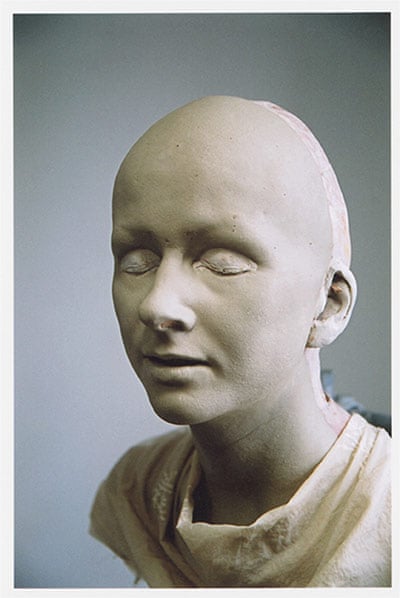
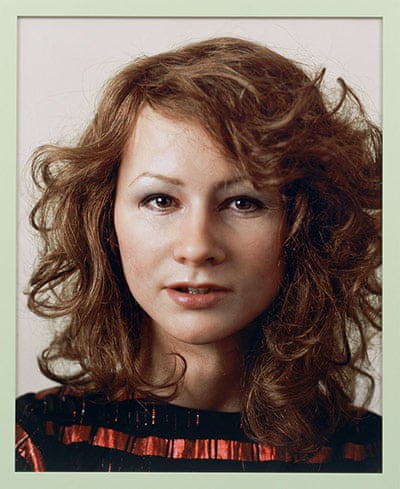
- Studio lighting used here to light the scenes and recreate the feel of the initial images, some were taken in 80’s and 90’s
- Most of the images are headshots but some include body parts and complete reworking of posture as it was in the initial images
- Wearing makes sure the viewer knows they are looking at a mask by leaving holes where the eyes are so you can see separation
- I would assume this is so she is not seemed as taking over the identity completely.
It would seem that accompanying text would be necessary for these images or the viewer would not know what they are trying to portray. The viewer would need to know that Wearing is representing members of her family rather than random people or friends. In this instance I do feel that some accompanying text would be needed to reaffirm the narrative.
The images themselves are superb and I do find the subject in itself very interesting and a quite brilliant idea. But it is not something that stays with me. I don’t find it as hard hitting as the work of Brotherus or Mann and not particularly poignant. That takes nothing away from the idea and it is very captivating in terms if subject matter. But the reproductions themselves are very vernacular in terms of content and a straightforward reproduction of the earlier images. There is little in the way of manipulation to add to the depth of the images and I feel that the meaning is probably lost of some viewers. In this instance I feel the images are a little narcissistic, odd really when the artist is not visually in the image. But it seems to me that the reasoning behind the shots are about ego, a bit of a “I can be like you” attitude, “I can take you over” almost. I don’t feel the images carry any other meaning and are like a play on words but with images. I feel that if the nature of the reproduced images were different then the would be more evocative. But that being said Wearing has obviously though carefully about what she wanted to reproduce, looking for information to reignite past eras and specific times within her families life.
References
Reference – (ONLINE) – Gillian Wearing –
https://www.theguardian.com/artanddesign/gallery/2012/mar/27/gillian-wearing-takeover-mask (accessed 19/6/20)
Reference – (ONLINE) Gillian Wearing – http://www.artnet.com/artists/gillian-wearing/ (accessed 19/6/20)
Reference – (ONLINE) Gillian Wearing – https://www.tate.org.uk/art/artworks/wearing-self-portrait-as-my-sister-jane-wearing-p81099 (accessed 19/6/20)
Sally Mann
Sally Mann had a horse riding accident which left her virtually unable to work. She was quite badly injured and bed ridden for some time. This led her to a body of work that was largely based on self-portraiture and images of herself as she recuperated from the accident. Below is an image for artistic reference only.
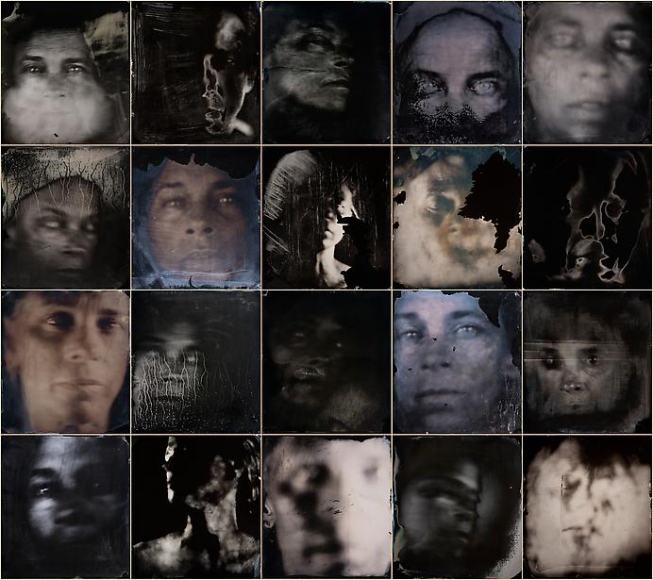
- Mann’ uses a very specific technique in her imagery which I have only recently learnt. I believe she uses the positive collodion technique or ambrotype as it is also known. This creates a very specific look and the image is processed onto a glass plate.
- This process makes every image itself unique
- In the images Mann is almost unrecognisable
- The work is present in sets of ambrotypes, some in three’s and others more or less
- In most of her work Mann seems to be interested in the very nature of life, and for that matter death
- Her images have a dream like aesthetic and they are almost corpse like
- Detail and definition is lost in favour of mystique, blurred lines and form and unnatural appearance
- Placing the images into sets of various size adds to the sense of being and indeed what it is to be a human being
A starting body of work from Mann, which I find quite unsettling and almost disturbing. They are like the photographic equivalent of a horror movie. In some ways the viewer doesn’t know whether the person photographed is dead or alive. This is also true of a lot of Manns work which seems to carry a quite surreal and morbid fascination. Some of the images which appear “torn” take on a more sinister sense, almost akin to a murder scene. Does this set of images require further text to accompany the images? I very much doubt it, I for one would not know what else to say. They are simply self portraits, but not in any way conventional. Mann is almost taking on a completely new identity, but not stealing it such as Wearing, but decaying, decomposing into something or someone that is a reaction to our inner self, perhaps the unseen character we all try to hide. The fact that these images are in themselves completely unique adds to the eerie, macabre replication of the human face, which is sometimes partially shown, sometimes without eyes, sometimes lurking in the shadows. What fascinates me is how Mann chose to light these images. In normal circumstance the viewer can often see where the light is coming from, and in some cases this can be seen , but often this characteristic of an image is hidden or subdued. I really don’t see these images as self indulgent, if I am being honest I feel they are the complete opposite. These are about revelation, an exploration into the human psyche that is not for egotistical reading, but an engagement with ourselves in the more purest form. It is photography without ego. Full of life but without positive or negative emotion, a relaying of fact almost. This is me, but not how I feel, who I am. It has to be said that Maier’s work is purely personal, could it get any more personal? She in most cases dent develop her work and I doubt she took these images in a bid to be adhered by the photographic public. They were assembled as body of work that was intricately looking inward and outward at the same time with the same level of significance. This is me and this is how the world sees me. But without the camera and self portrait she would not have obtained a greater understanding of either.
References
Reference – (ONLINE) Sally Mann – https://www.houkgallery.com/exhibitions/sally-mann-upon-reflection?view=slider#6 (accessed 19/6/20)
Reference – (ONLINE) Sally Mann – http://photography-now.com/exhibition/86352 (accessed 19/6/20)
Reference (ONLINE) Sally Mann – https://www.youtube.com/watch?v=sfPBfqE9sCs (accessed 20/6/20)
Vivian Maier
Vivian Maier produced hundreds of self portraits in her more secretive life as a photographer, and it was only after her death in 2009 that her body of work was uncovered. She produce over 100,00 negatives in her lifetime most of them shot in Chicago or New York City. Below is an example image for artistic reference only.
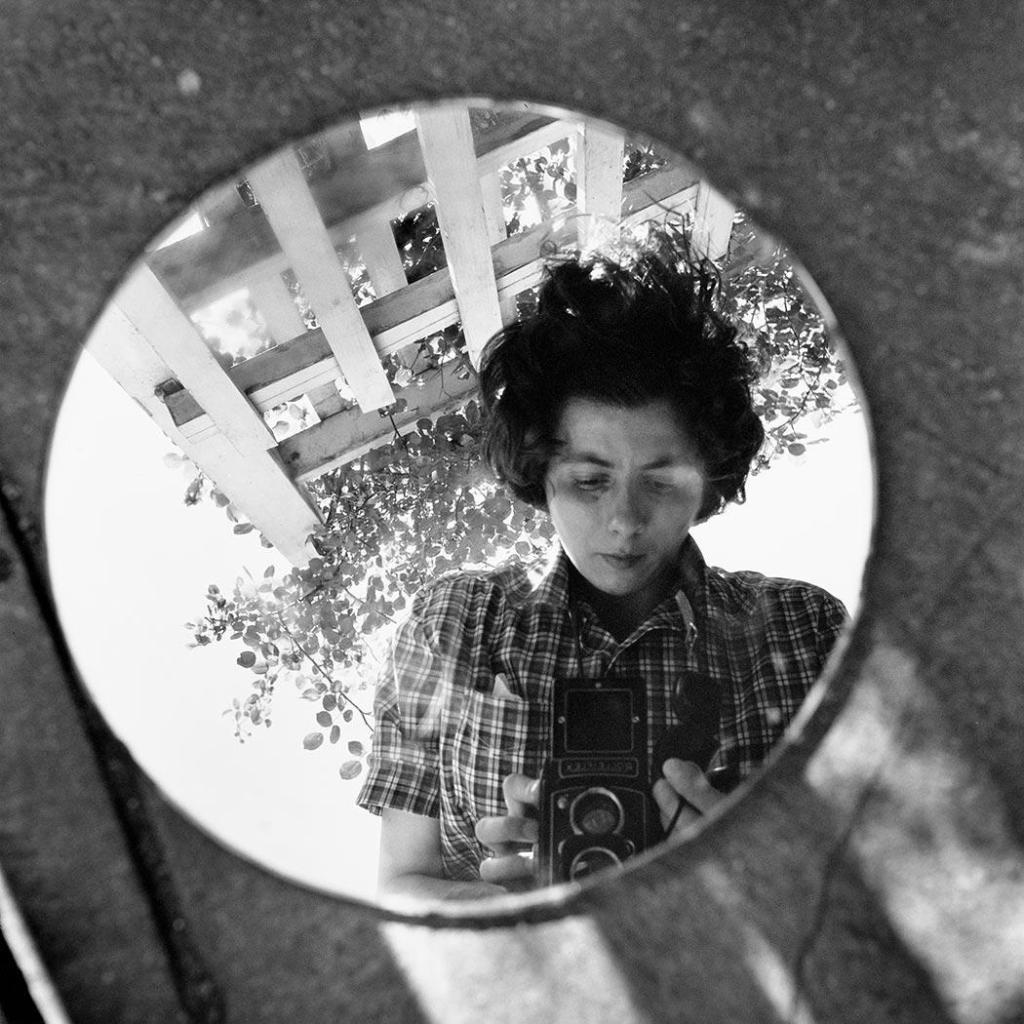
- In most of her self portraits the involve reflections from mirrors or glass windows
- She is sometimes looking into the lens of the camera sometimes not
- The often use perspective and she is sometimes accompanied by other people
- She uses light and show to profound effect
- Sometimes in her images she is only portrayed by shadow, sometimes she is subtle hidden by shadow
- She rarely if ever smiles in her self portraits
- She seems obsessed with how she is seen in the world, in window, mirrors, shadows etc
- Startling use of composition, it seems she rarely got it wrong
- A huge body of work at such a high level
- Out of her images are clear and concise, only a few use blur, lack of focus or movement
How do these images make me feel? Freed, liberated and fortunate. Compelled with an urgency to explore personality, the world outside and my place, my setting, my circumstance. And the circumstance of photography and its very nature. (20/6/20)
It is interesting to see such a wide variety of self portraiture and how differently it can be produced or interpreted. Firstly with Maier, I am struck by the sheer volume of work and how she was such a master of composition. I liken her body of work with that of Bresson, and find her quite vital and unique. These images do not need any further dialogue, they are completely understandable. The only point to remember is that we will never know quite why she took theses images and why to such an extent. Why did she keep her work so secretive? I highly doubt she was ashamed of her work, but maybe it was who she was she wanted to keep from the public. Perhaps she felt that her quest in trying to understand herself and who she fitted into the world as indeed self indulgent, narcissistic almost. We will never have the answers but we can admire the work of greatness and this is certainly extremely noteworthy photography. It also reiterates the artistic desire within such creative individuals to produce a body of self portraits. Now in the age of the selfie, we can see that this self documentation as being more fundamental and inherently interesting. The selfie means little to me, I rarely take them, perhaps if I am running or cycling. I rather take pictures of people taking pictures of themselves, strangely. Perhaps trying to unravel the mystery of the selfie and its existence. It carries little weight in the (my) world of photography, whereas the work of Mann et al, is essential, crucial to us understanding who we are and what we stand for. It makes for some fascinating work and one can only wonder at its limitations, I for one can’t see any.
References
Reference – (ONLINE) – Vivian Maier – http://www.vivianmaier.com/gallery/self-portraits/#slide-44 (accessed 20/6/20)
Reference – (ONLINE) – Vivian Maier – https://www.brainpickings.org/2014/11/12/steven-johnson-mirror-selfie/ (accessed 20/6/20)
Reference – ()NLINE) – Vivian Maier – https://www.brainpickings.org/2013/11/26/vivian-maier-self-portraits-book/ (accessed 20/6/20)
 Dan Towell OCA Context and Narrative