Introduction
The cogs were set turning through some interesting research and I began to think of ideas for the 5th assignment. Due to the nature of much of the coursework, I had become more interested in self portraiture and portraiture as a a specific genre within the photographic medium. Through looking closely at the work of Diane Arbus and others it gave me a completely new thinking in terms of portraiture and what it can be. When I used to think of portraiture, I thought of tightly posed subjects, hi-tech flash, ring lights, a busy photographer ducking and diving, directing the scene in studio type environments. The reality of course can be very different, and this has conclusion has come through my wide and varied body of research. Portraiture can be more relaxed, subtle and as in some cases with Arbus, poorly lit and composed in a rather unruly fashion. It also doesn’t need to be singular, portraiture can be couples, sometimes more, all the subjects having an equal prominence within the frame. Arbus rejected classical theory and photography and the way she portrayed her subjects reinforces this. Through the work of others such as Gillian Wearing, I saw that portraiture can be also be a picture documenting an identity, an interpretation or even a direct copy of an individual. Whilst in the 3rd assignment I took on another identity as such, I thought about doing the same here but in a different way. I had an initial feeling that I wanted this image or series to be in colour, I also wanted to play a different role this time. I know had become with the ability to take on new identities within the freedom of photography. I also wanted to hinge the image on fantasy, perhaps a little voyeuristic, using the camera to be someone else, to explore a new identity or masquerade as someone else entirely.
Exploring ideas
I began with an initial idea of something that is quite poignant to me personally, and I can see with most of these photographers, much of their best work comes fro an underlying connection and emotional relationship. Whilst a little cliched I thought about boyhood dreams and the dreams we all have, something or someone we perhaps wanted to be but never quite made it. The root of this idea stems back to the exercise where I re-created a childhood memory, it reminded me of how I felt when I was a teenager, and also what was important to me at that time. I have alway been a music fan and in particular rock music, I have great empathy for the music I like and also have a sort of fascination with the iconic frontman type. From Scott Weiland, Chris Cornell to Robert Plant, even Ozzy in his prime, they have always provided a source of intrigue and mystique unparalleled in my way of thinking and interests. I had the basis of an idea which I could now develop in my sketchbook. I used this to think about technical aspects of the shoot, lighting, lens, props and other information such as potential backdrops.
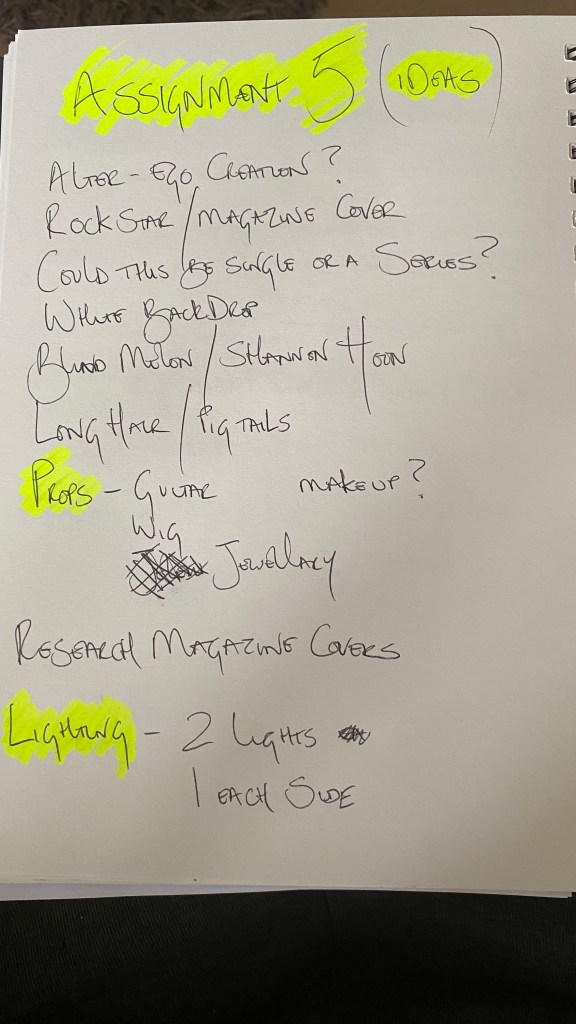
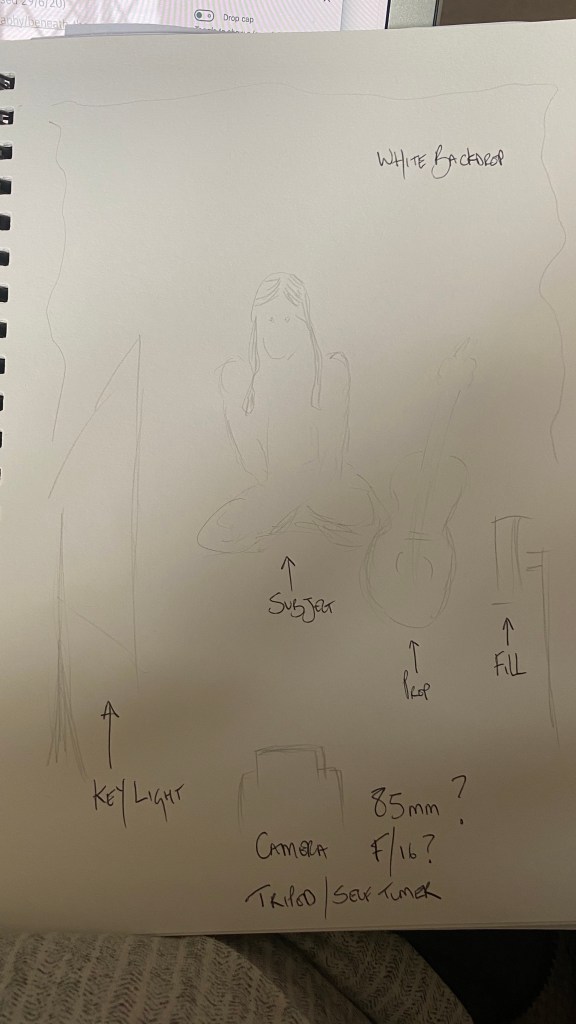
My mind at this time is veering toward magazine style front page shoot, and I think there could be more than one image in the set, a kind of departure for me in many ways, but a very interesting one.
The image below came to mind almost immediately when I began to digest my idea. I had seen it years ago, and for some reason it really stuck in my mind. I have no idea why in particular, because I can’t remember any other magazine covers at all, literally none. I don’t even own or have ever bought the magazine. The image must have struck some sort of adolescent chord.
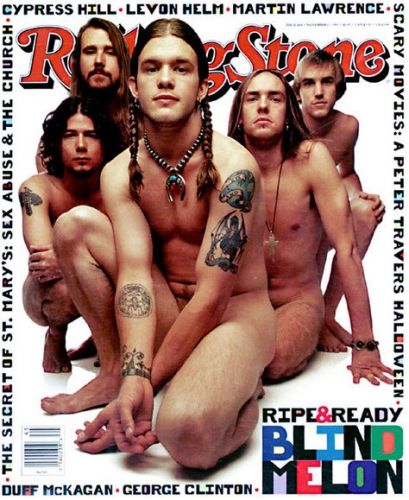
Reference – (ONLINE) – https://www.pinterest.co.uk/pin/307370743288469814/ (accessed 30/6/20)
Research
Gregory Crewdson
I watched a fantastic documentary on Gregory Crewdson courtesy of amazon prime, “The aesthetics of repression”. It really gave further insight into Crewdson’s work and the ethics behind his particular way of working. What was most fascinating for me was the way Crewdson and his team shaped light, and he himself admitted at “at the end of the day, it all comes down to light”. It was of great interest to see behind the scenes and understand how they manipulated the light onto certain areas within the frame to create the required aesthetics. Crewdson also cites Alfred Hitchcock as a major influence on his work and certain comparisons can be drawn from his more macabre images. Also he suggests his work was once likened to a cross between “Norman Rockwell and Norman Bates” one which he says is perhaps the best way to describe his work. He also says that his images are largely about repression, and this is very evident in his work, often giving fleeting glimpses of repressed thoughts, feelings and emotions. He does create a fine balance between beauty and horror by use of cinematic style production and ambiguous psychological narratives.
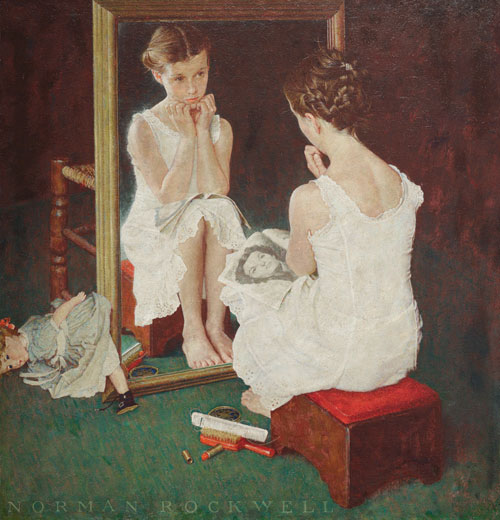
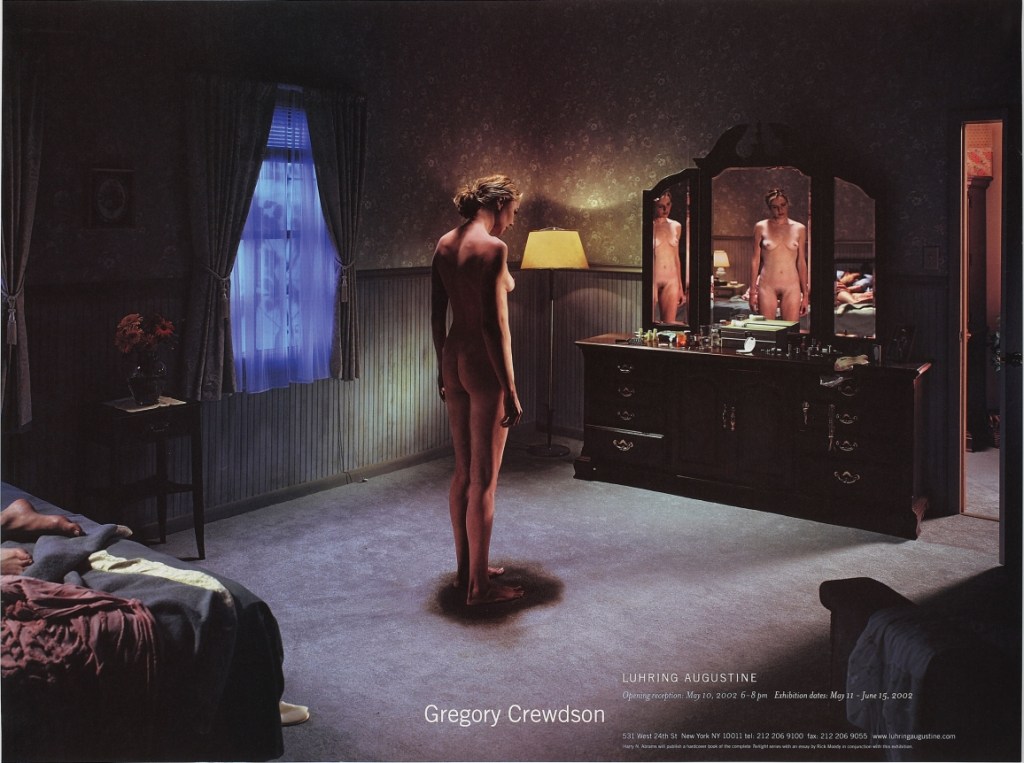
A loose reference here perhaps in Crewdson’s work and Rockwells, with the use of a mirror and a reflection in the frame. In his work Crewdson also states that he always has some sort of other frame in his pictures, whether that is a window, doorframe, mirror or painting. Obviously a mirror and reflection often connotes a vision of another self or being which is also another motive behind his work. It is interesting to see the pose of the nude subject, arms held loosely but closely guarded to her body, which creates a sense of unease and vulnerability. The lighting is complicated, ethereal blue light coming through a curtained window, ambient light from a bedroom light in the corner of the room, and a clear use of frontal lighting on her body which in turn creates a vivid reflection of her in the mirror. What we also see is a light which is directly over her head, creating a completely isolated shadow, this connotes the idea of the otherworldly, almost as if she is about to be abducted by an alien life form. A definitve juxtaposition with the aesthetic of historical paintings combined with the idea of movie like science fiction.
References
(ONLINE) https://www.amazon.co.uk/Gregory-Crewdson-Aesthetics-Repression/dp/B07C415KN9/ref=sr_1_1?crid=BILXDMWZHEAX&dchild=1&keywords=gregory+crewdson&qid=1593679072&s=instant-video&sprefix=gregory+cre%2Caps%2C148&sr=1-1 (accessed 1/7/20)
(ONLINE) https://www.artsy.net/artist/gregory-crewdson (accessed 2/7/20)
(ONLINE) https://www.artsy.net/artwork/gregory-crewdson-untitled-woman-stain (accessed2/7/20)
(ONLINE) http://www.nrm.org/MT/text/GirlMirror.html (accessed 2/7/20)
Tom Hunter
Toms work to me seems very steeped in English tradition and culture. A straight faced sort of humour seems to underly his images which are set in his native Hackney. I took a further look at some of his work in “living hell and other stories” to further understand how he took headlines from a local paper (gazette) and turned them in a form of tableau photography. I wanted to look at how photographers such as Hunter and Crewsdon use staging within their work and how they have created unique scenes which reflect their unique voice within the medium.
I have chosen to bullet point my findings and ideas on the images below, more of a brain storming style of analysis. I hope this helps me dissect the images and pick out particular technical and visual components.
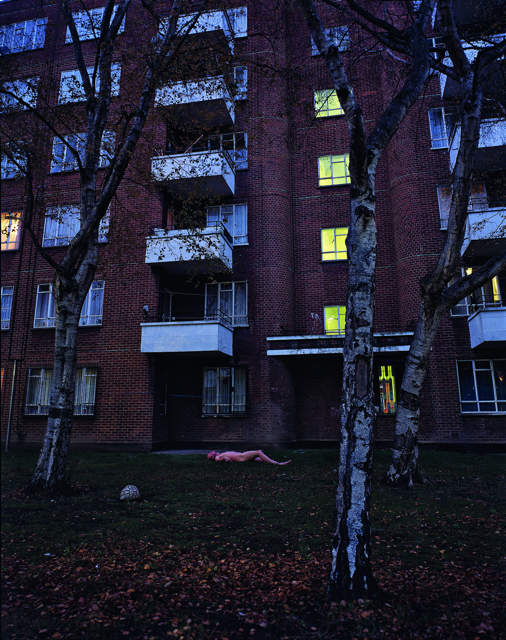
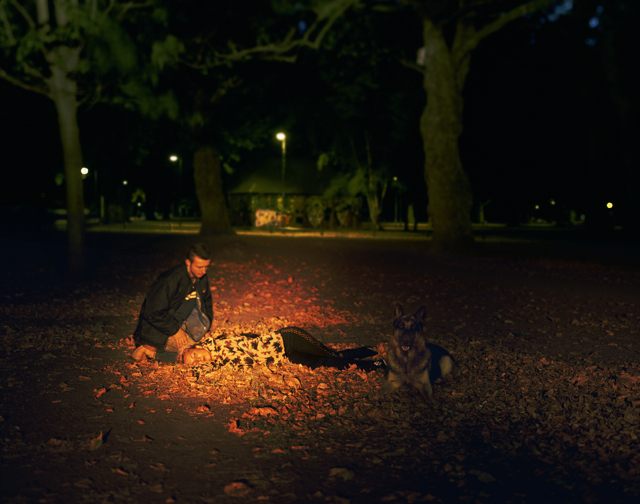
- suburban setting
- minimal content
- stark / isolated lighting
- staged photography
- sometimes contrast of warm and cold light
- fantasy type world drawn from headlines in newspaper
- negative space
- expansive location adds to feelings of isolation
- sense of scale
- eerie
- mysterious
- also a feeling of calm / again relative contrast
- contrived setting which also contradicts the photographic connotation of reality
References
(ONLINE) http://www.tomhunter.org/ (accessed 1/7/20)
(ONLINE) http://www.tomhunter.org/living-in-hell-and-other-stories/ (accessed 1/7/20)
Phillip Lorca DiCorcia
I also took a closer look at the work of Phillip Lorca DiCorcia, in particular his series “Heads” and “Hustlers”. Earlier in his career in 1993, DiCorcia photographed male prostitutes by offering them money to be photographed, this series was called “Strangers”. When the work was exhibited, the name of the male, location and cost were assigned to the images. The theme was revisited in 2013, with a fuller set of around 80 images being exhibited, this time called “Hustlers”. This was DiCorcia photographing “real” people on the street in contrived situations.
As above I will bullet point my thoughts / ideas / musings on the images.
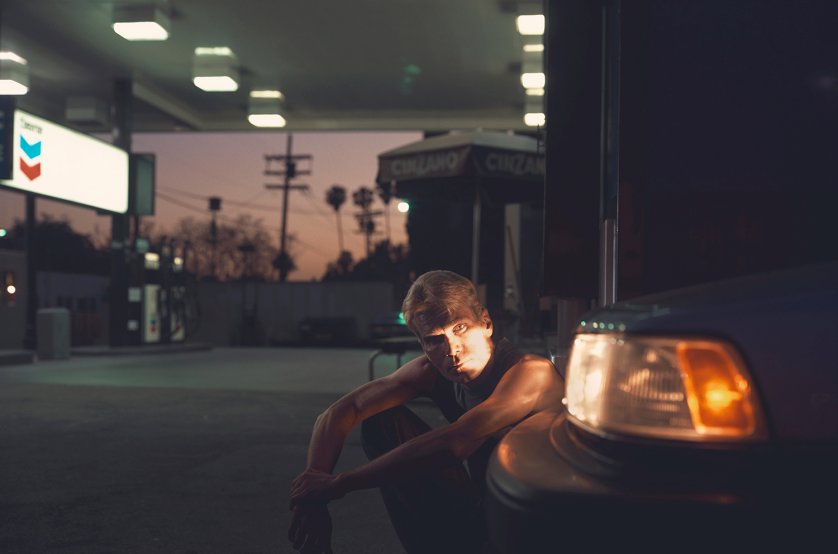
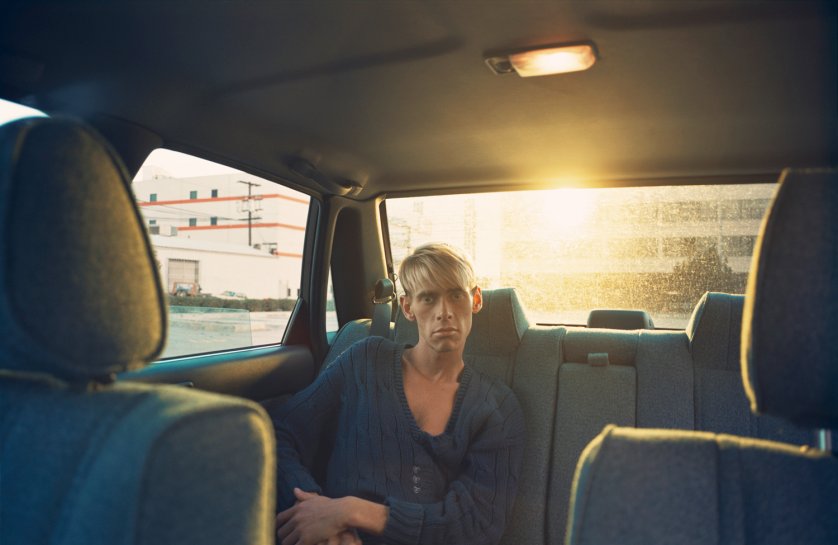
- minimal content / subject / location / light
- staged portraiture
- light is what is perhaps most striking
- portrait like scene / styling
- subject looking directly into camera / passive aggressive almost
- obviously a posed situation / contrived sense of reality
- connotations seem to be pronounced / enhanced / literal
- use of car lights / inside / outside
- empty / lonely setting
- feeling of isolation / desperation
- interesting subject is in the back seat of car (2nd image)
References
(ONLINE) https://www.moma.org/artists/7027 (accessed 1/7/20)
(ONLINE) https://www.nytimes.com/2013/08/25/arts/design/philip-lorca-dicorcias-hustlers-return-to-new-york.html (accessed 1/7/20)
(ONLINE) https://time.com/3803327/trade-philip-lorca-dicorcias-hollywood-hustlers-drug-addicts-and-drifters/ (accessed 1/7/20)
My continued research and thought has led me to rethink my images for this assignment. I started to think am I challenging myself enough? Not necessarily with the camera but as I said previously challenging my comfort zones and mentality. For that reason I am going to be using Diane Arbus and Gillian Wearing as blueprint for the assignment. I will be going into full “drag” and photographing myself as a woman in full makeup. At this stage I would like to think it will be a set of 2 “single” images, as I want a black and white and a colour shot, much like the two images below.

In much of Wearing’s work she takes on a completely new identity, the camera giving her the ability to pose as friends and family by uses of appropriate clothing and masks. What is perhaps most interesting is that Wearing does not hide the fact she is wearing a mask, a clear hole in the eye is evident in her images. This adds to the questionability of what a portrait actually is and or what it stands for. We are led to believe that in a portrait, a painting or photograph, it gives us the opportunity to define ourselves, to highlight characteristics that make us who we are. Does this mean that by becoming someone else in a photographic portrait, we become closer to what it actually feels like to be that person. Or does it mean that a portrait is never really true, as quite clearly we can be whatever we want to be, characteristic or not. It was this idea I now wanted to explore further in my assignment.
Reference – https://awarewomenartists.com/en/artiste/gillian-wearing/ (accessed 4/7/20)
Cindy Sherman
Cindy Sherman is an artist who predominately produces self portraits, depicting herself as imaginary characters in various guises and settings. She rose to prominence with her series “Untitled film stills” which was a series of black and white images taken between 1977 to 1980. The images are fictional and depict scenes from television shows or old vintage style movies. Sherman initially started taking these images in her apartment, using this as her setting, but later moved outside to produce scenes in urban and rural landscapes. It seems form the majority of Sherman’s work that she is challenging how women are perceived and portrayed in various contexts within society.
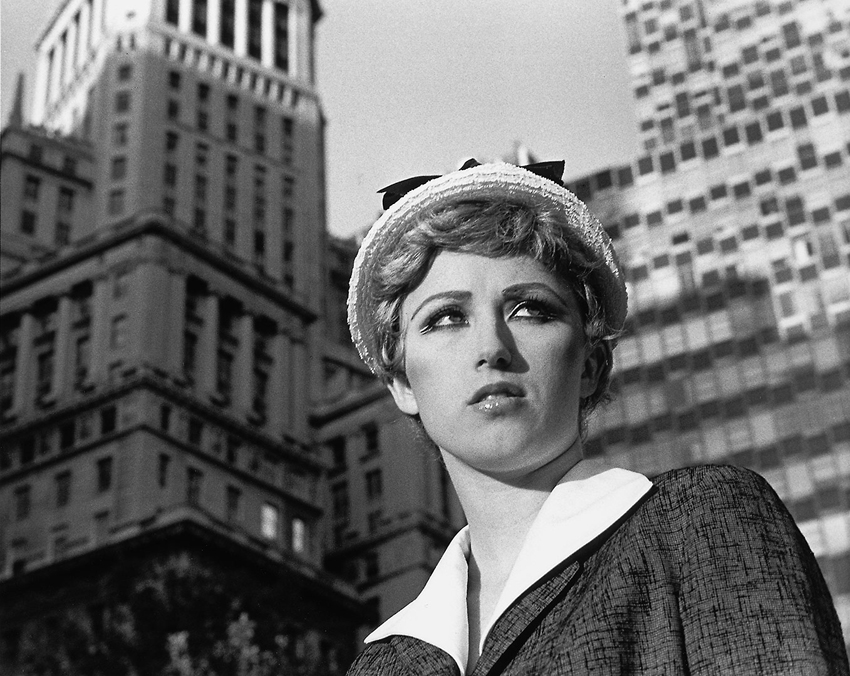
Below are some bullet points on tow of Shermans images I found quite evocative.
- vintage style clothing
- feeling of suspense
- sense of scale / tall buildings
- aged film aesthetic
- feels like it could be set in 50s or 60s
- voyeurism in terms of becoming or exploring another identity
- disguise – a sense of mystery as to who the real person is
- complete control as an artist over the scene
- becoming someone else / fabricated reality
- alter ego
- looking up camera view adds tension / psychological
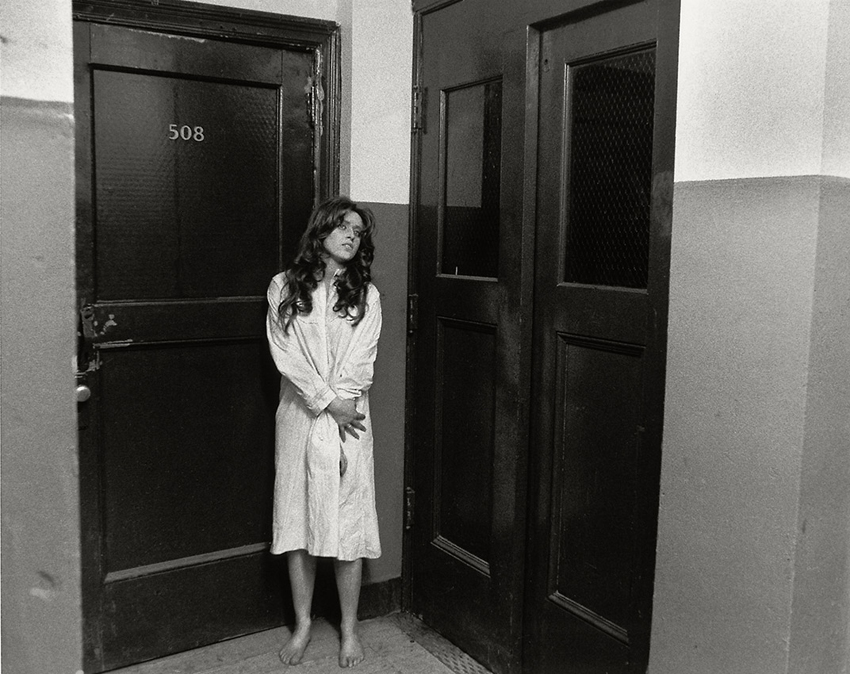
- feeling of isolation
- desperation
- loneliness
- highlighting vulnerability
- doorways and windows / frames within the frame
- subject pressed into corner of frame
- subject has worried / frantic look
- nightdress adds to depth of feeling of tension
- barefoot outside / looking for help?
- hiding something under nightdress
- slightly looking down camera view also emphasises small statue of the woman
- large door frames add to sense of scale
- square format squeezes the information into the frame
- slanted wall to the right of frame adds to aesthetics
- doesn’t seem to be any sort of specific highlight
References
(ONLINE) https://www.tate.org.uk/art/artists/cindy-sherman-1938 (accessed 2/7/20)
(ONLINE) https://www.moma.org/calendar/exhibitions/1154 (accessed 2/7/20)
(ONLINE) https://artlead.net/content/journal/modern-classics-cindy-sherman-untitled-film-stills/ (accessed 1/7/20)
Diane Arbus – Chosen image for reproduction
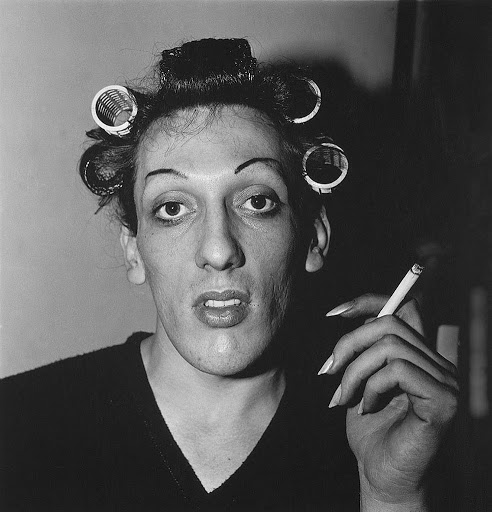
Reference – http://internationalphotomag.com/photobiography-diane-arbus/ (accessed 4/7/20)
I have chosen this image to photographically reproduce as it seems to really grab my attention emotionally, contextually and perfect for the taking on of a new identity. Diane Arbus does seem to create very unique style of portraiture, often visually striking, yet seemingly simple in style and execution. It will certainly test me as I will be completely out of the proverbial comfort zone, a man dressed as a woman. Lighting the scene and creating the right ambience will be paramount. Whilst producing the image of a rock “icon” would also provide a set of challenges, I feel that working on this set will ultimately be more evocative and links well to my research throughout the course framework. I also feel that this image by Arbus will be the lead image in my final set.
Further thoughts
My wife is a very astute make up artist and runs a small side line business, so I am in good hands! I am really excited by this project now, and feel that it will take me where I want to go technically and artistically. Both these images by Arbus and Wearing really struck me when I saw them, and I want to explore how it feels to take on a new identity whilst also pursuing a new investigation into portraiture. The new identity will be much in the same vein as Wearing works, but I will not be imitating family members, but taking on a completely new identity, a man in “drag”.
My lighting set up for the image will be largely the same, but I intend to use warm ambient light for the Diane Arbus reproduction. I want the same tones and highlights that Arbus captured adding to the final feel of the shot. I intend to use a corner of the room for my images in keeping with some of the work I have earlier researched. For the 2nd image I intend to use flash and a fill light, but I do want some definite high key and low key elements within the frame. Both images although very different seem to have a light source to the right of the subject, I will attempt to recreate this in my project.
Reading / Camera Lucida
During the process of this project I have been continued my reading of Camera Lucida by Barthes. As I have mentioned before it has been quite a daunting task to read anything by Barthes but I do feel like I cam beginning to understand his work in a more coherent way. The way I am approaching the book is quite simple really, I highlight and look up words I don’t understand and also highlight key phrases or paragraphs that seem to resonate or link to my work or others. I am also reading the book in conjunction with Basic Critical Theory, which goes some way to deconstruct Camera Lucida in a way where the penny can profoundly drop. This has been crucial to my understanding and has helped me in how I put images into context and follow any underpinning narrative. It also gives me a valueable look into the semiotics and its study of signs. I had not thought of photography this way so it was interesting to see how Barthes looked at photographs in this way. I found myself identifying with some of Barthes thoughts such as “I wanted to learn at all costs what photography was “in itself” (ch.1, pg 3, Camera Lucida – Roland Barthes – Published by Vintage 2000). I found this quite profound and I also feel the same but obviously from the view of an “operator” rather than a “spectator” as Barthes would say.
“What photography reproduces to infinity has occurred only once” (ch.1, pg 4, Camera Lucida – Roland Barthes – Published by Vintage 2000) provides another interesting idea if perhaps one that is more easy to contemplate. Yet when we begin to make photography rather than take pictures, it is of insurmountable value to be in tune with he fact that what you are capturing is characteristically unique. To my mind this also becomes more evident when beginning to find your photography voice, which I believe needs the operator to be present in that very moment, whether in the field or in the studio. Below is an image which I took recently which links and also contests Barthes ideas.
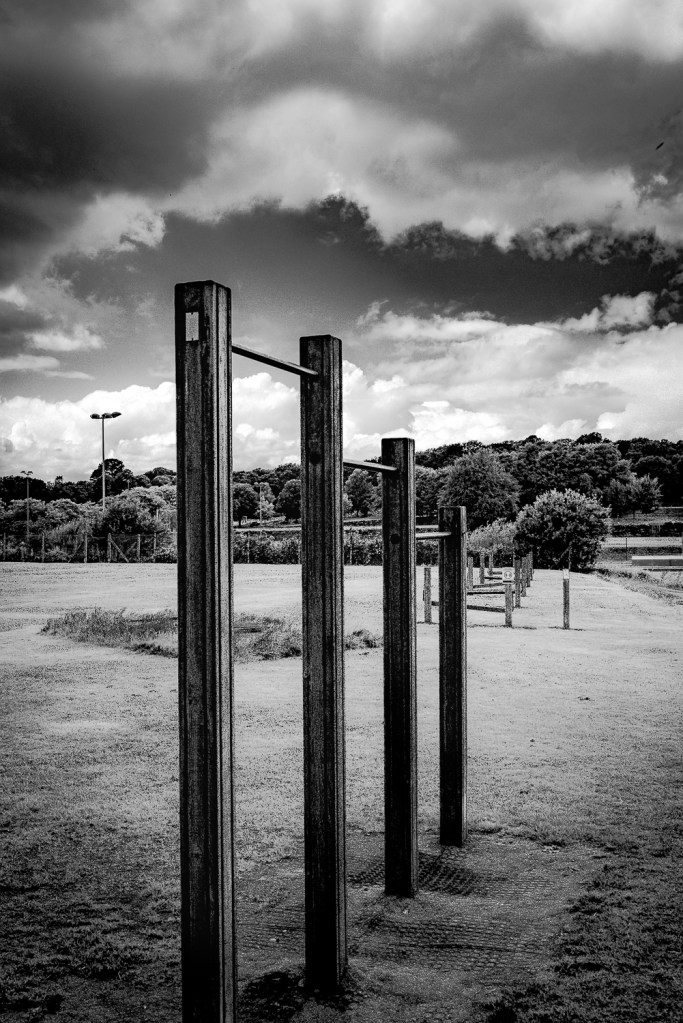
I edited this using the infrared filter in lightroom and I like the visual aesthetic. But it could be argued that this this image can be taken again and again and again. Perhaps the only difference would be within the skyline or a different perspective. Much vernacular photography would perhaps provide the same argument, a picture of the tower of Pisa is a picture of the tower of Pisa? Perhaps this image would not provide the punctum or studium that Barthes describes in Camera Lucida, yet it does show a level of how the geometric form of lines and lengths can be visually quite stimulating. I guess in conclusion though that whether an image is repeated or not, they will always relay a specific moment in time, the difference though maybe as trivial as how the clouds dispersed at that time or how the light affected the cameras exposure.
The Photographers Eye
I have also finished reading the quite brilliant “The Photographers eye” by John Szarkowski. The book contains some quite stunning photography, but also Szarkowski goes to great lengths to document the issues all photographers must face when working on their images. The book breaks down the image making process into 5 main categories, the thing itself, the detail, the frame, time and vantage point. Szarkowski was trying to identify “what photographs looks like and why they look that way” (pg 6). This I would assume is of quite vital importance in conjunction with working through this particular course (and further), as it gives an understanding of how to contextualise your own work and others. Also how to understand the visual narrative and equally how to create your own.
The book itself uses particular images in each category to highlight or emphasis these particular points that Szarkowski is attempting to make. They are certainly all aspects of the process we have to take into account and it was interesting to see which images he chose to highlight these points.
Below is a screen grab of an image from the chapter “Frame”
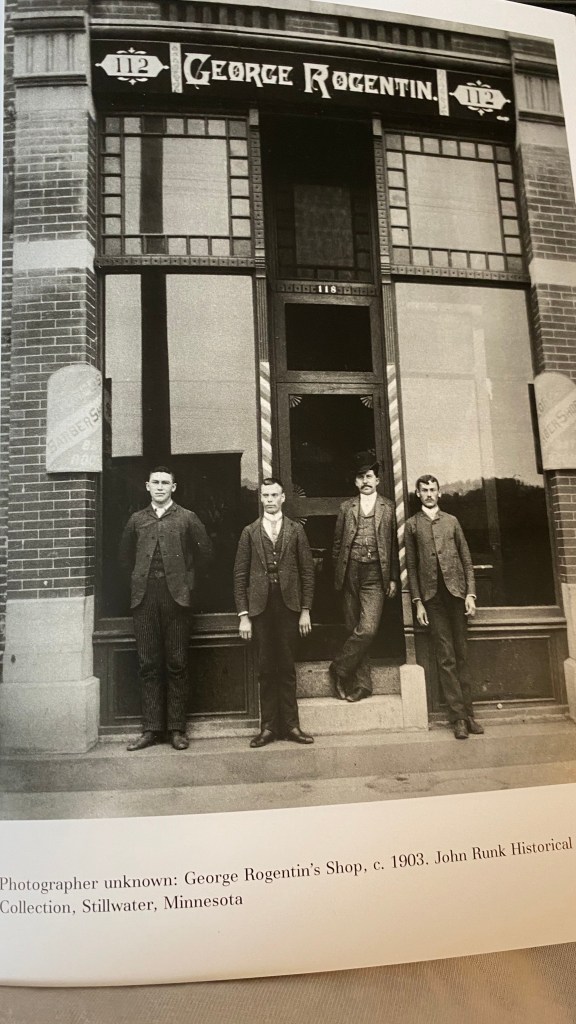
Quite a staggering image above by an unknown photographer taken circa 1903 sees 4 men framed within the door way of a local building. The image presents visually as exploration of scale rather than anything more, with the four men shrinking within the vertical lines of the building. “What shall he include, what shall he reject” (pg. 70) asks Szarkowski, a very important point that confronts the camera operator and one that provides its obvious challenges, yet is such an exciting part of the image making process. I often find myself wondering what to leave outside of the camera “wall” and it the four lines that create the frame itself seem to be so important. Where subjects are placed in the frame can lead to certain information being left out or being complemented with negative space for example. Below is an image that I have took which I feel highlights the importance of the “frame”.
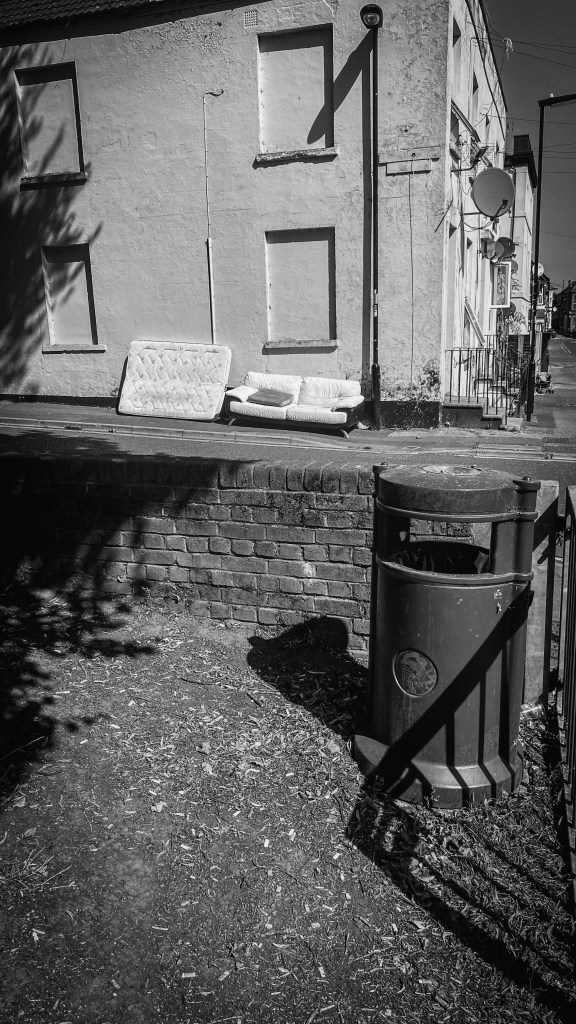
I took this on my iPhone 11 after I stumbled across a scene that was of visual interest to me. I liked the way the urban landscape sprawled away to the back of the frame, out into the distance, whilst the juxtaposition of the bin and the dumped mattress and sofa providing the subject. Shot in portrait, I wanted to capture the height of the building and scale it presents again the intended subject, much like the image of the 4 men in the book by Szarkowski. I also wanted to have the reflection of the gate cutting into the right of the frame, but chose not to add all of the the gate itself, no reason other than it seemed to suit my artistic intention. I think you would attribute it to a level of developing photographic instinct, which links quite nicely to my associated research.
Bibliography
Camera Lucida – Roland Barthes – Published by Vintage 2000 – Vintage, Random House, 20 Vauxhall Bridge Road, London SW1V 2SA
Basic Critical Theory for Photographers – Ashley La Grange 2005, Published by Elsevier LTD, Focal Press Linacre House, Jordan Hi, Oxford OX2 8DP
The Photographers Eye – John Szarkowski – Seventh Printing 2018 – Published by the Museum of Modern Art, New York, 11 West 53 Street, New York, 10019
 Dan Towell OCA Context and Narrative