28/6/20
Research began with reading through some initial articles present on the OCA webpage. I also looked at some videos that were suggested there also. I also took the time to print out some of the articles so I could highlight and make notes. I do seem to prefer reading almost anything on paper rather than a screen. Initial thoughts on research include being foxed by a number of words in the English language I had not come across before! I began to look more closely at semiotics and it’s meaning. I also took the time to try and understand the method of deconstructing an image. My current reading involves Camera Lucida by Roland Barthes which gives an understanding of semiotics and how signs are used to dissect an image. I found this interesting and useful, yet as I think I have mentioned before, I do struggle with Barthes work, I can only take what I can from it. What I tend to do is read through in small bitesize chunks rather than taking in to much information, it seems to work better for me. I combined my research with looking at how others have dissected and written about singular images. The way I approached this was to print out the pieces I wished to read, and then highlight and write thoughts and ideas that struck me alongside the text or in my sketchbook.
Rhetoric of the image – Roland Barthes
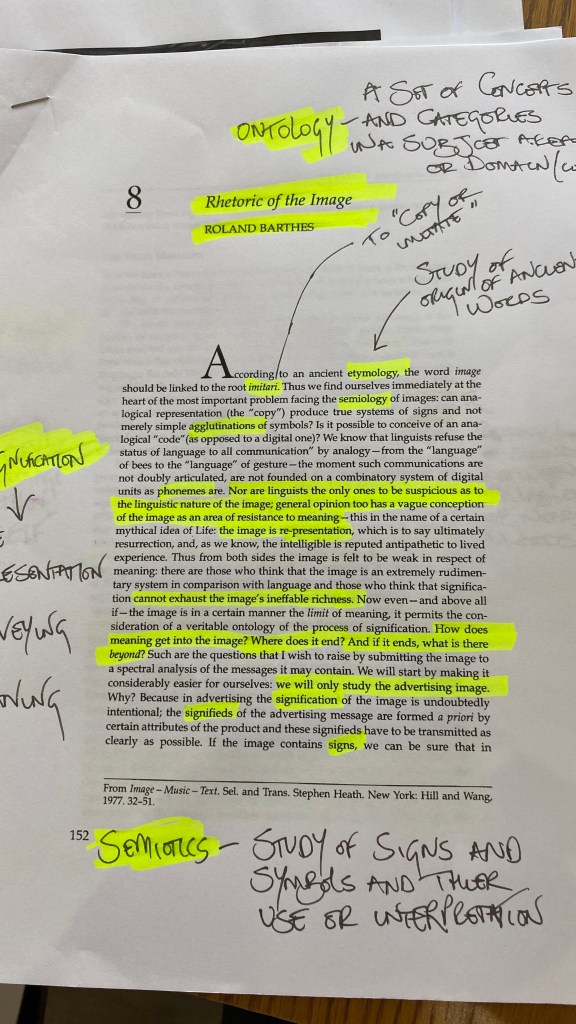
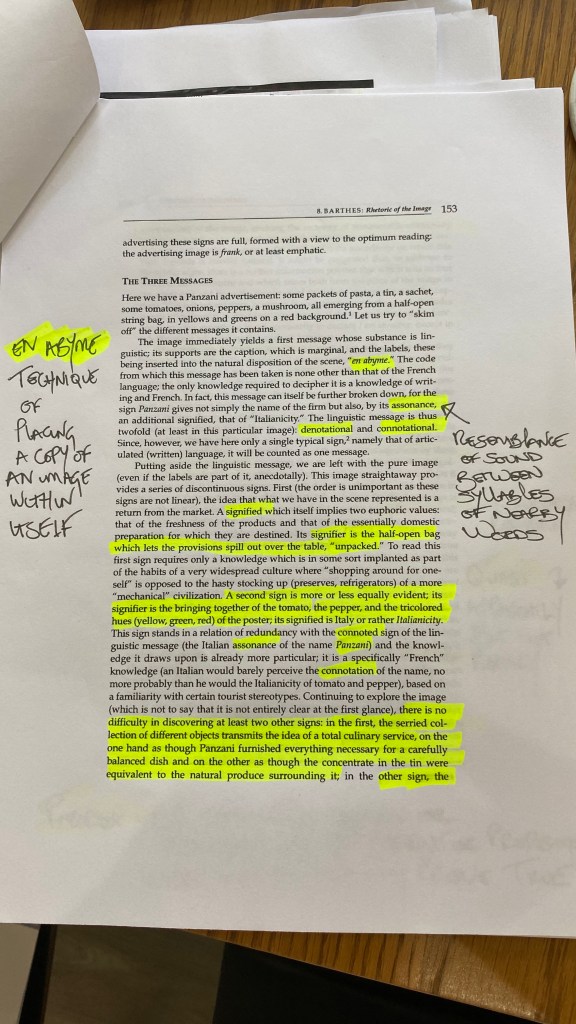
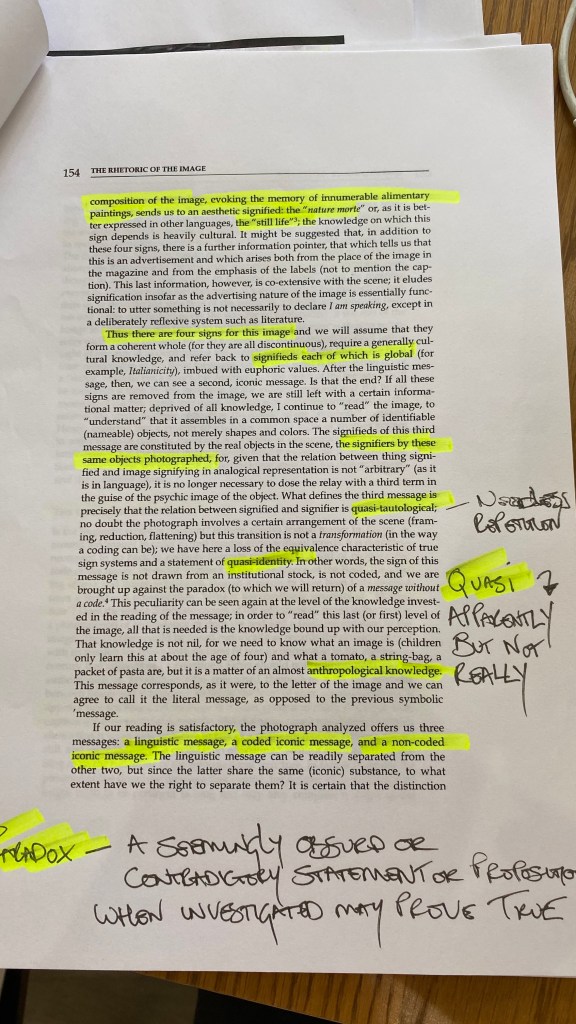
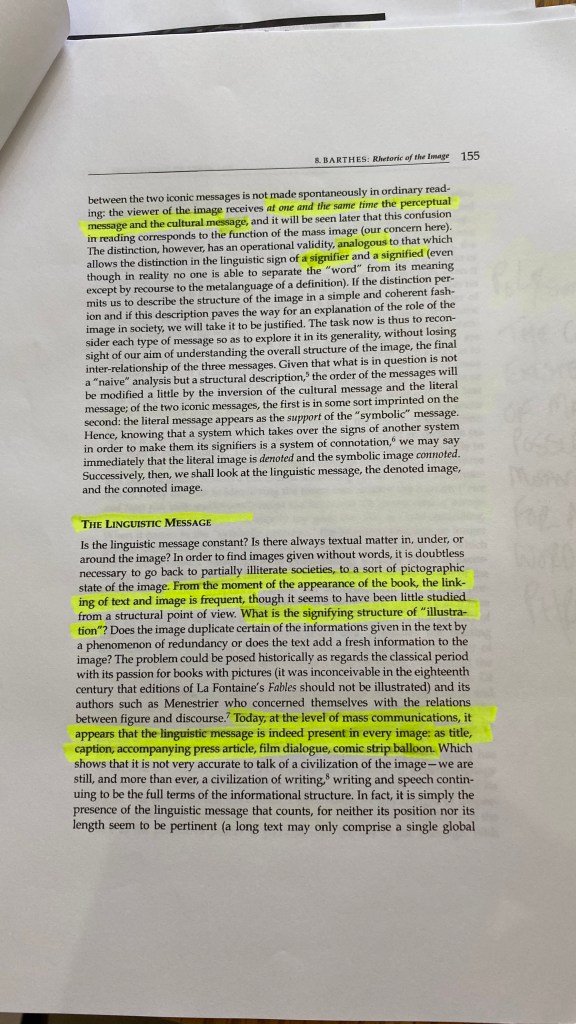
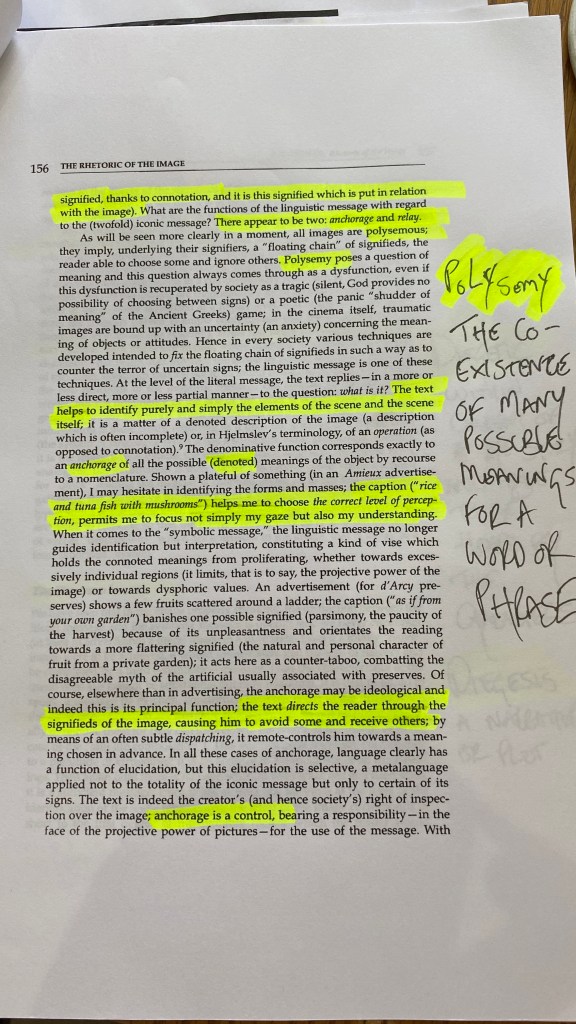
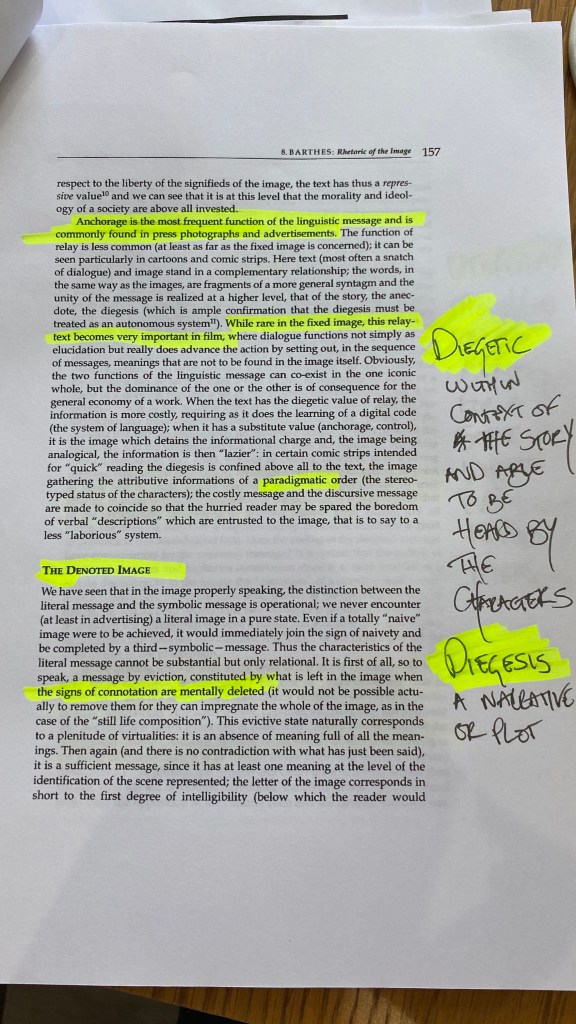
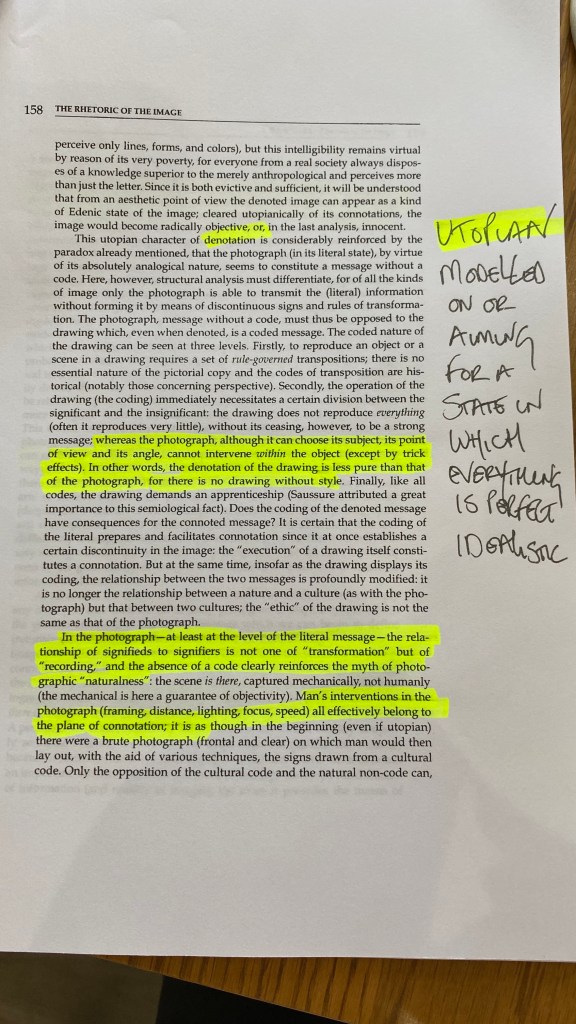
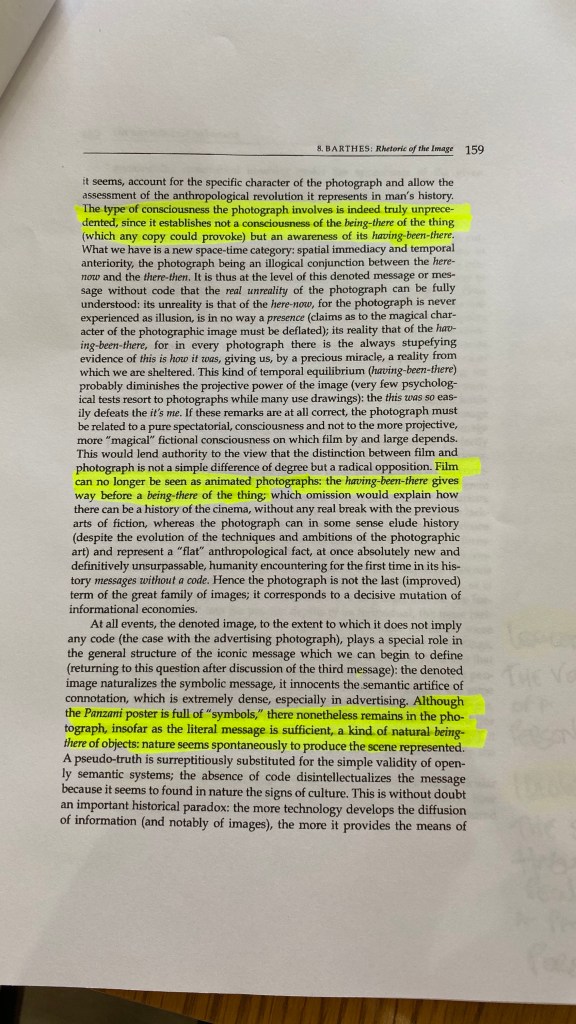
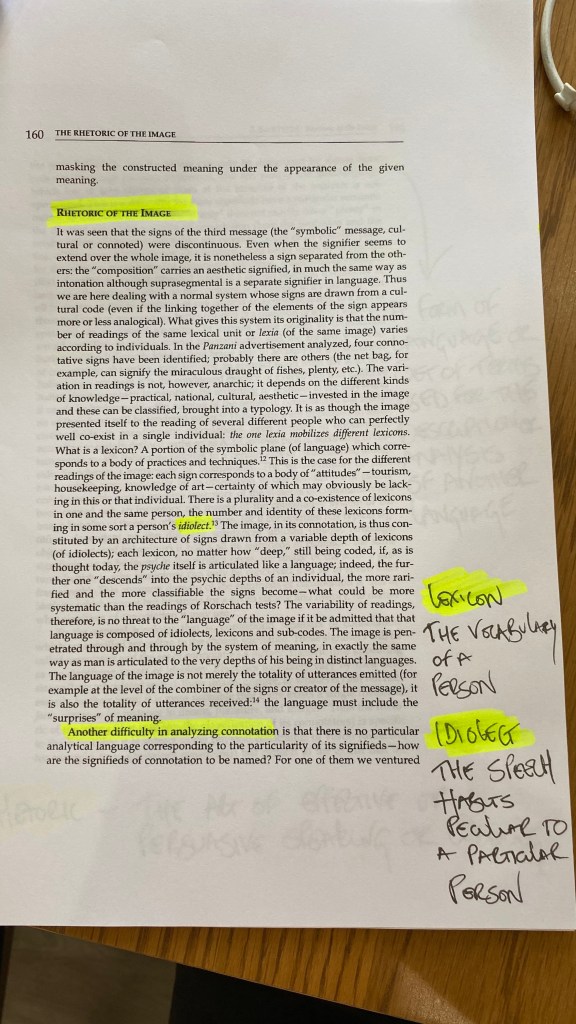
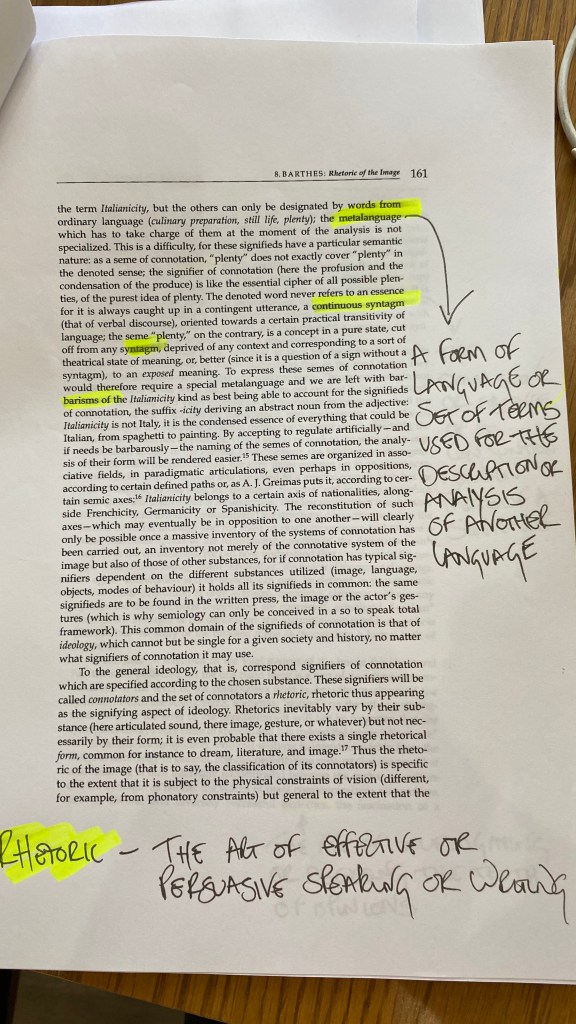
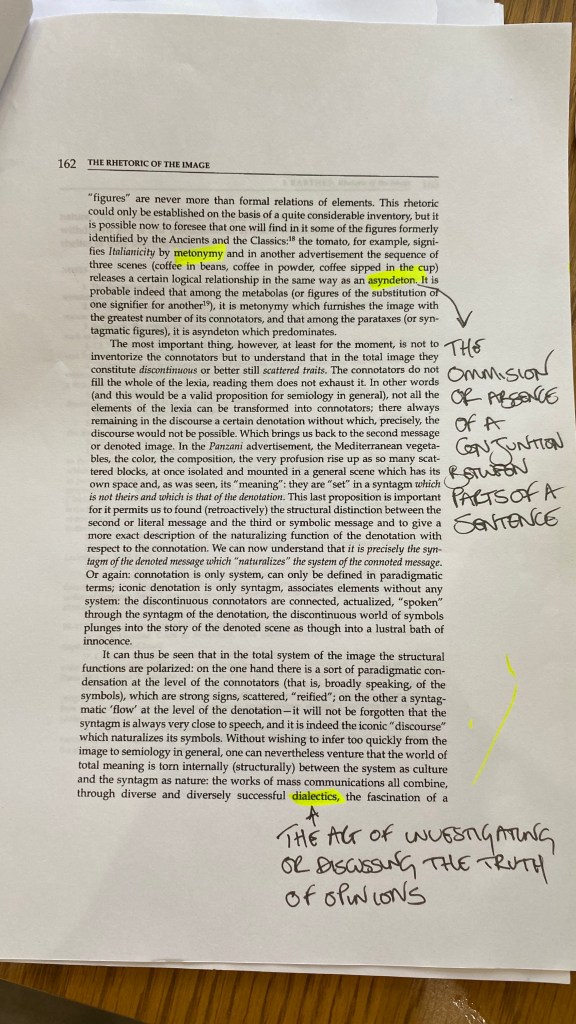
It was immediately interesting how Barthes used an advertisement picture to contextualise his thoughts on how an image can be deconstructed and itself put into a more coherent context. I have to agree that the way these images are produced and used it does make for a useful tool in learning how images actually work. Largely we are all drawn in in some form by advertising, often pushed and pulled in certain directions by the use of clever marketing and its associated photography. Whilst I continue to find the work of Barthes largely confusing it was of benefit to see learn a more theoretical approach to semiotics and how it used to deconstruct imagery. It was most interesting to see how Barthes describes the photographer as the “operator” and the viewer as the “spectator”.
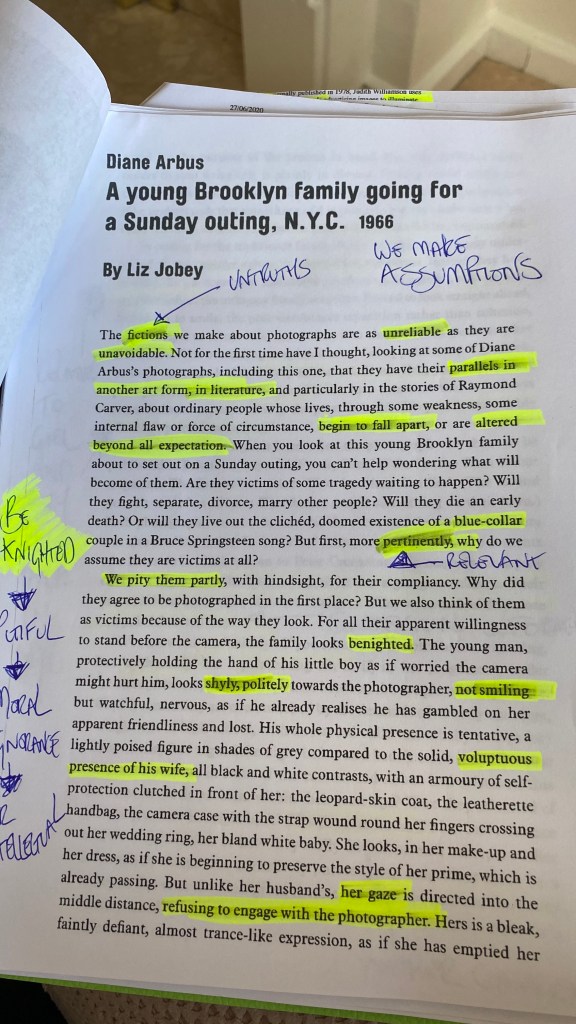
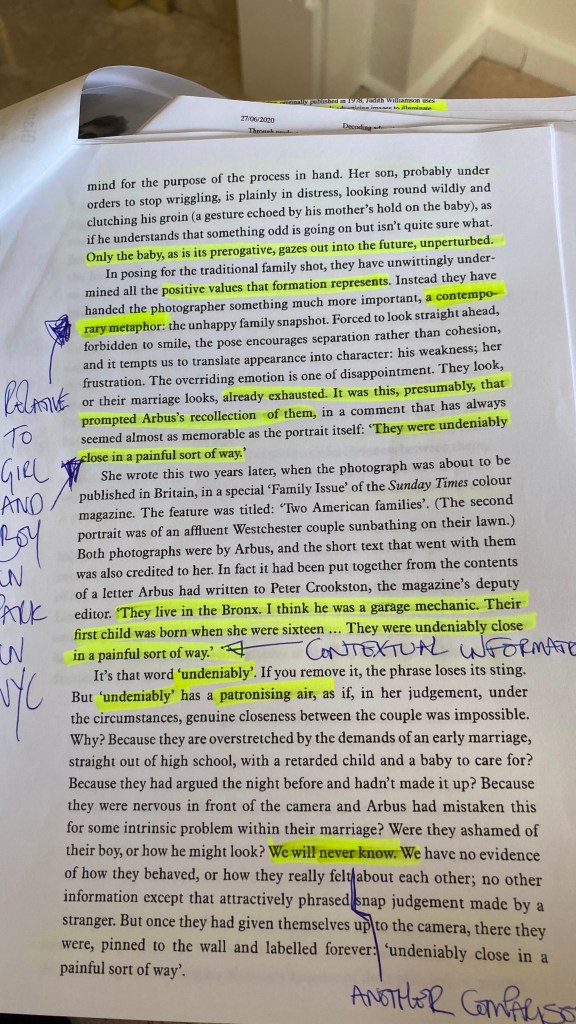
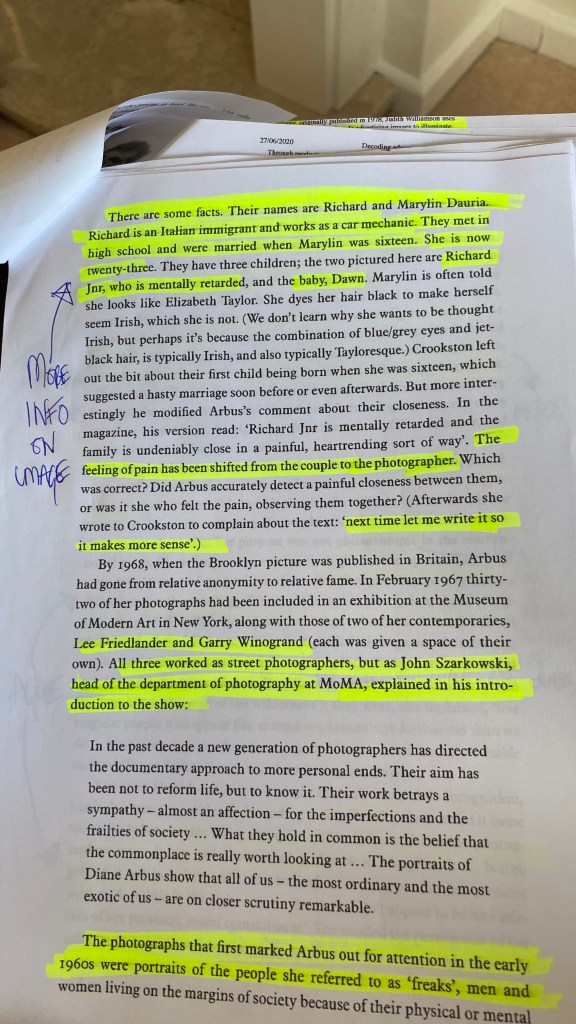
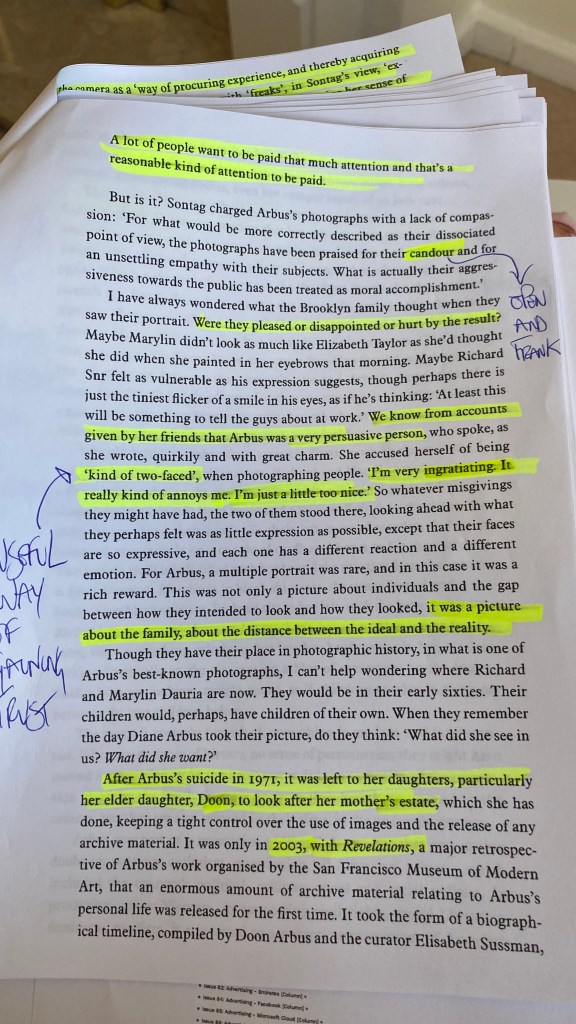
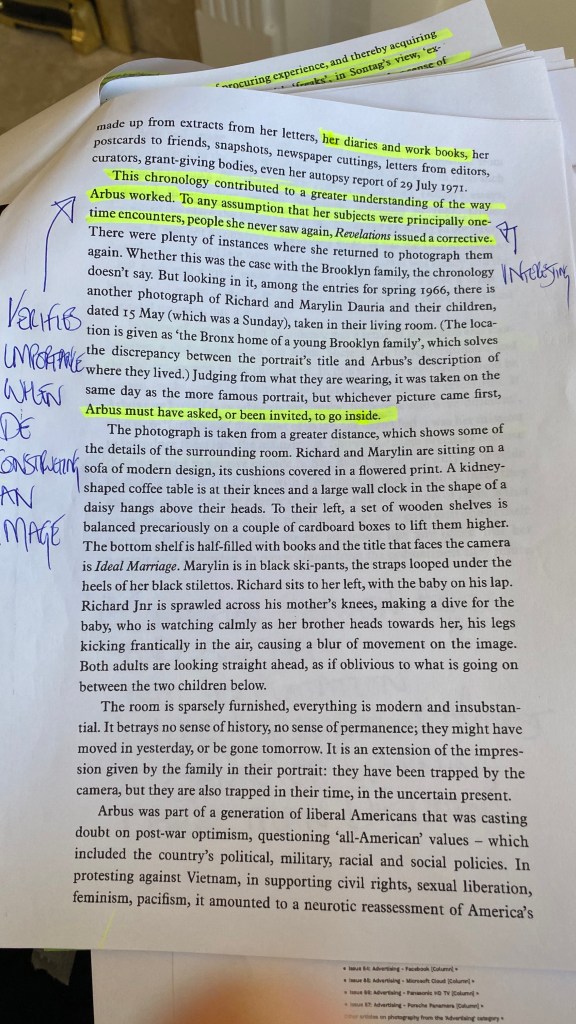
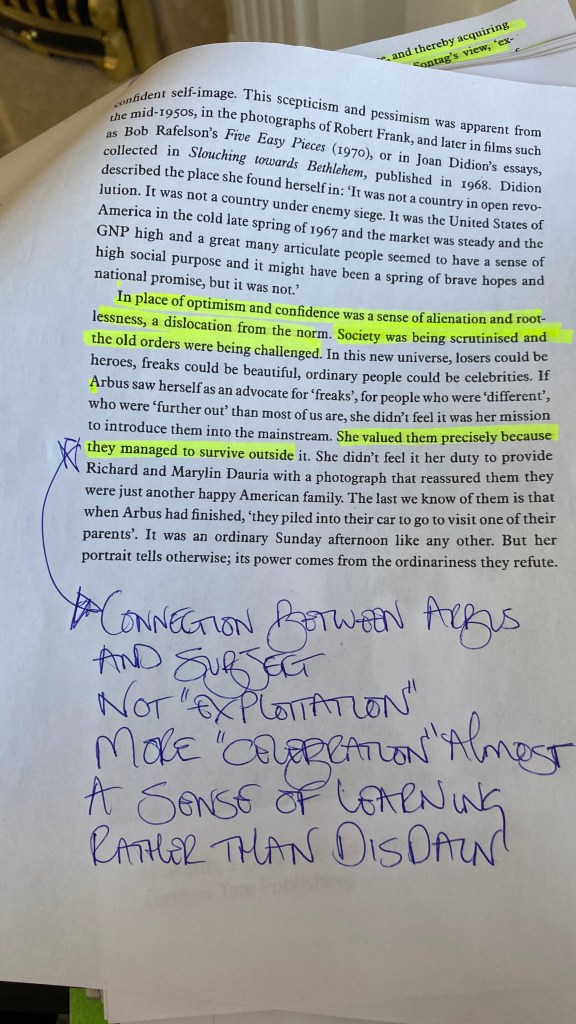
Singular images: Essays on remarkable photographs – Sophie Howarth
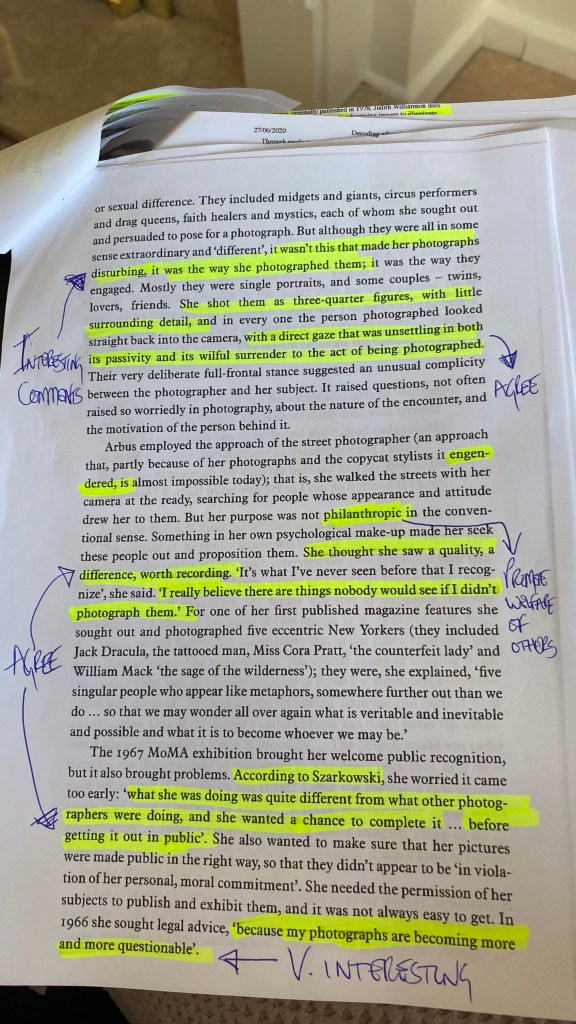
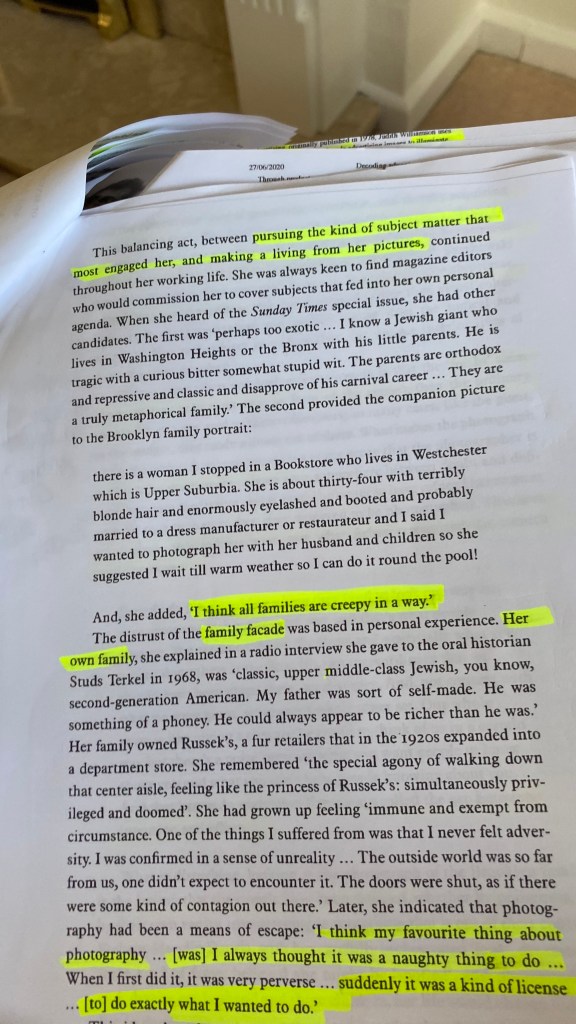
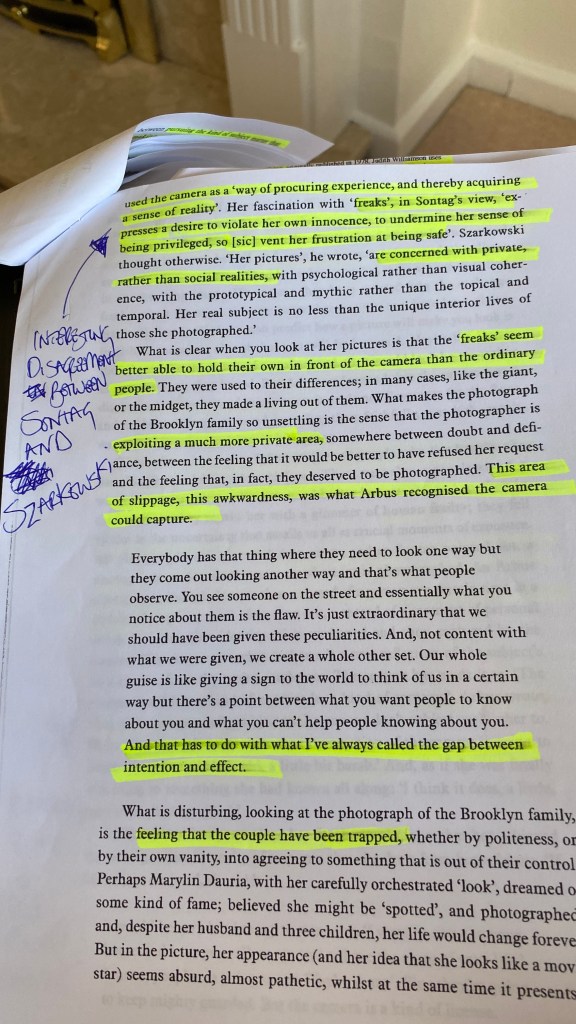
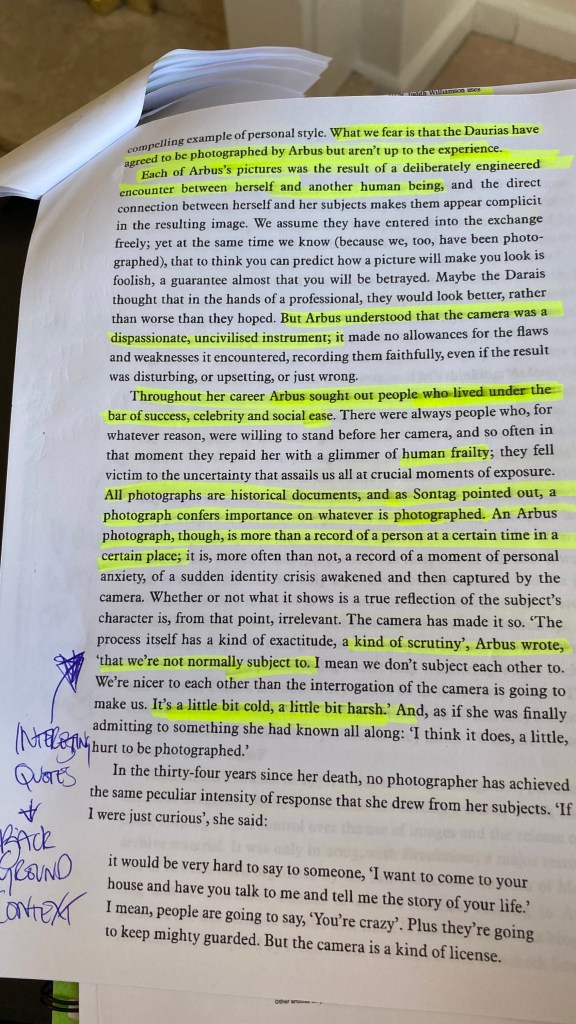
28/6/20
The above essay on an image by Arbus provided an invaluable insight in how to approach the deconstruction of an image. In particular I was struck by the importance of the background knowledge required to dissect the image in a meaningful way. The writer here had information on her chosen photographer and how the photographer worked and important aspects of their career. Also the writers had researched in a way that she had uncovered information about the subjects in the photograph which was particularly interesting. Details about the history of the couple enabled the writer to create an essay of much wider context and also enabled her to zone into how the relationship had potentially formed and evolved. This is something I feel of vital importance and I would need to find out as much about my photographer and subject for my assignment.
Semiotics and decoding
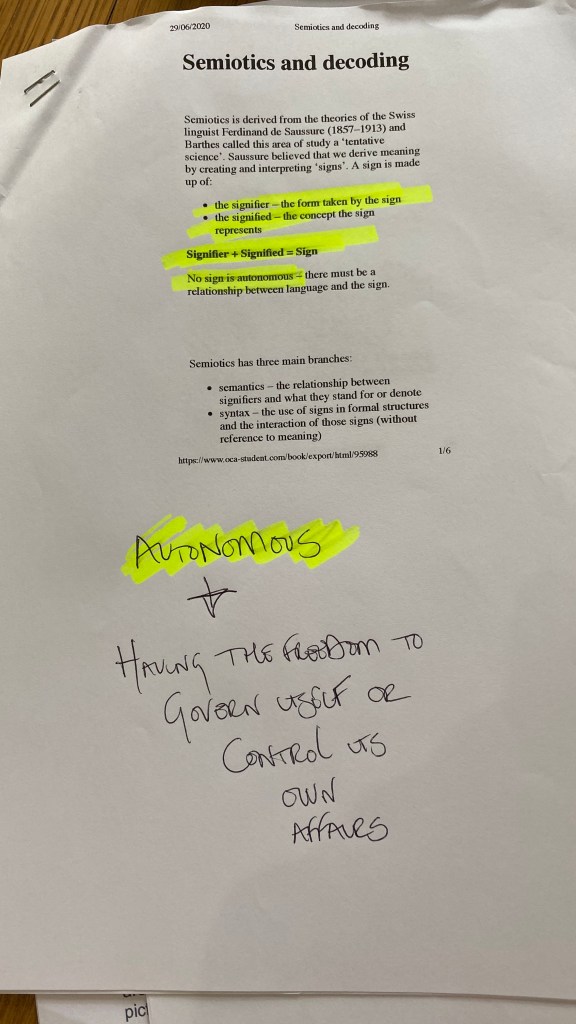
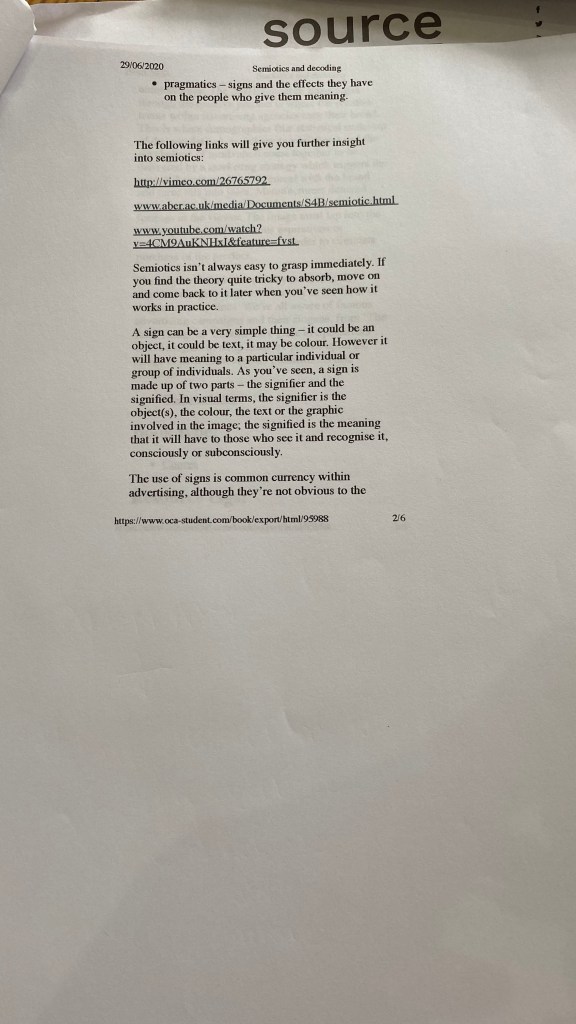
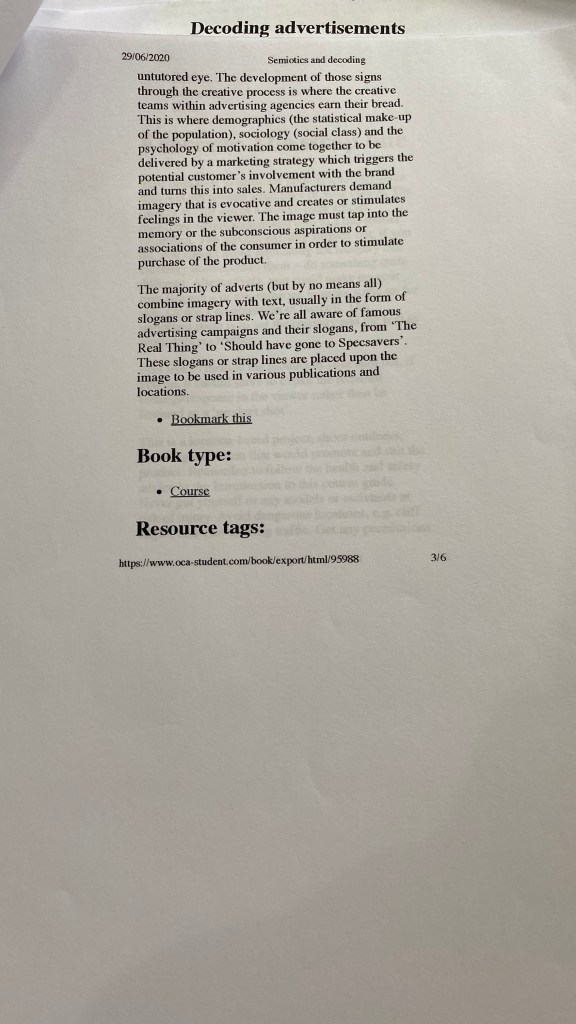
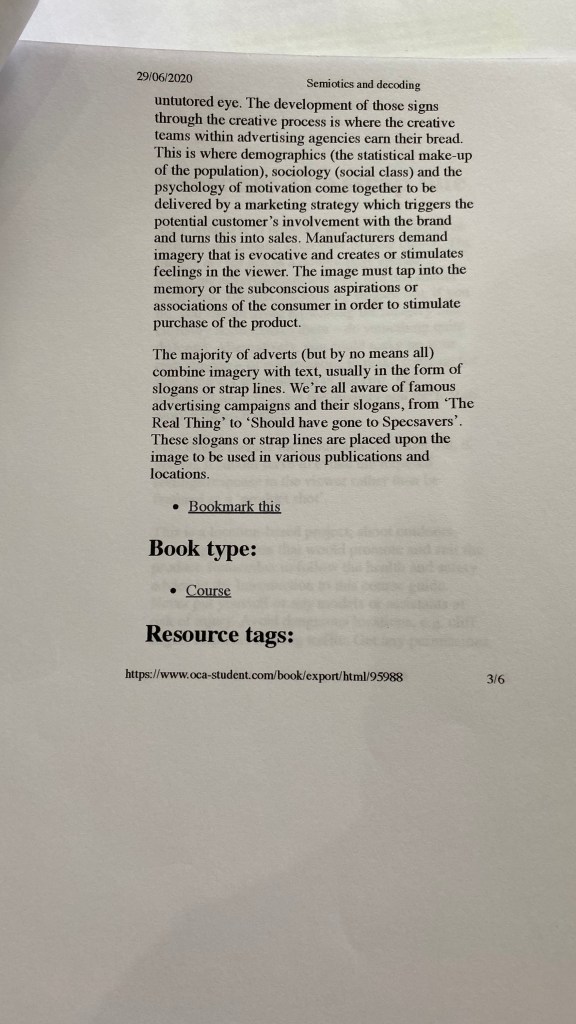
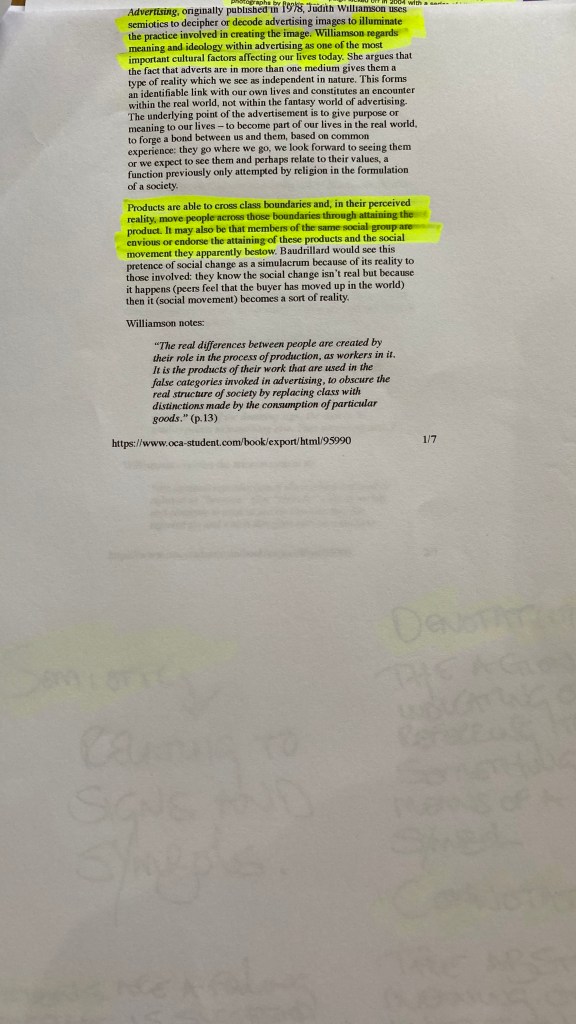
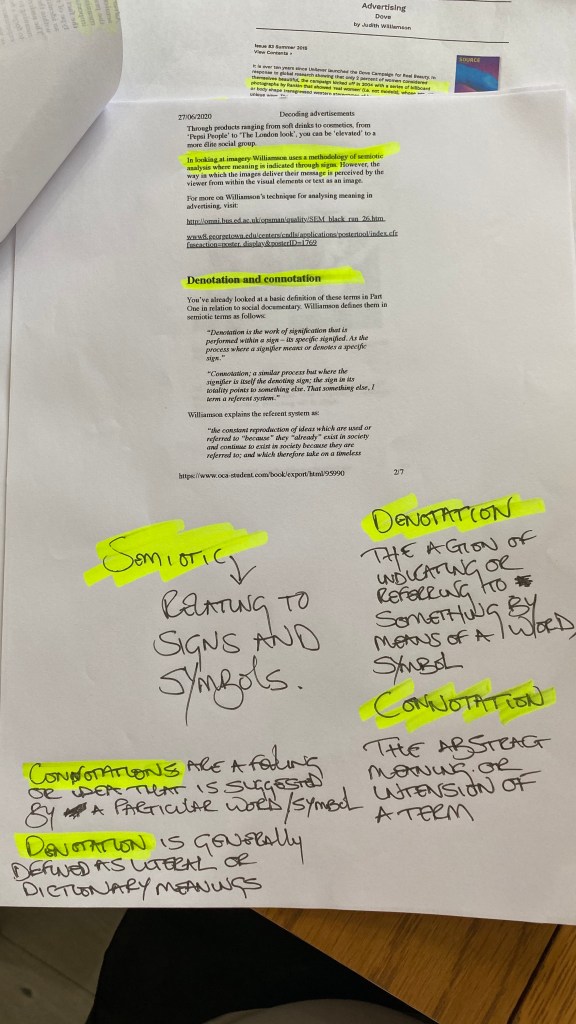
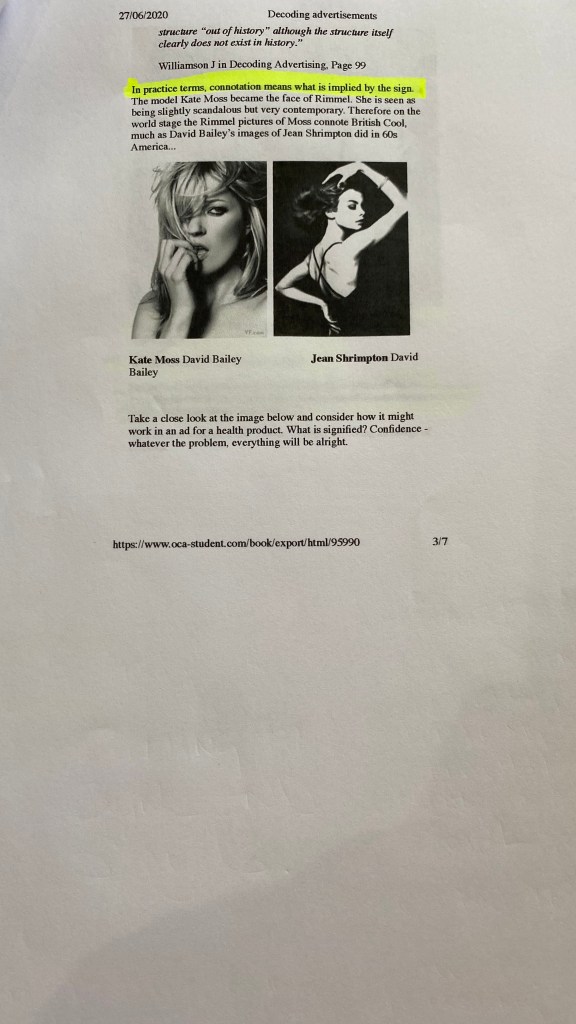
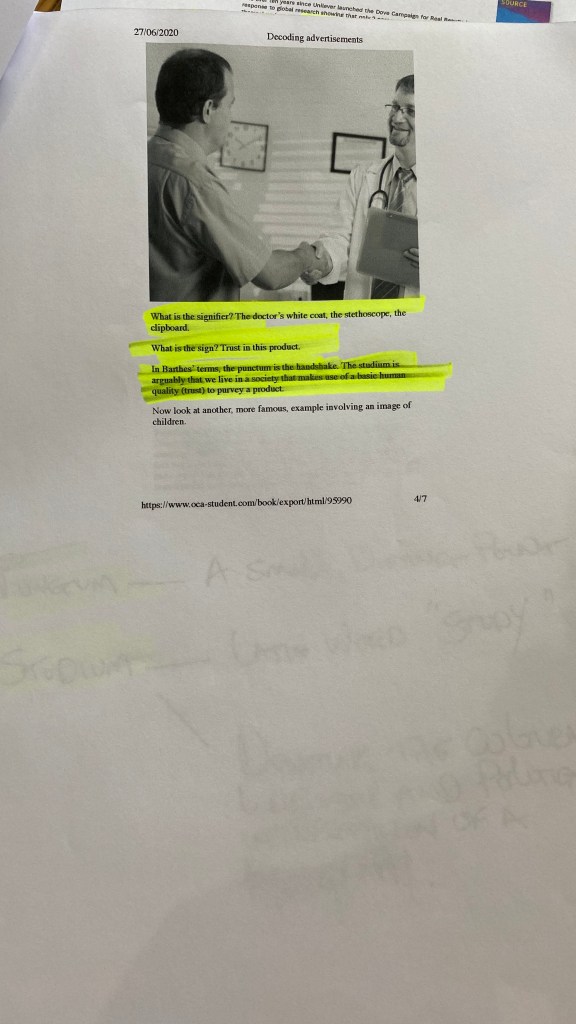
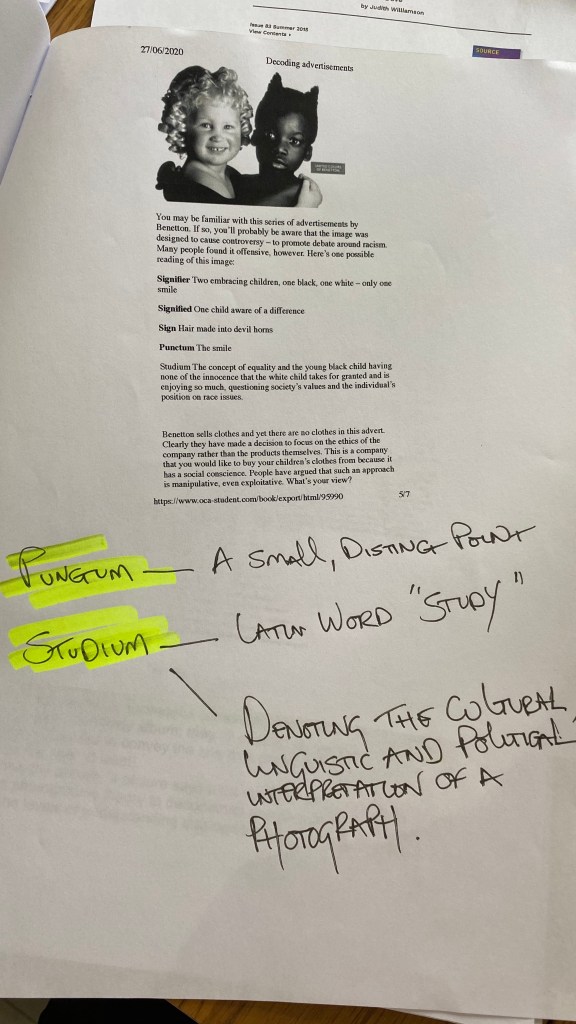
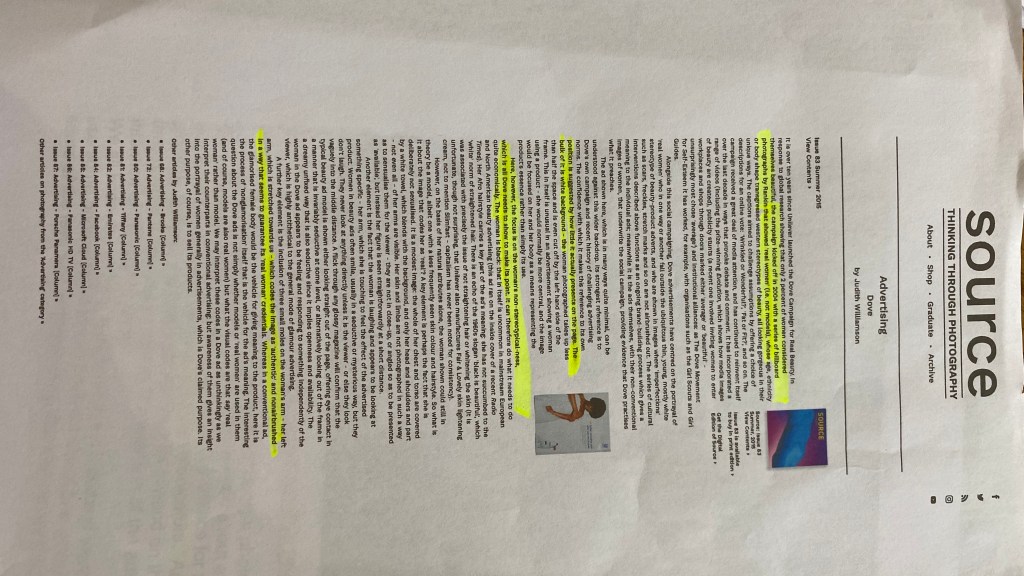
I had previously looked at some of the work by Judith Williamson in the introduction to the course, so I did have some insight into how we can use advertisements to deconstruct and analyse photography, link here https://danieltowellocacontextandnarrative.photo.blog/judith-williamson/
Looking at the work of Williamson provided another useful tool to better understand how semiotics are used in advertising photography. It was also interesting to appreciate the magnitude and impact advertising has on our lives and the way they give us a sense of purpose or meaning. Although I am indirectly influenced by advertising, I had not looked at it in this way and it gave me a much greater realisation of its power and associated impact.
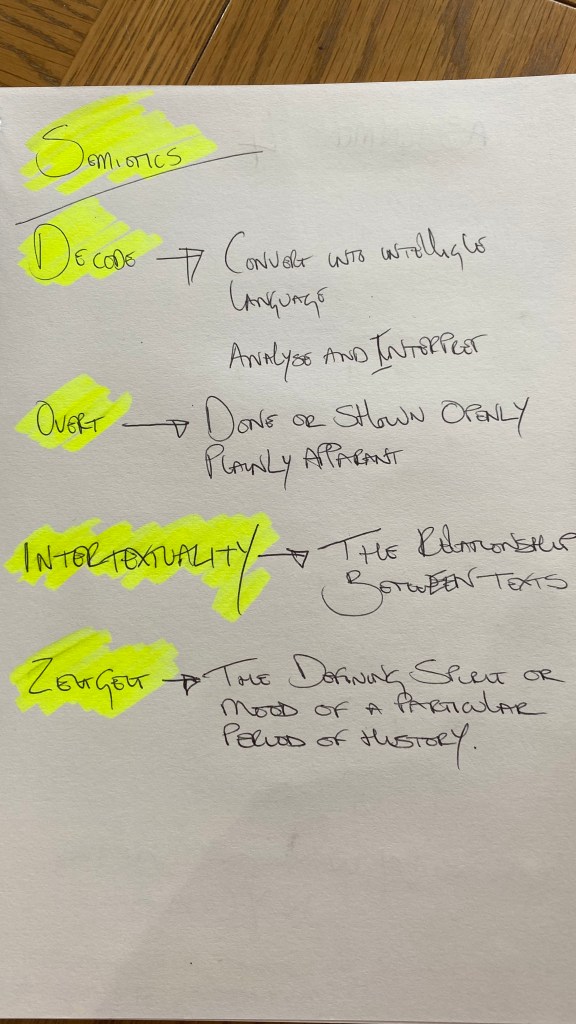
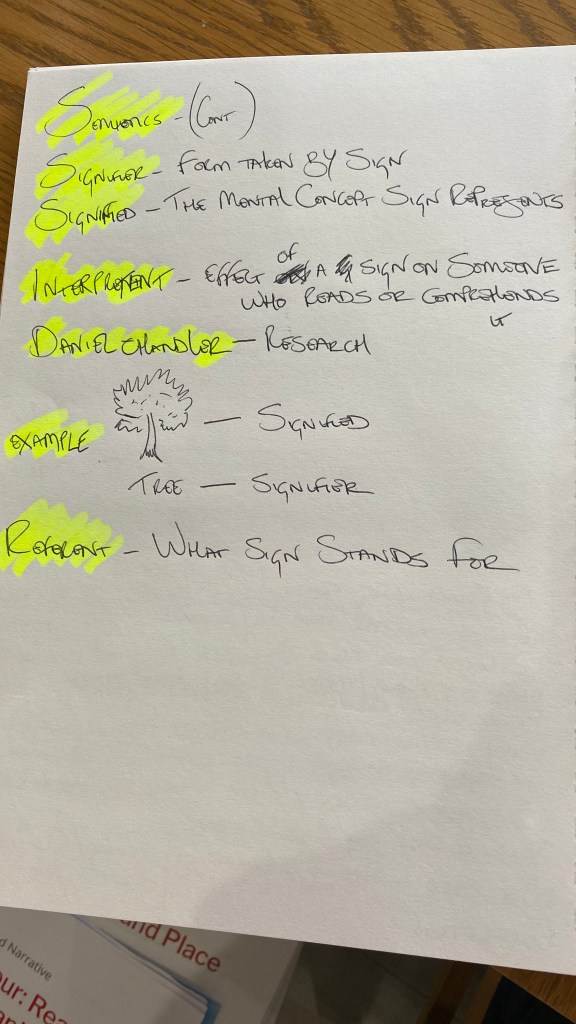
Following on from looking at the work of Barthes, it was interesting to see how Williamson used the terms studium and punctum within her work, this helped to somewhat ease my Barthes pain. I also utilised the opportunity to better understand the meanings of the terms involved, such as semiotics, denotations and connotations. My understanding is that semiotics relates to the use of signs and symbols, a denotation being the action of indicating or referring to something by means of a sign or symbol, a connotation being a feeling or idea that is suggested by the associated sign or symbol.
Decoding images / Deconstruction / insomnia Jeff Wall
30/6/20
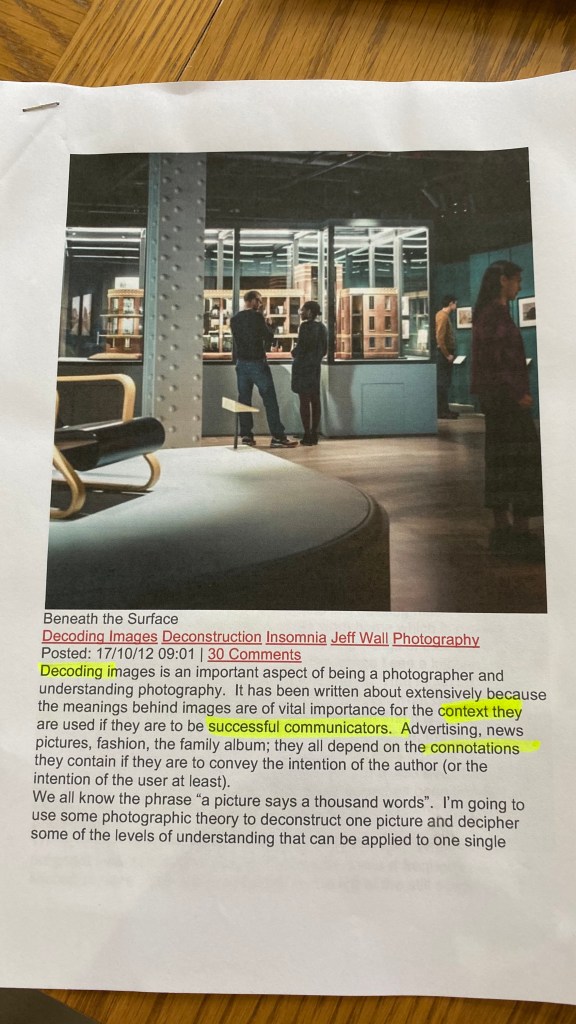
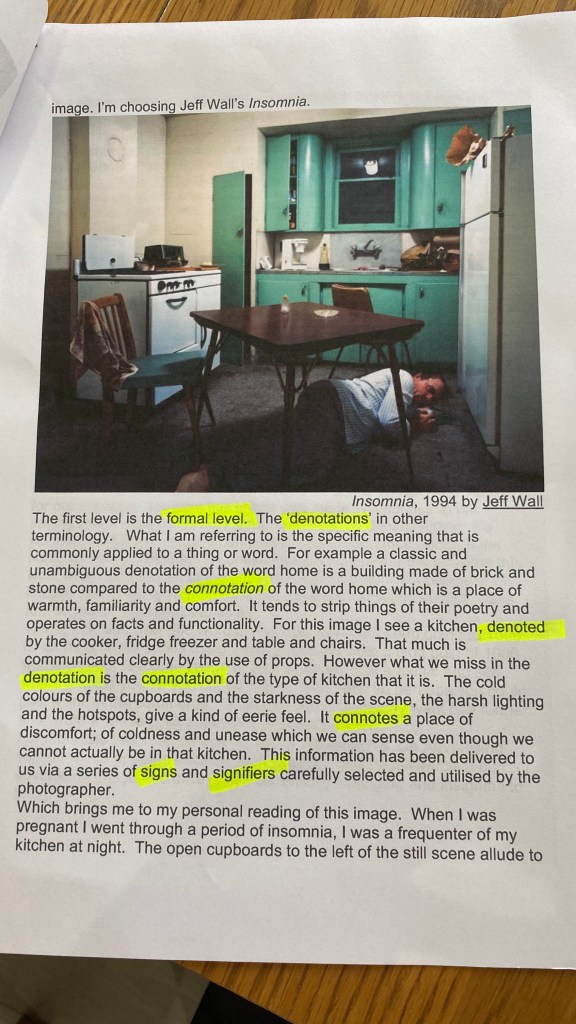
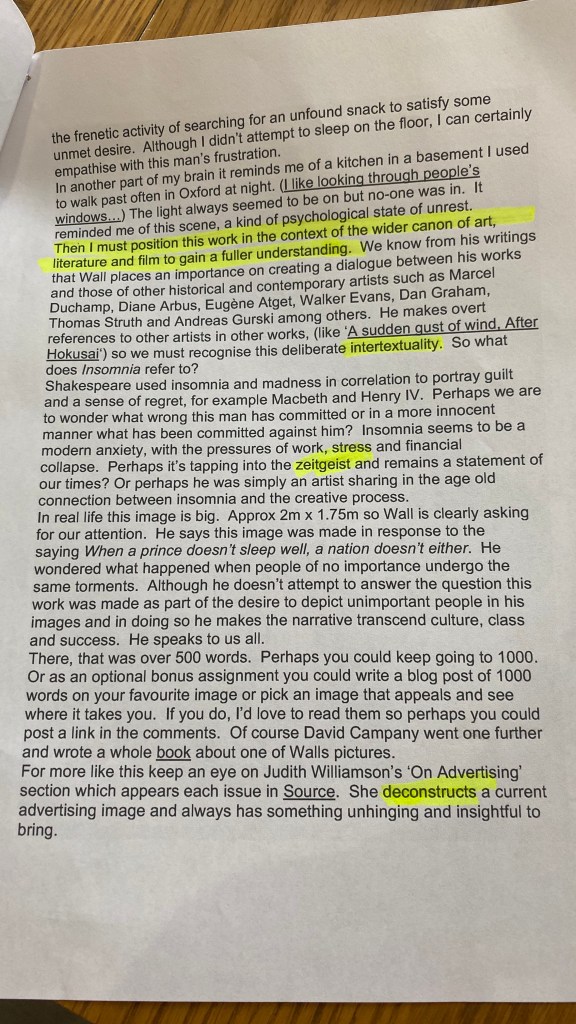
Reading and understanding “Beneath the surface” gave me a much better understanding of how to clearly and concisely deconstruct and image. Combining this with the more theoretical approach of Barthes gives me a good overview of how to construct my essay. The one thing that does concern me presently is the essay needs to be 1000 words, which in all honesty does not seem a lot. I tend to waffle and this may need to be constrained!
I gained a better insight into how we use denotations and connotations in order to gain a better understanding of an image, but it was also apparent from this piece of work that it is equally important to be have as much background information on the image as possible. This means finding as much about the image as you can, who took it and their history, is it part of a series, etc etc. I also better understood how these denotations and connotations are delivered via signs and signifiers. For instance in Walls image he uses carefully selected kitchen interior to connote a sense of eerie discomfort. It was also interesting to read how an image outside of the world of advertising was deconstructed.
Sketchbook
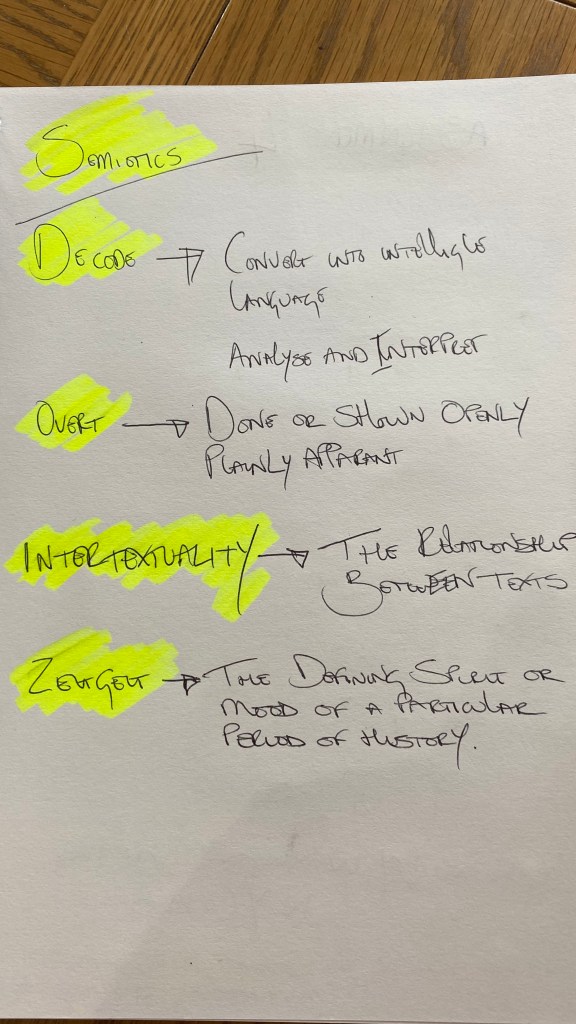
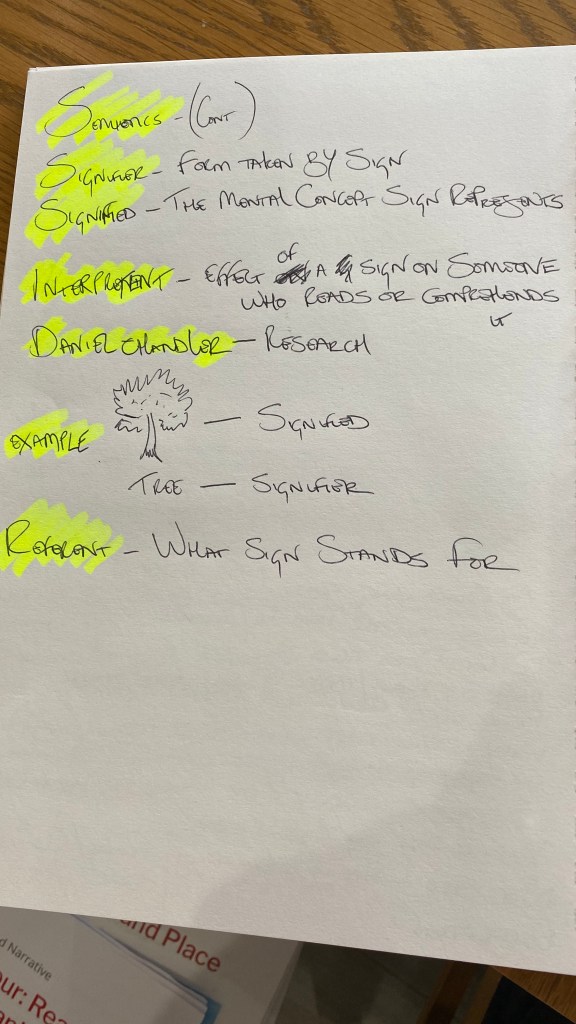
I further documented some of my learning in my sketchbook which accompanies the work I document on my blog. I still believe that the use of pen and paper is a valid and useful way of documenting and enhancing the learning process and one which I will continue to utilise. I also use the sketchbook (as seen above) to dissect and interpret words that I come across that I am unfamiliar with, I can then go back to them when necessary to refresh learning and use within my own work.
References
(ONLINE) https://www.oca.ac.uk/weareoca/photography/beneath-the-surface/ (accessed 26/6/20)
(ONLINE) https://www.youtube.com/watch?v=4CM9AuKNHxI&feature=fvst (accessed 26/6/20)
(ONLINE) https://vimeo.com/26765792 (accessed 26/6/20)
Further research is evidenced here – https://danieltowellocacontextandnarrative.photo.blog/research-insomnia/
1/7/20
Work continues on the exercises leading up to the assignment and I continue to look more closely at the work of Diane Arbus. I am quite intrigued by her work, and some of the research I have carried out has led me to an better understanding of not only her work but her asa aprons and photographer. I cant help but feel that one of her images may take form in the assignment essay, I am struck by a number of her images.
I also watched a short documentary on Joel Meyerowitz and it was interesting to her how he approached his street photography. A lot of the photographers I listen to seem to talk mostly about patience, feeling and perseverance. I am sure this could be likened to the ethics of Diane Arbus to, albeit she seems to be much more maverick in approach. Meyerowitz during the making of this short film didn’t really seem to interact with his subjects during the photographic process, his street photography was not so much about portraiture but more about freezing evocative moments in time, or capturing fleeting moments which are often overlooked in the busy hustle and bustle of a busy city. This seemed to be in quite a contrast to Diane Arbus who was more persuasive by nature and seemed to want to create more of a connection with her subjects.
Reference
Reference – (ONLINE) https://www.youtube.com/watch?v=KDSGWy1CU78&t=2507s (accessed 1/7/20)
Image
I made the decision to go with my gut and work on a Diane Arbus image for my 4th Assignment. The process I went through is one I use quite often. It is pretty basic but I research images of photographers on Pinterest and I then make a board for each photographer. This creates a database of images and information that I can draw on at any time. It also is a nice way to view an artist in almost gallery style. So, while I was in the process of creating a board for Diane Arbus, I ran into an image that just immediately struck me. It is probably noticeable in my workflow that I have a specific way of working in that I am often fuelled viscerally rather than by intellect. This has pros and cons. But at the end of the day I cant change it, and I am not sure I would want to. The image in question just spoke to me, I found it mystifying, evocative, unique, profound, creative, and largely a real departure from the work that I produce. This would provide the right challenge I thought to try to interpret and translate an image that I would certainly not take at this present time. I had my image.
I began by sketch booking my image, and looking at the work in closer detail, using the practices I had learnt in part 4 of the coursework.
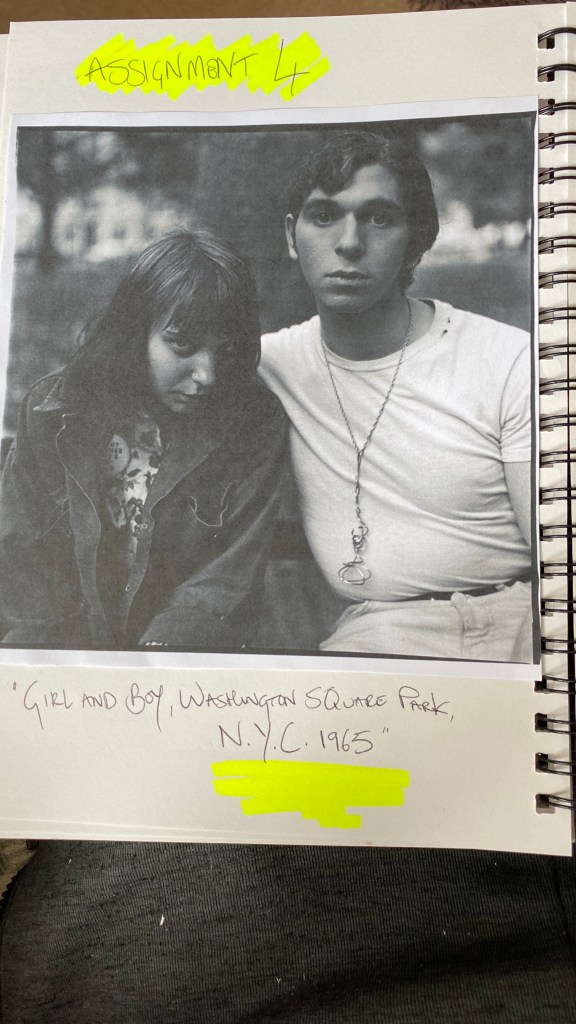
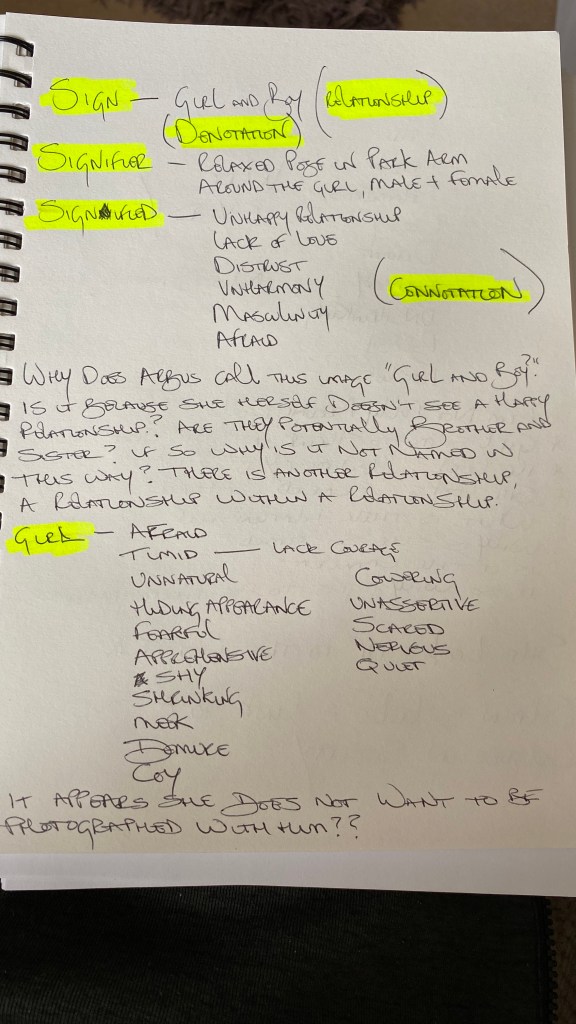
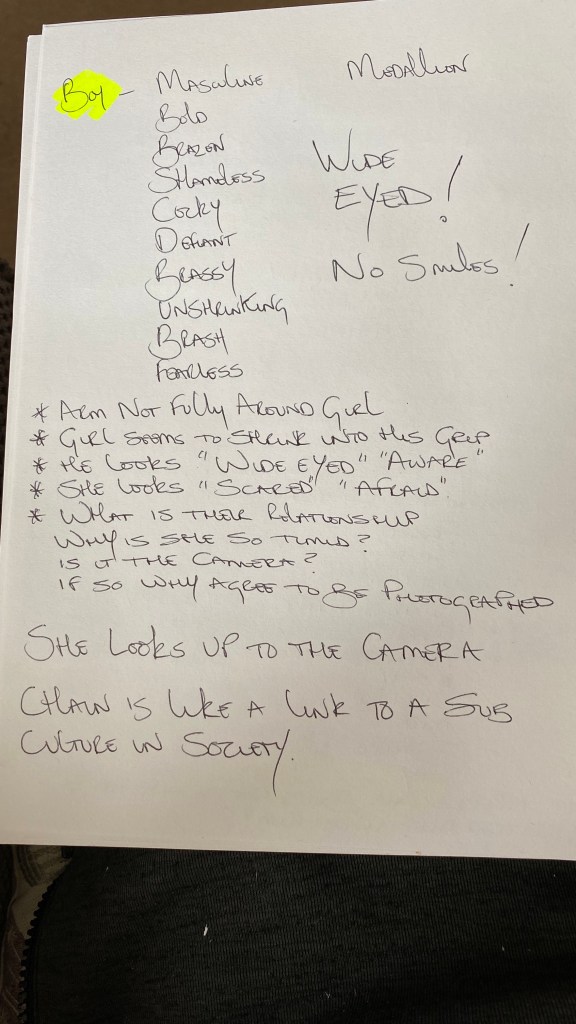
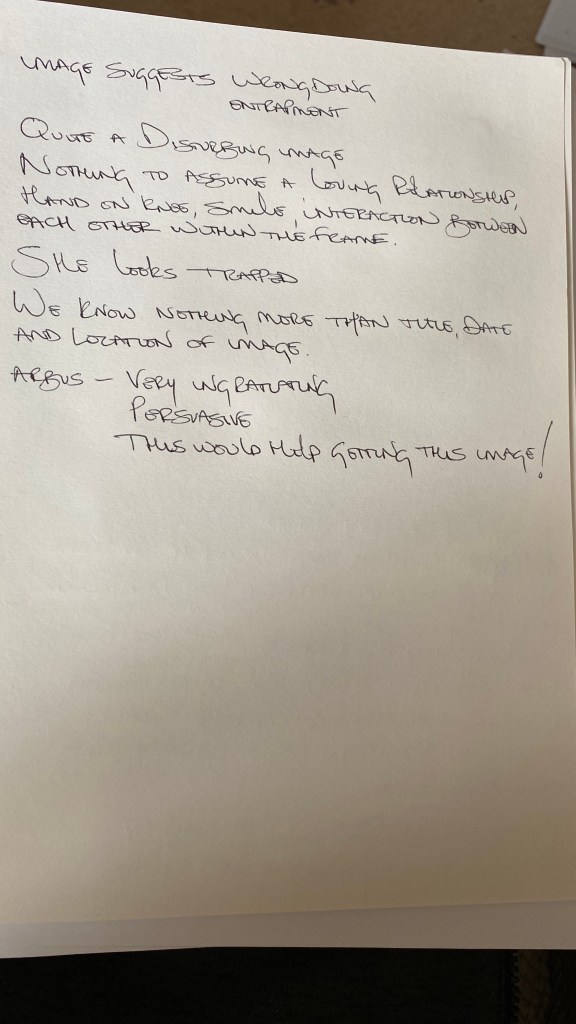
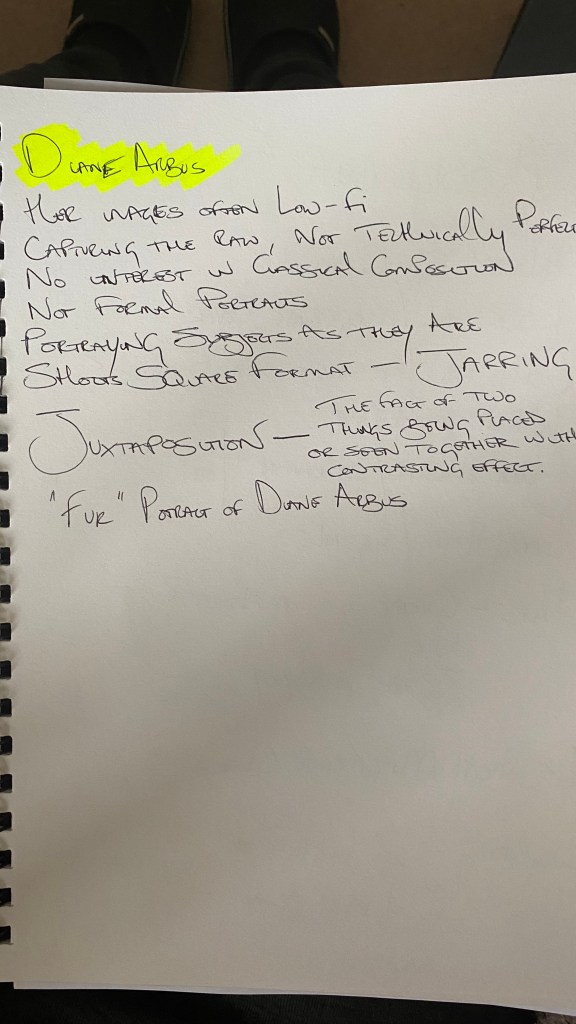
I also felt it necessary to get a better understanding of Arbus and understand her life better, her philosophy and way of working and her upbringing. I watched some documentaries on her life and work and resourced some information online.
Below are some bullet points on Diane Arbus that I have discovered through varied research.
- Born 1923 / Died 1971
- Committed suicide in a bath tub by overdose and slitting wrists
- Location of ashes unknown
- Wealthy upbringing form Jewish parents in NYC
- Some of her creative tendencies are linked to her upbringing and is quoted as saying “the outside world was so far from us”
- All her siblings grew up to be creatives
- Married her childhood sweetheart Allan Arbus at 18 years old
- They had 2 daughters together
- Allan bought Diane her first camera
- Arbus and husband worked together in photography from 1946 to 1956 predominantly in fashion photography
- Arbus became unhappy with he photography she was working on and decided to begin work that interested her independently
- Arbus became voyeuristic and attended body building competitions, youth gang meeting and beauty contests
- Transformed her apartment into a workspace pinned images to the walls and sleeping on a mattress in the room
- Through sometimes multiple visits over many years she built up a relationship with her subjects which often became friendships
- Allan Arbus continued to support Diane Arbus until their separation in 1959
- The continued a close friendship and shared use of the studio darkroom for processing and printing of Diane’s work
- They divorced in 1969
- Arbus in 1956 used a 35mm nikon and meet a lot of her subjects by chance
- In 1962 Arbus switched to a twin lens reflex Rolliflex which produced more detailed square images
- Arbus photographed the unusual and the unseen (amongst others), including giants, dwarves, transvestites, people with mental illness, lesbians etc etc
- She became know as the “photographer of freaks”
- Arbus experienced “depressive” episodes in her life
Bibliography
(ONLINE) https://mashable.com/2017/05/20/diane-arbus-in-the-park/ (accessed 30/6/20)
(ONLINE) https://www.theguardian.com/artanddesign/2019/feb/17/diane-arbus-in-the-beginning-hayward-gallery-don-mccullin-tate-britain-review (accessed 30/6/20)
(ONLINE) http://www.artnet.com/artists/diane-arbus/ (accessed 30/6/20)
(ONLINE) https://en.wikipedia.org/w/index.php?title=Diane_Arbus&oldid=963587824 (accessed 30/6/20)
(ONLINE) https://www.youtube.com/watch?v=sbsrJTjV8BI&t=16s (accessed 29/6/20)
(ONLINE) https://www.youtube.com/watch?v=Q_0sQI90kYI (accessed 29/6/20)
(ONLINE) https://www.theartstory.org/artist/arbus-diane/life-and-legacy/ (accessed 30/6/20)
 Dan Towell OCA Context and Narrative