Overall a good, informative and enjoyable assignment and the feedback I have received has been encouraging. I am relatively happy with the outcome for the assignment, and perhaps most importantly happy with my chosen image. I seem to be drawn to a specific type of work, the likes of Arbus, Mann and Woodman have played a significant part in my development. This is something I want to further embrace. My tutor made some comments regarding some of my wording and phrasing which I have adjusted accordingly. I also need to make sure I use citations within my work. I am making a conscious effort to highlight key phrases within my reading which can be clearly linked to my assignments and further work. I have also decided to make a slight rework to my assignment and added some citations and try to contextualise my essay in a more interesting and suitable way. I have also given the written piece a title which further adds to the context of the work.
Learning outcomes
- Create images that demonstrate a practical and conceptual understanding of techniques, and the importance of context in creating meaning and narrative.
Whilst this assignment does not require me to produce any photography, I have continued to take images on an independent basis. I have followed this up by reflecting on this work in my LL and also in my diary which accompanied assignment 3. In doing so I have utilised various in-camera techniques such as double or long exposures and also continued to develop my editing techniques. I have also tried to evaluate the context and narrative of these images and used the editing process to further develop the aesthetics and story within other work.
- Demonstrate an emerging critical awareness and an ability to articulate ideas into imagery through appropriate use of technique.
I believe my critical awareness of photography is continuing to develop, yet at this time is not the finished article. I am now more astute at creating narrative through imagery and have done this on prior assignments and independent work that use a variety of techniques. I do feel that most importantly I need to be able to evidence my development of this critical awareness within my LL. This is a continuing work in progress and one that has been highlighted by my tutor.
- Conduct research, development and production of photographic work in response to the themes explored in this unit and show a developing understanding of contemporary imagery in relation to historical practice and theory.
I have continued to research my work and that of other practitioners throughout this assignment. Perhaps quite poignantly during the course my tutor has made me aware of how I can put this more coherently into my LL and also link it to my work and the images I produce. This also makes me aware that I need to use citations more concisely and accurately, and evidence my contextual understanding in a better more informative manner. I feel that I have researched a wide range of work from historical practices to contemporary work, and I need to make this clear on my LL.
- Show an ability to critique your own imagery and reflect upon your learning experience, and developing sophistication of your assessment of the work of other practitioners.
I have began to understand how important it is to critically digest my own work and I also need to make this more evident on my LL. I do feel that I am reflective upon my work and how I have evolved throughout the learning process. I also feel that this assignment in particular shows a clearer and better understanding of how to assess the work of others. I now realise the importance of not only trying to understand a photograph but that it is of equal importance to understand the photographer, their background and the intended output whilst assessing work. Having an all round level of knowledge of a photograph, along with details such as where it was taken, why it was taken, where its intended to be seen, lead to an ability to better contextualise a series of images as well as singular work.
Further reflection
On the advice of my tutor I returned to Camera Lucida by Roland Barthes to further help my contextualisation and reading of images. I also wanted to use Barthes in my slight reworking of the assignment, using some citations from the book. I used my sketchbook to highlight some key phrases that struck me and also linked well to my thoughts on the image I had chosen. Whilst some of Barthes writing does bamboozle me slightly, I do connect quite deeply with his opinions and ideas, the way he describes and contextualises the photograph is quite extraordinary. I am sure it is a book than I will continue to return to now I have finished my first full reading.
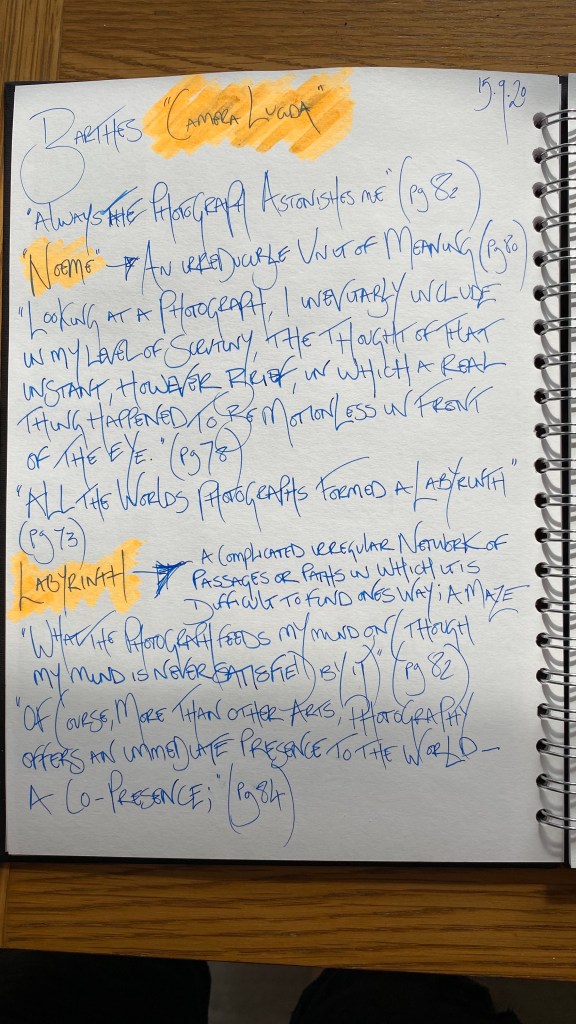
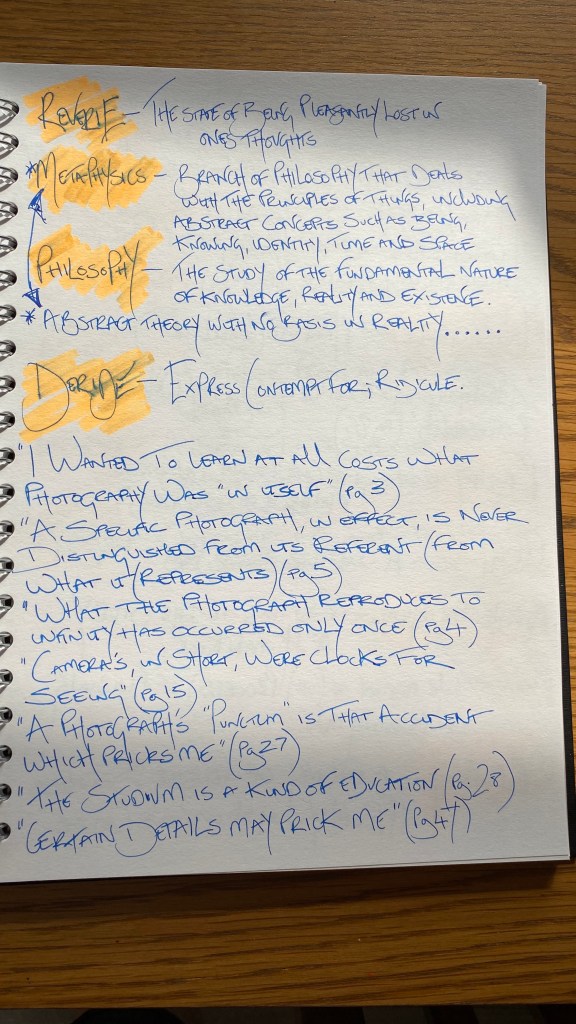
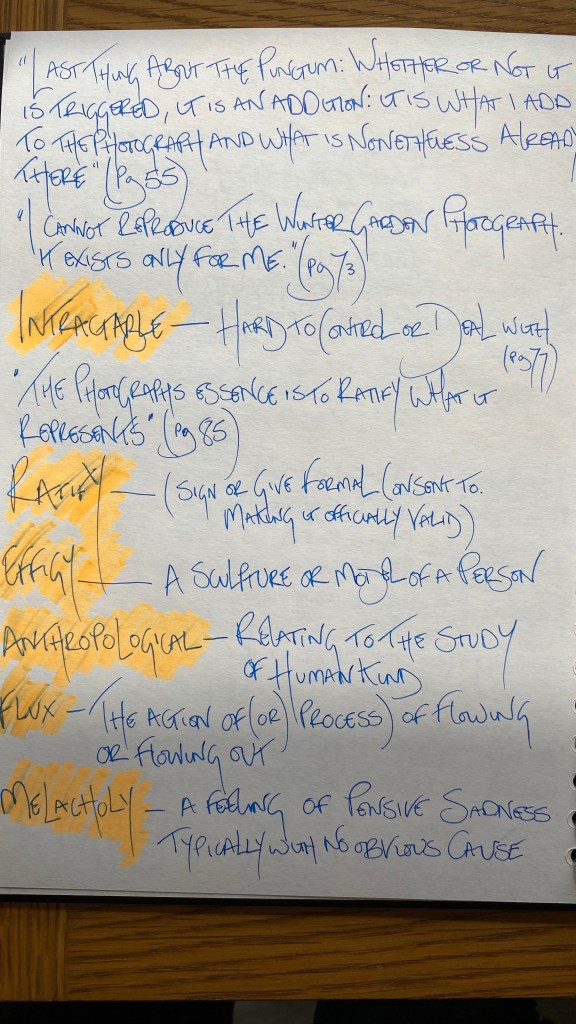
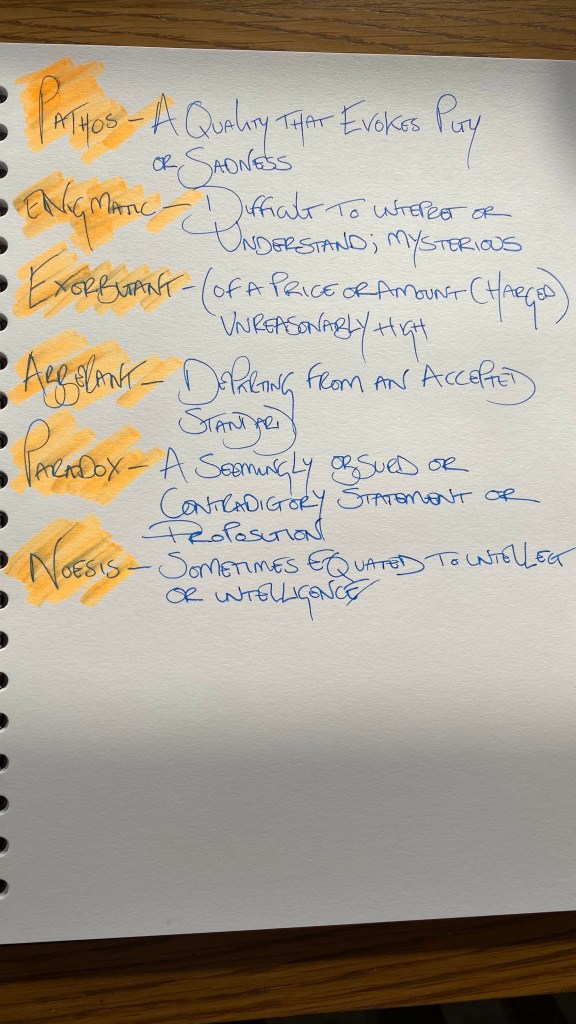
Cyanotype
Not inherently linked to my reflection here but this does put some context on my research into more historical photographic practices. I have begun to experiment with the cyanotype process and below are some of my first results. I came across the method whilst listening to a photographic podcast, History of Photography by Jeff Curto. A really informative podcast and I am keen to keep using this medium within my research and development. The cyanotype method was initially developed by Sir John Herschel in 1842, he initially saw it as a method of reproducing notes and diagrams, or “blueprints”. It is a quite fascinating process, working particularly well with plants, flowers and foliage. I used my garage as a makeshift darkroom and used an LED torch to paint on the two chemicals I had mixed together to form my light sensitive solution. It soon became apparent how I need to adjust to working in darkness! The two chemicals I worked with were Potassium Ferricyanide and Ferric Ammonium Citrate. I initially mixed these two parts separately with water to form stock solutions, and let them sit for 24 hours. The next part was then to mix equal parts of the two solutions together, before painting onto my chosen paper or fabric. In this instance I used a matte photographic paper I had purchased that was not suitable for my printer.
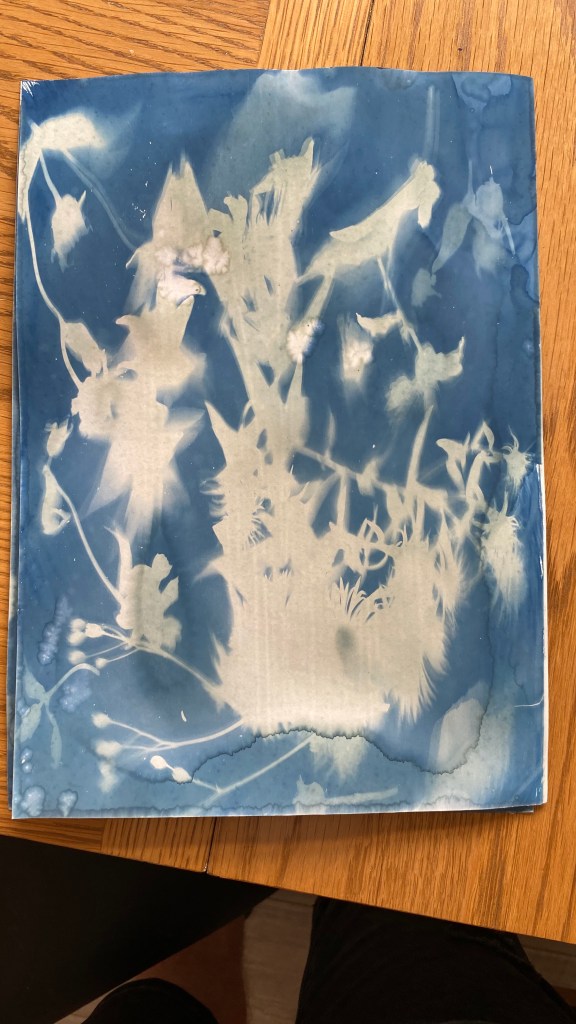
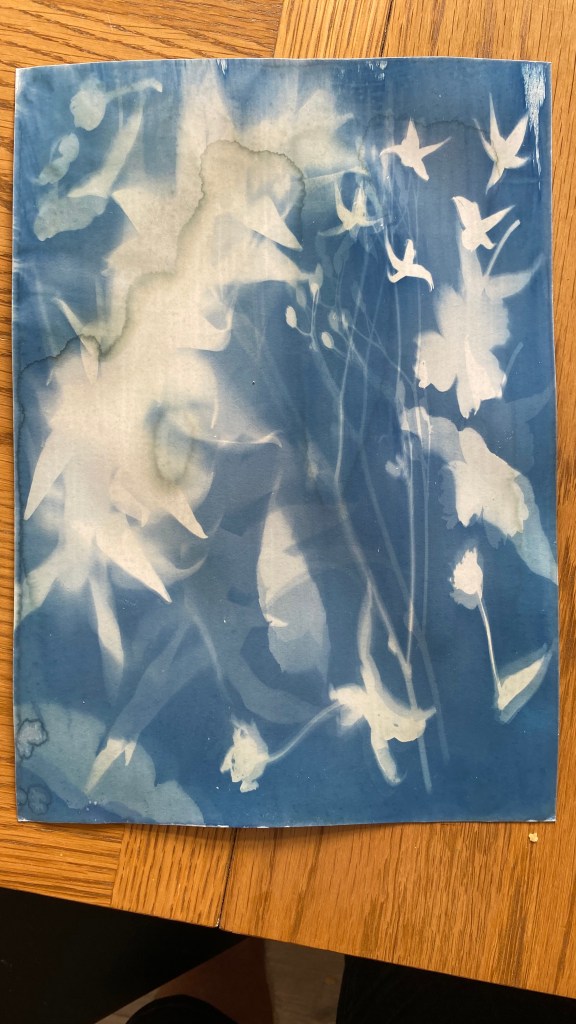
As clearly shown in my first attempts I did not dry the paper correctly after exposing the images, which has led to come staining on both images. They also seem cluttered and perhaps not under light for long enough The day started out with some bright light coming through my window, but his was quite inconsistent.
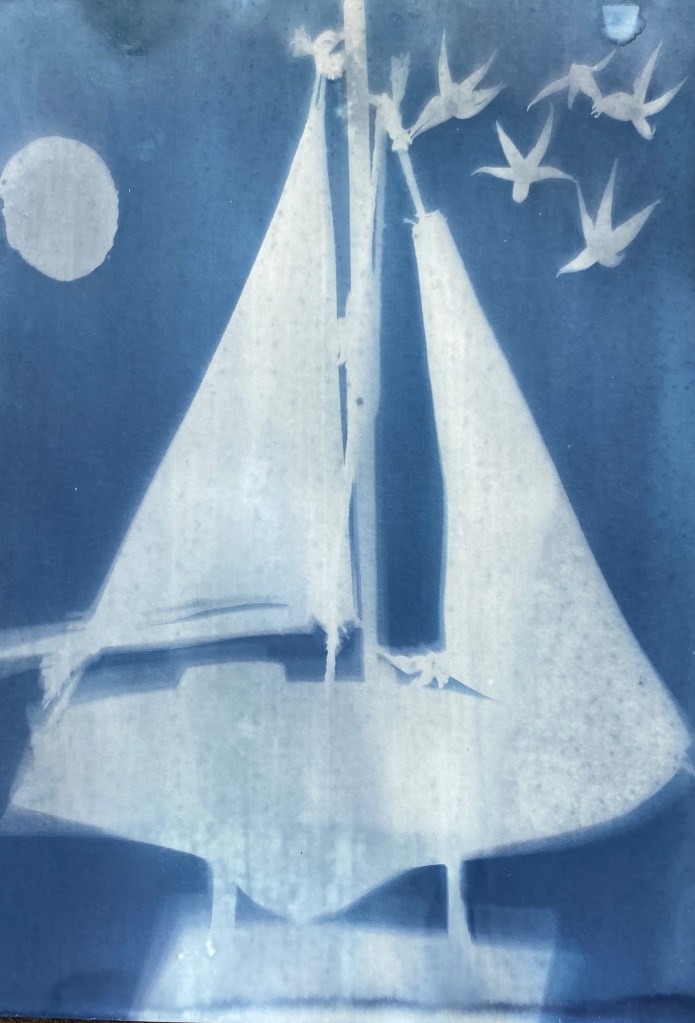
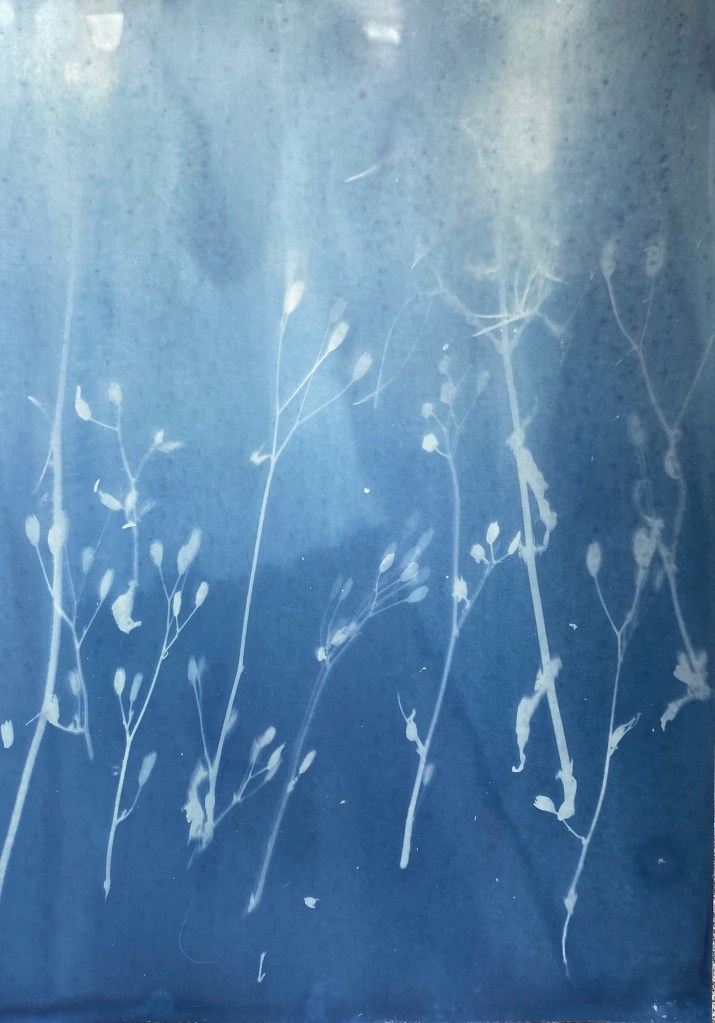
The 2nd attempt did seem to work well with slightly better composition and better results from drying the images. I really like the ethereal aesthetic that the cyanotype produces. What firstly seems like a quite easy process does still need some careful planning, preparation and execution to create exacting photograms. I will continue to work with cyanotypes as it is a fantastic and enjoyable process. I also seem to feel closer to the photograph as a whole and am now looking into developing my own film. I believe that developing and embracing this connection with the image making process can only support my learning and photographic output. I will continue to blog my development of this process and any images that can be contextualised further.
 Dan Towell OCA Context and Narrative