Diane Arbus – In the park 1962 – 1971
“What we (can) see when we begin to look….”
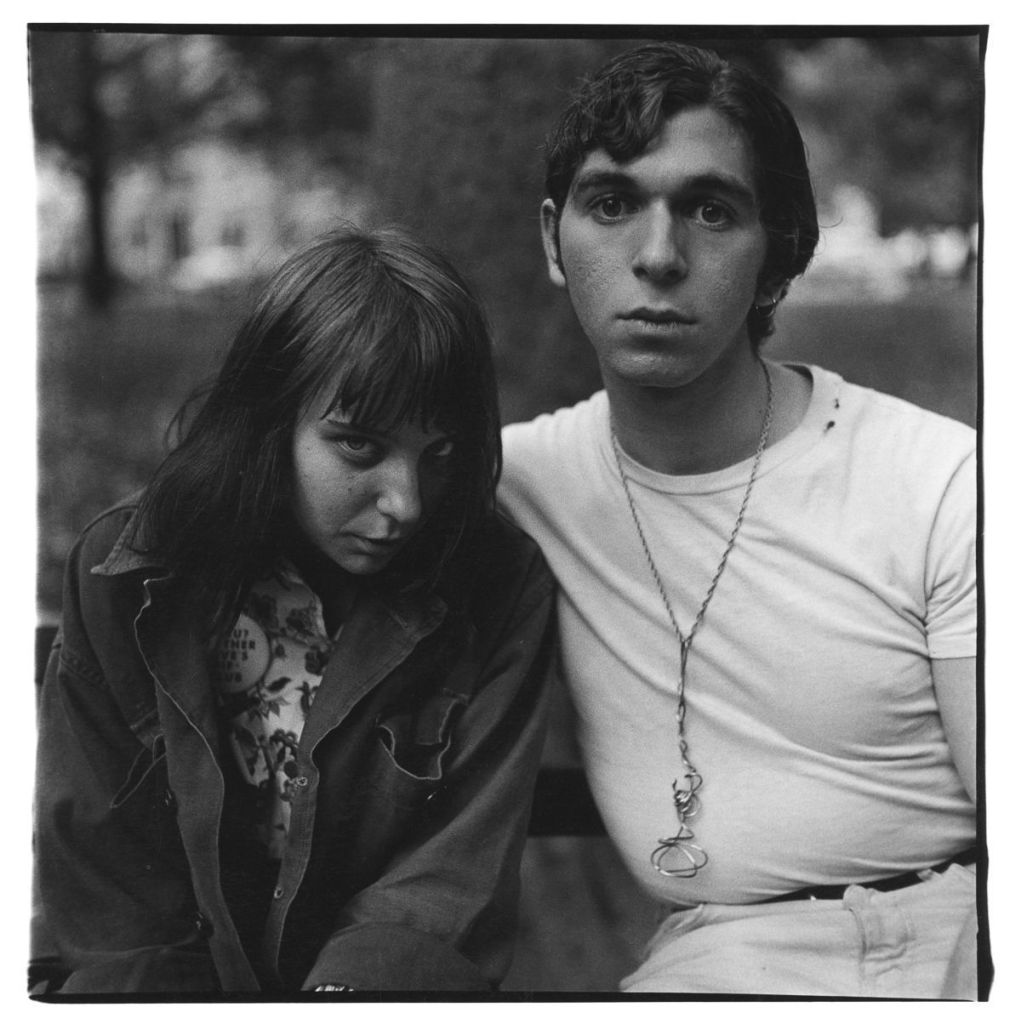
Girl and Boy, Washington Square Park, NYC, 1965
“Always a photograph astonishes me” (pg. 82) proclaimed Roland Barthes in his short book Camera Lucida, published in 1980, a very personal enquiry into the nature and essence of photography and the subsequent reading of it. I can certainly concur with him in this instance, his study of semiotics goes a long way to contextualise and decode the “labyrinth” that is the photographic medium. Barthes explores what he terms the “referent” within an image, the signifier and the signified, along with its noeme, the inherent power of its meaning. He also goes on to discuss the “studium” and “punctum” within the photographic image. “The studium is a kind of education” (pg 28), he proclaims quite emphatically, “a Photographs punctum is that accident that pricks me (pg 27)”. It is the nature of this studium and the corresponding punctum that “pricked” me when I first saw the image that I am about to discuss.
The above image was taken by Diane Arbus in Washington Square Park, NYC, 1965. This photograph, amongst others, later formed part of an exhibition at the Levy Gorvy Gallery in 2017 called Diane Arbus : In the Park. Arbus had lived in NYC for most of her life and began photographing in her local parks in 1956. She had become largely disillusioned with the fashion orientated work she had carried out throughout most of her photographic career, and, in largely voyeuristic manner Arbus set about photographing calculated subjects on the street, in their homes, in the workplace and as in this instance, in suburban parks. She often photographed them as three quarter figures, with no backdrop or surrounding detail and or information. Sophie Howarth, in her book “Singular Images” describes how quite often the person photographed looked “straight back into the camera, with a direct gaze that was unsettling in both its passivity and its wilful surrender to the act of being photographed’. Something that can quite clearly be seen here, or at least with one of the photographic subjects. “The camera is a kind of licence” Arbus remarked, and she had become quite fascinated by people deemed on the “fringes of society”. She sort to use her licence to photograph strippers, transgenders, the mentally ill, circus performers, lesbians, nudists, dwarves, alongside what had been described as the “ordinary” person. Arbus took the time to get to know her subjects considerably well, she described herself as having an “ingratiating personality” and this led to photographing people in familiar situations or surroundings. Quite critically this created a unique connection between her, the camera and her subject(s). An exposure triangle of a very idiosyncratic nature I would deduce.
The photograph of a young couple is titled quite simply, “Girl and Boy, Washington Square Park, NYC”. What is presented is in essence quite “simple”, yet what Arbus seems to have captured offers much more to the discerning viewer. I wonder if something like “a strange relationship” would offer a more suitable title, but this is only a personal thought. The hinge does strike and resonate (to me at least), subtly profound almost but could indeed also be quite meaningless. The ambiguous nature of the title seems to add to the mysterious narrative of the photograph, connoting to something quite distinct. The sign within the image is denoted by the girl and boy who do sit quite “wilfully” on a bench, a relationship between the two is unequivocally evident. What signifies their relationship is the relaxed pose of the male subject who has his arm loosely around the shoulders of his female companion. Yet further connotations drawn from the aesthetics of the image seem to be much more enigmatic. Perhaps there is a more uncommunicative relationship within the obvious, apparent relationship? What could be “signified” by the photograph is a somewhat unhappy pairing, but this again would only be an assumption based on the visual information given by the photograph to me, the “spectator” (pg. 28) by the “operator” (pg 28), Diane Arbus. The girl appears as being unsure, almost afraid, visibly detracted and coy. Is it the camera that enhances her timid, apprehensive personality or is there something else that is making her appear quite uncomfortable. There seems to be a certain disharmony between the girl and boy, a sense of distrust perhaps (even). She presents like a shrinking violet in the frame, slender, diminutive, meek and subtley apprehensive. Her reluctance to raise her head only adds to her nervous disposition. Yet the boy seems to present himself in quite stark contrast to the girl, who sits quite tentatively, arms closely guarded in avoidance on her lap. He looks though the camera almost, as Howarth describes, with an air of “passivity”. This is jarred with a clear denotation that the girl does not want to be photographed. I would suggest the “girl and boy” are most definitely the studium within the frame, the photographic referent in this instance, their relationship. The seemingly or perhaps apparently fractured nature of this “relationship” the punctum, the detail that most certainly “pricks” me.
Arbus seemed to genuinely master the art of portraiture, not only within her series of images set in the parks of NYC, but also in her other work, which seemed focused on capturing what she believed, “nobody would see if she didn’t photograph them”. In much of Arbus’ work she seemed to disassociate with the generic rules of photographic composition, as in one of her more famous images, “Child with toy hand grenade” (1962). The boy appears quite unstructured within the frame, cast with an overbearing silhouette behind him, framed within blown out highlights and somewhat distracting subjects in the edges of the frame. Yet the power and level of intensity that is perpetrated by the image is nothing short of shocking. It could be argued that the nature of the unbalanced composition adds to the tension within the frame. To my mind the image of the girl and boy in a NYC park offers the same level of potency but in much less dramatic fashion. A close crop and a more generic use of composition add a level of sharp intimacy to deliver the photographic studium. Arbus has clearly used a longer focal length here, probably paired with her medium format Rolliflex which she had switched too in 1962 from a Nikon 35mm camera. The focal length creates a very shallow depth of field, which further isolates her subject and by nature avoids other elements in the makeup of the frame. The boy appears wide eyed, masculine, bold and cocky, quite relaxed and unperplexed by the camera or his demure companion. He is appears almost defiant, a typical New Yorker perhaps, unshrinking and bold in his plain white tee shirt and long chainlike necklace. His brassy demeanour suggests dominance and hierarchy within the relationship, connotations seems quite limitless. The girl appears to shrink into his grip, evoking a sense of wrong doing perhaps, an unsettling air of entrapment. There is little offered here to suggest a happy, loving relationship, nothing that we would normally expect from a portrait of this nature. No hand on the knee, no smile, no eyes glazed with a sense of giddy glee, no genuine interaction in the frame, be it physical or emotional. There is little background behind this image and indeed many others that later formed part of the series “In the park”. No further information which can be relayed to the spectator in the way of accompanying text, no confirmed names or addresses to help decode the image further. What is left is an image that whispers rather than shouts, that facilitates rather than obstructs. It quite poignantly provides a vivid portrayal of the often ambivalent nature of the human relationship. The result as viewers is that we are left breathing heavily by an overall sense of allurement, a feeling that we have ran for a bus that has already left.
Arbus quite sadly took her own life in 1971 after suffering continual depressive episodes and illness. A wealthy upbringing had strangely left her unfulfilled and she felt disconnected from the reality and struggles of everyday life for some years. After her foetal years in the world of fashion photography, Arbus set about her legacy, one which continues to educate and grip viewers and students alike, yet we cannot conclude to her “noeme”, the true meaning held in much of her work. We do have a library of connotations that we can draw from much of her photography, alongside a level of genuine mystique. Arbus’ estate was left to her daughter Doon, and only in 2003 was archival material relating to her work released for the first time, snippets of her letters, diaries, workbooks and postcards along with other personal material. Due to a lack of hard fact, Arbus will continue to fascinate and likely divide the world of art and photography for many years to come. Could we argue that Arbus herself a photographer on the “fringes” of her own photographic vocation? Well, she was armed with a sycophantic, often persuasive personality, technical photographic ability and the inclination to intertwine both quite cleverly. I would suggest that Arbus had much in common with the marginalised groups she photographed, even though her upbringing was quite different. What we can conclude is that this created an undeniably evocative link between Arbus, her camera and her subjects.
Research
A link to some further research can be found in my LL here – https://danieltowellocacontextandnarrative.photo.blog/assignment-4-research/
Bibliography
(ONLINE) https://mashable.com/2017/05/20/diane-arbus-in-the-park/ (accessed 30/6/20)
(ONLINE) https://contentstore.cla.co.uk/EReader/Index?p=RDpcU2l0ZXNccHJvZHVjdGlvblxUZW1wXERDUy1lMDZjMjg3OS1iMDZlLTRjNTEtYTE5Ny1mNjY0YmRiNzIzZTQucGRm&o=JnB1Ymxpc2hlZENvbnRlbnRfSWQ9OTc3OTg5JmNvbnRlbnRSZXF1ZXN0X0lkPTEwNzA0MDUmZG9jdW1lbnRMaW5rPWIzZDA3MTQ4LTIyZWMtZTkxMS04MGNkLTAwNTA1NmFmNDA5OSZjb250ZW50SXRlbV9JZD0yODAwOTA=&id=b3d07148-22ec-e911-80cd-005056af4099 (accessed 30/6/20)
(ONLINE) https://mastersof.photography/diane-arbus/ (accessed 30/6/20)
(ONLINE) https://www.theguardian.com/artanddesign/2019/feb/17/diane-arbus-in-the-beginning-hayward-gallery-don-mccullin-tate-britain-review (accessed 30/6/20)
(ONLINE) http://www.artnet.com/artists/diane-arbus/ (accessed 30/6/20)
(ONLINE) https://en.wikipedia.org/w/index.php?title=Diane_Arbus&oldid=963587824 (accessed 30/6/20)
(ONLINE) https://www.youtube.com/watch?v=sbsrJTjV8BI&t=16s (accessed 29/6/20)
(ONLINE) https://www.youtube.com/watch?v=Q_0sQI90kYI (accessed 29/6/20)
(ONLINE) https://www.levygorvy.com/exhibitions/diane-arbus-in-the-park/ (accessed 30/6/20)
(BOOK) Camera Lucida – Roland Barthes – Published by Vintage 2000 – Vintage, Random House, 20 Vauxhall Bridge Road, London, SW1V 2SA.
(BOOK) Singular Images: Essays on remarkable photographs, Sophie Howarth (2005) London: Tate Publishing.
 Dan Towell OCA Context and Narrative