Upon receiving feedback from my tutor it was suggested that I put my research which was documented in my diary entries into a more concise form in my Learning Log. Below are some pieces taken from my diary which help to contextualise my work on the project.
Francesca Woodman
Francesca Woodman was certainly an enigma and unfortunately passed away at the young age of 22, after committing suicide by throwing herself out of a loft window in New York City in 1981. It is understood that her face was unrecognisable and she was ultimately identified by her clothing. She had spent her years doing mainly self portrait photographic work in both New York and Rome, Italy. She studied both in Italy and Rhode Island, where she produced some of her most emphatic work. She had also spent a large amount of time in Italy during childhood years and was fluent in Italian. Her parents were also artists, with her father being a painter and her mother working in pottery. Woodman took her first self portrait at age thirteen and continued to do so throughout her life and journey in photography.
Upon looking more closely at Woodman’s work it is clear she was a prodigious talent. Her work still stands up today and is perhaps more vital now in the age of the selfie and the vanity laiden instagram feed. While she used various techniques in her images she predominantly shot with a medium format camera producing mainly 6cm x 6cm square negatives. A lot of her later work was “studio” based where she used old abandoned buildings to shoot her self portraits, often she was scantily clothed and used movement and slow shutter speeds to create blur and hide details of herself.
It seems that Woodman’s unfortunate demise was largely down to her work not being as critically acclaimed and lauded as she wanted or felt she deserved. This I believe was not only down to accompanying public acclaim but I personally believe she did not feel as appreciated as an artist by her own family. After watching the documentary on The Woodman’s (see YouTube reference) it is clear today that her parents still jostle for critical acclaim and its notoriety, and in particular would not want the attention of Francesca’s work to detract from their own. It is also clear that Woodman was at her happiest when creating her work, and that photography was her way of expressing herself and her demons. Was she in a state of depression, a troubled state of mind? Well quite clearly I would say yes, anyone who chooses to through away such talent in such dramatic fashion must be a fairly loose cannon. It is also known that she was diagnosed with depression after a failed first suicide attempt, and was placed in the care of her parents after this. She was prescribed anti-depressants and in time most people felt she was on the mend, yet close friends still saw an alarming turn in her emotional state in the days leading to her death.
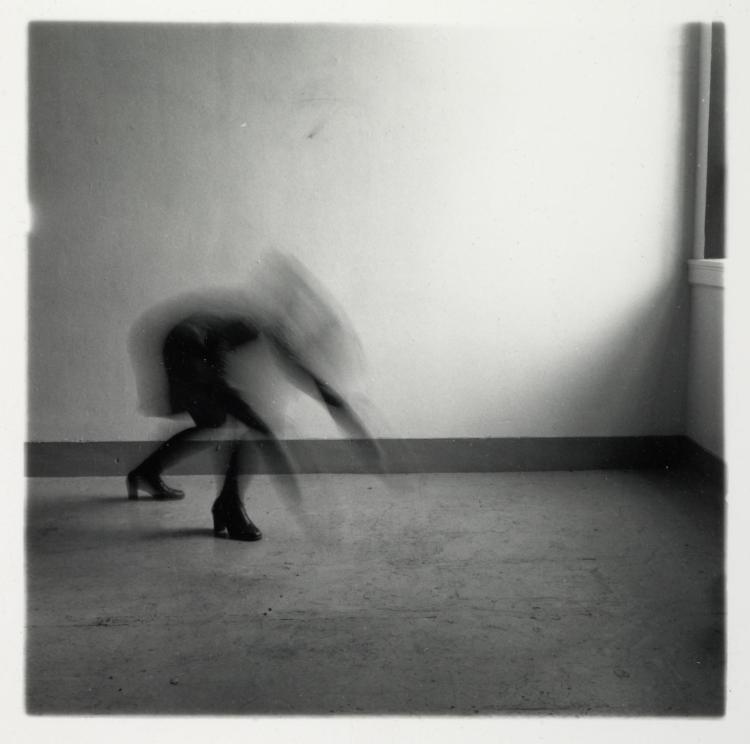
Francesca Woodman’s work is startlingly oblique and almost bordering on morbid as Woodman portrays herself almost shrinking away into corners of rooms, abandoned and isolated in desolate buildings. The movement blur serves to add to the sadness she cannot perhaps escape, her brain twisting and contorting her body into a whirling mess of inadequate emotions. Why she felt like this will be open for much debate, but it can also be observed that when she was growing up her parents spent much of their time on their respective projects, with everyday being a “creative day”, and maybe she felt inadequate due to this from a young age. Perhaps she felt left aside, slightly unloved and emotionally malnourished. When she finally began to express herself in a truly artistic fashion was she greeted with feelings of wonderment from her artistically (struggling) parents? Did she feel that her work would finally give her the attention, not only from peers, friends and the public she so craved, but also that of her parents? Whether I am right or wrong we will never know, but for me I have seen and researched enough to come to the conclusion that her work was that of a tortured artist, indeed a “troubled mind”. Her work is eery, scary, desolate, unique, evocative, provocative and more often that not filled with feelings of isolation, despair and loneliness. Her work was a diary of how she felt, how she wanted to portray her own personal thoughts and feelings. I don’t often clearly see happiness in her images although she was obviously very happy in the making of them. This was Francesca Woodman’s world as she saw it, and her gratification came from being able to interpret and reflect that in her photography. In some of her videos that go behind the scenes to her images, she can be heard laughing loudly and speaking ecstatically when things come out as she had envisioned. Her happiness was finally having her voice, her opportunity to be heard, her time, finally. I can almost hear her sigh with relief. Unfortunately it seems that the interest and admiration for her artistic qualities and talent came all to late. To concur, it is often genius is saddled with great torment and this is very much the case with Francesca Woodman. Why she was quite so troubled will certainly never be fully understood.
Response
In response to Woodman’s work I took some images at home of corners and other abstract scenes to get a better taste for how they affect and are affected by the photograph. Stains, cracks and debris are all left unadulterated in the shots. It is safe to say two young children our own home has been slightly “abandoned”. Shot these images with a Nikon D800 and used a 50mm 1.8g lens. I also explored shooting the corners in landscape or portrait fashion.
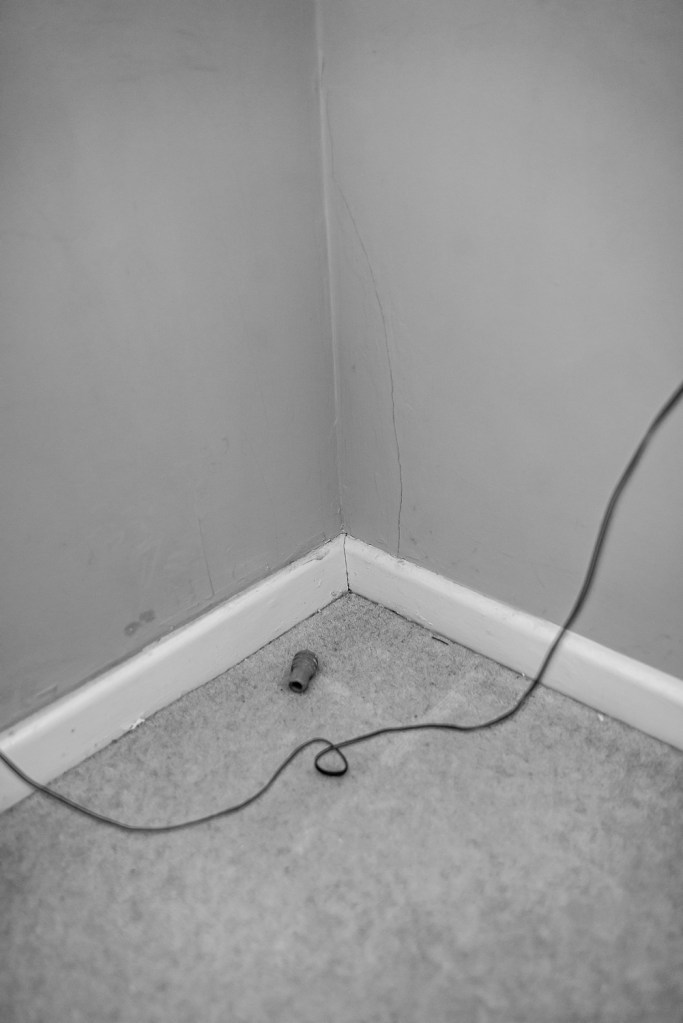
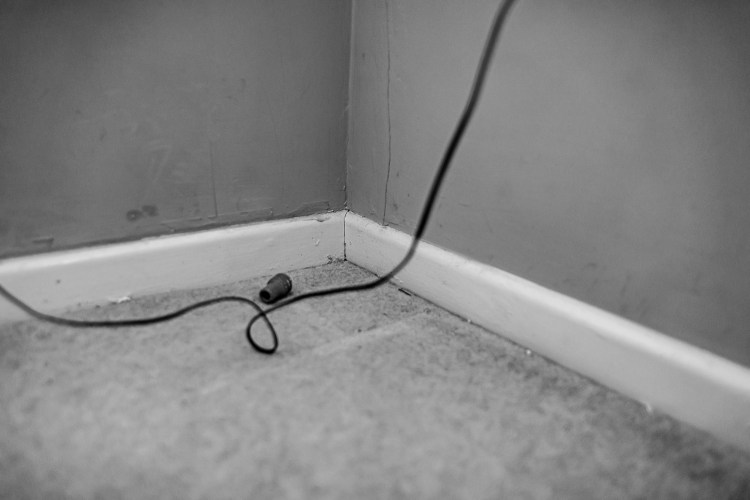
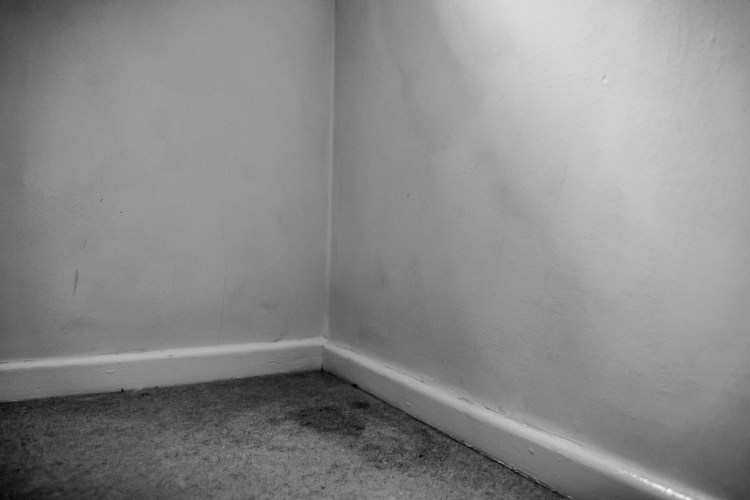
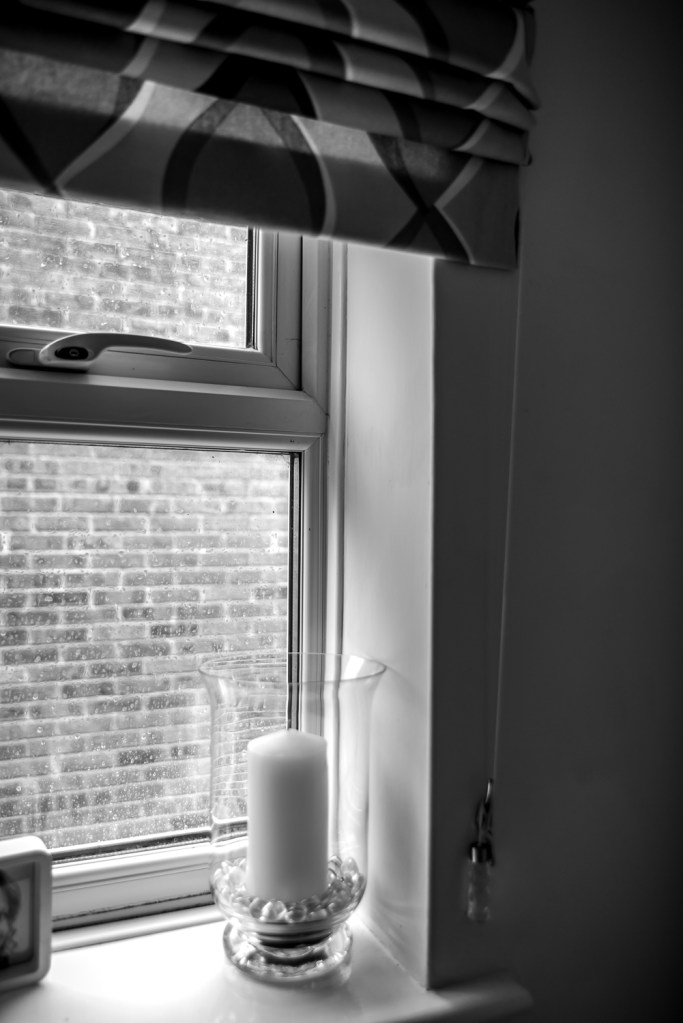
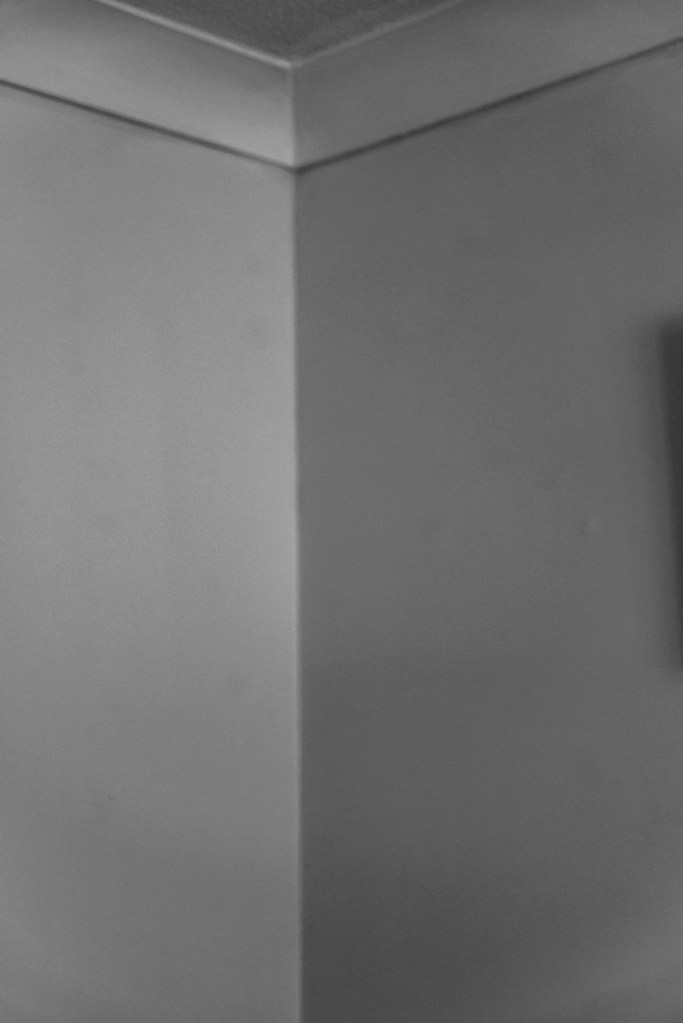
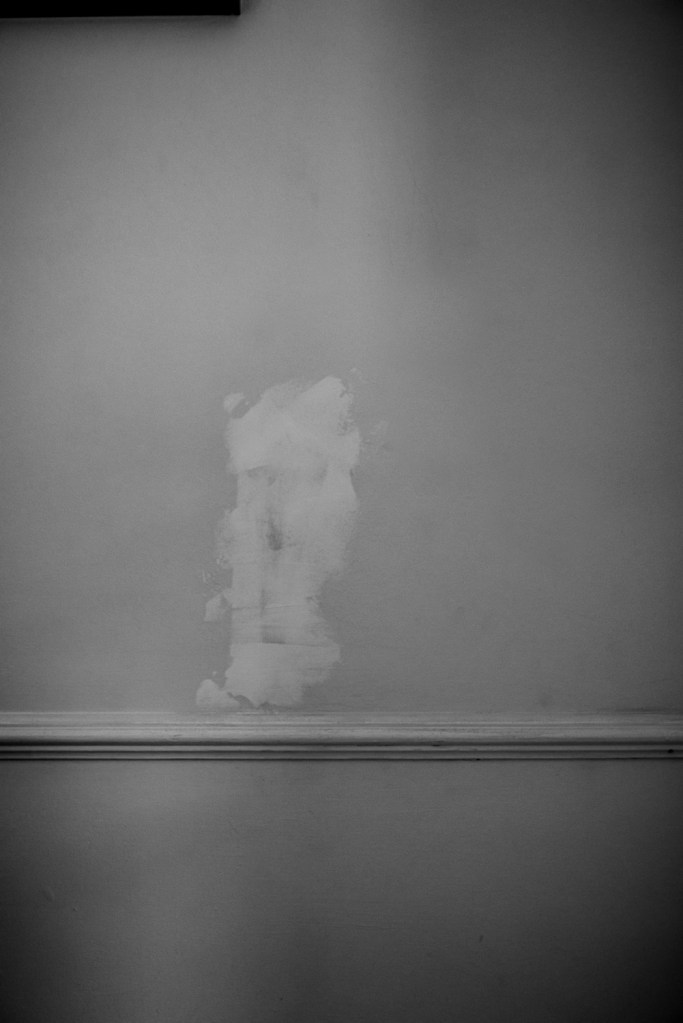
I have deliberately left the noise on these images (ISO 640) as to add to the dynamic of these black shots. Its clear that the camera picks up minute detail and corners of any room seem to have an eerie like presence which is exasperated by the still image. This is obviously something that Woodman notice early on and used to dramatic effect as she often withdrew her persona into these tiny crevices of the rooms she used. It is also clear the two dimensional aesthetic of the camera enlarges the size of the corner, flattening and lengthening it adding quite enormously to its enigmatic personality. This is particularly true when shooting landscape. I have left small unidentifiable elements in the frames which serve to add to their mystique.
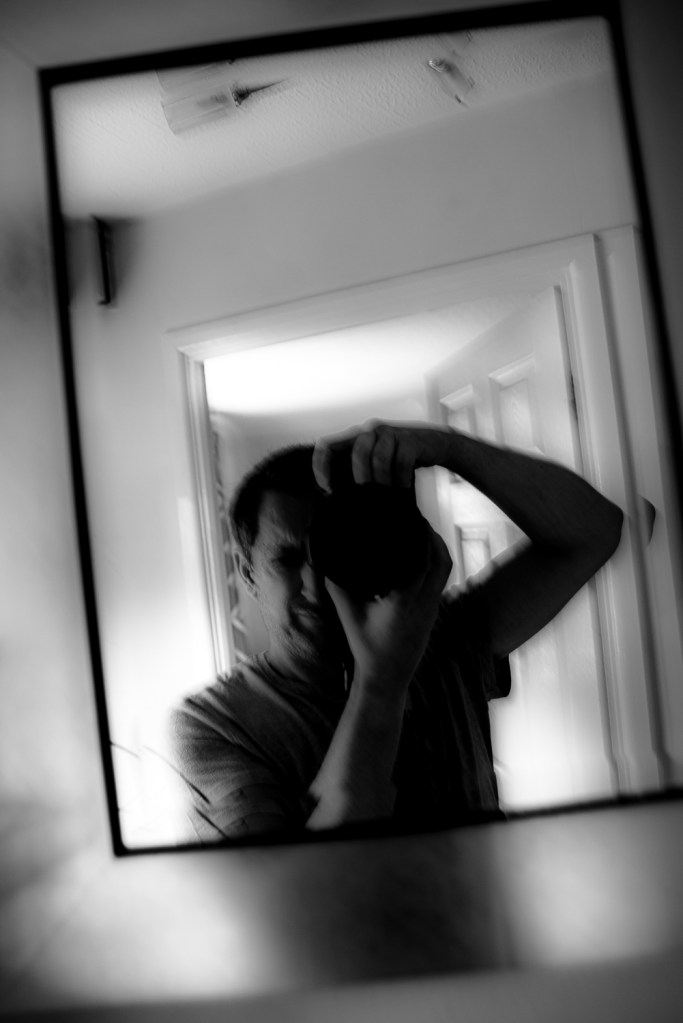
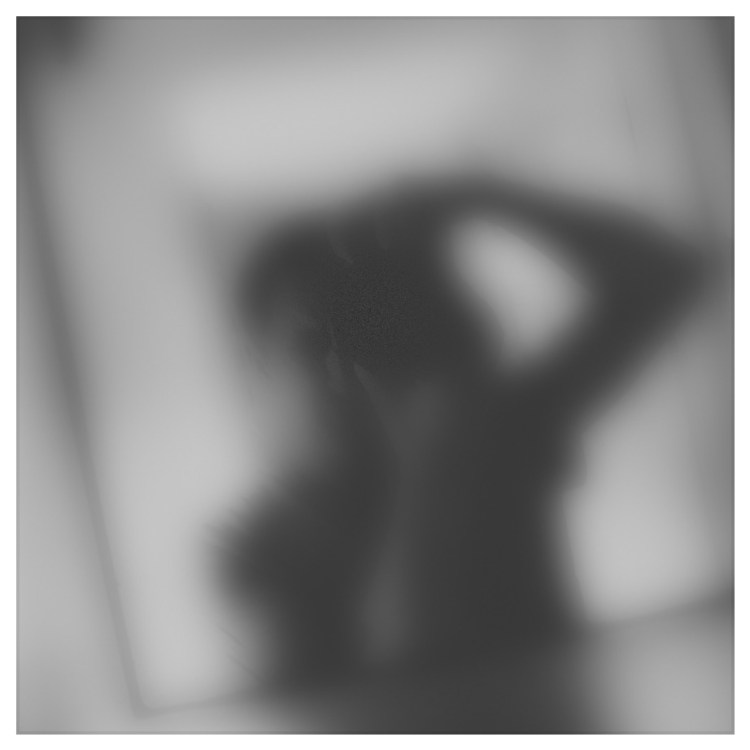
A slow shutter in the mirror reflection image of 1/8th sec causes natural camera shake and movement which enhances a purely experimental image. I tilted the frame in process to add a more “frantic” feel to the shot which again enhances the feeling of quick movement. This is something Woodman used to good effect in her work often producing a lot more movement and blur but always having a definite point go focus. I think this also highlights her feelings of wanting to reveal herself in a different form, almost becoming how she feels in the frame, completely devoid of human aesthetics but a more complete depiction of emotion. Below is a further edit in Photoshop where I added more blur, subtle grain and fade to dramatise the effect. I also edited this into a square format.
References
Reference – (ONLINE) https://www.guggenheim.org/exhibition/francesca-woodman (accessed 11.06.20)
Reference – (ONLINE) https://www.tate.org.uk/art/artists/francesca-woodman-10512 (accessed 11.06.20)
Reference – (ONLINE) https://www.youtube.com/watch?v=OM3uBw5_voY (accessed 11.06.20)
Reference – (ONLINE) https://www.youtube.com/watch?v=5zqNUdtCwkU (accessed 11.06.20)
Reference – (ONLINE) https://www.tate.org.uk/art/artworks/woodman-space-providence-rhode-island-ar00350 (accessed 17.06.20)
Bill Brandt
During my research for this assignment I also watched numerous YouTube documentaries, which I found a interesting way to get into the mind of the photographer. A Bill Brandt documentary was fascinating and, in much the same vein as Andre Kertesz, a lot of his work was taken in his locality close by to his home. This in itself I find quite intriguing. I liked the way that he said he didn’t plan much of his work, he just seemed to let it happen, scenes unfolding before him. He also said that the majority of his work was done in the darkroom where he manipulated the image to suit the mood or feeling he wanted to portray. He said he changed images “completely’ in the darkroom working in black and white. He said he tried colour be felt it was never very good. It was also shared that Brandt did not like to talk about his images, but his particular favourite series in his work were his nude portraits, which he also did not like to talk about. He began his work in 1929 and said that he had never really “done anything else”. A lot of his work involved long exposures, some up to twenty minutes. He also says “one must have some luck in photography”, an idea I can certainly empathise with.
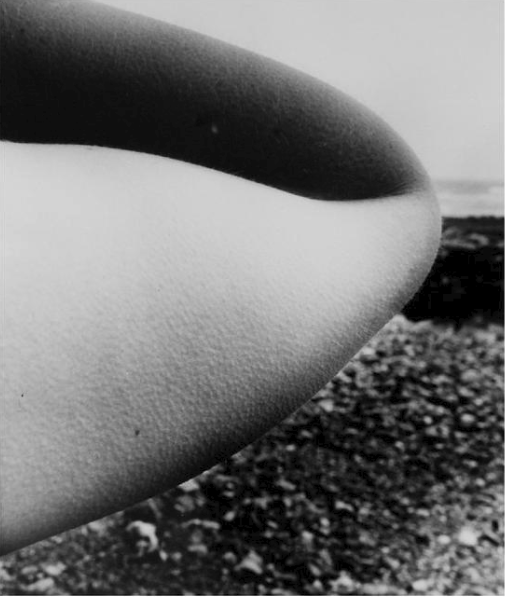
Quite an interesting image above where Brandt clearly seems to be exploring the body more as form than anything human. Curves and a faint horizontal horizon create a real juxtaposition photographically, the close up of a bent arm represents a form rather than an identity. It is almost as if the body is one with the landscape. I find this image to be quite ahead of its time, as is much of Brandt work. A real sense of ambiguity is levelled at the viewer and I would assume that Brandt himself was perhaps influenced by Edward Weston and his photographic study of form by such banal subjects as cabbage leaves and the humble pepper.
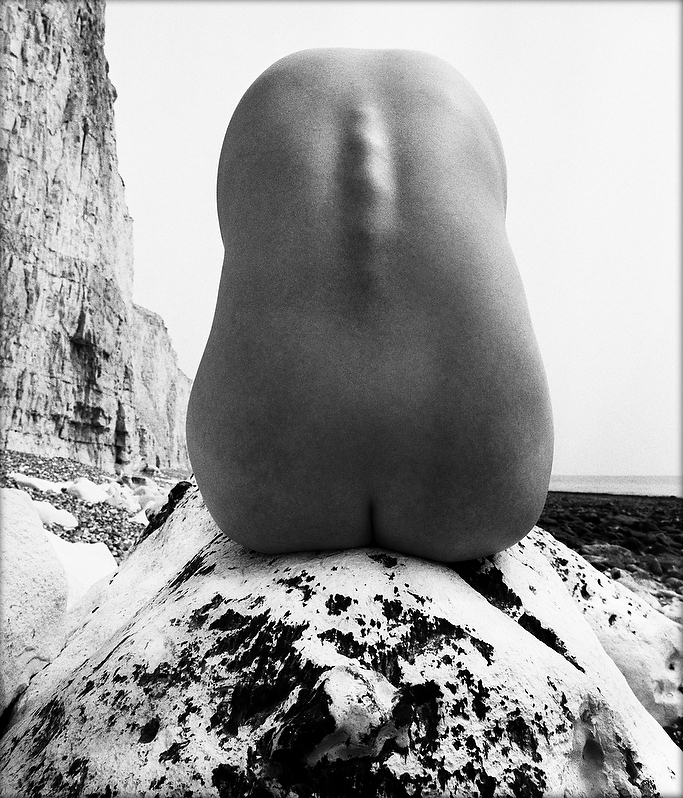
Again as we can see here from the image that Brandt is suing the human body to explore form and perhaps argue our own identity. The fact that the head is bowed and the subject is nude in such a open space suggests vulnerability and desperation. I would like to experiment with such ideas with my assignment, perhaps using my own body to explore such connotations. Again I would reiterate how profound I found his comment of that he felt that his nude work was amongst his best. Somewhat strange from a man is likely more remembered for his documentation of the English landscape and heritage.
References
Reference – (ONLINE) – Bill Brandt – https://www.youtube.com/watch?v=o3KuY0quBsk (accessed 21/6/20)
Reference – (ONLINE) – Bill Brandt – https://www.billbrandt.com (accessed 22/6/20)
Reference – Ansel Adams – https://www.youtube.com/watch?v=rdCq-1MJmHw&t=1176s (last accessed 23/6/20)
Reference – (ONLINE) – Andre Kertesz – https://www.youtube.com/watch?v=Olc_QLDPUeU (accessed 20/6/20)
John Szarkowski
I also watched a John Szarkowski documentary that was fascinating (see reference below) and gave me much food for thought. His work began as a photographer which in turn led him to become Chief Curator at MoMA from 1962 – 1991. The film gave a really interesting look at how a curator looks at the work of a photographer, and he picked out some of the numerous images that had struck him during his time at MoMA. It also provided me with some more great photographers to research such as Diane Arbus, Garry Winogrand, Art Shay and Lee Freidlander, amongst others. Compelling viewing.
References
Reference – (ONLINE) John Szarkowski – A life in photography – https://www.amazon.co.uk/John-Szarkowski-Life-Photography/dp/B07VN9B67G/ref=sr_1_2?dchild=1&keywords=john+szarkowski+documentary&qid=1592564742&sr=8-2 (last accessed 18/9/20)
Sally Mann
I have also had an affinity with Sally Mann and I love the sense of fragility and depiction of the unreal within her work. I explored her work and came across a series of images entitled “Proud Flesh” that document the health of her husband who suffers from muscular dystrophy. I was again really taken by how an artist can use the camera as such a dynamic and ethereal tool, it became more obvious to me that I wanted to think outside of the box in my forthcoming project. I did not want to necessarily conform to the “norm”, I wanted to challenge myself and I had come across artists that were doing the same. I suddenly had a vision for my images, exploring repressed feelings and the human form but also by way of playing with setting and the use of light. I wanted fragility and fragments of reality in my images, much in the vein of Mann and Woodman.
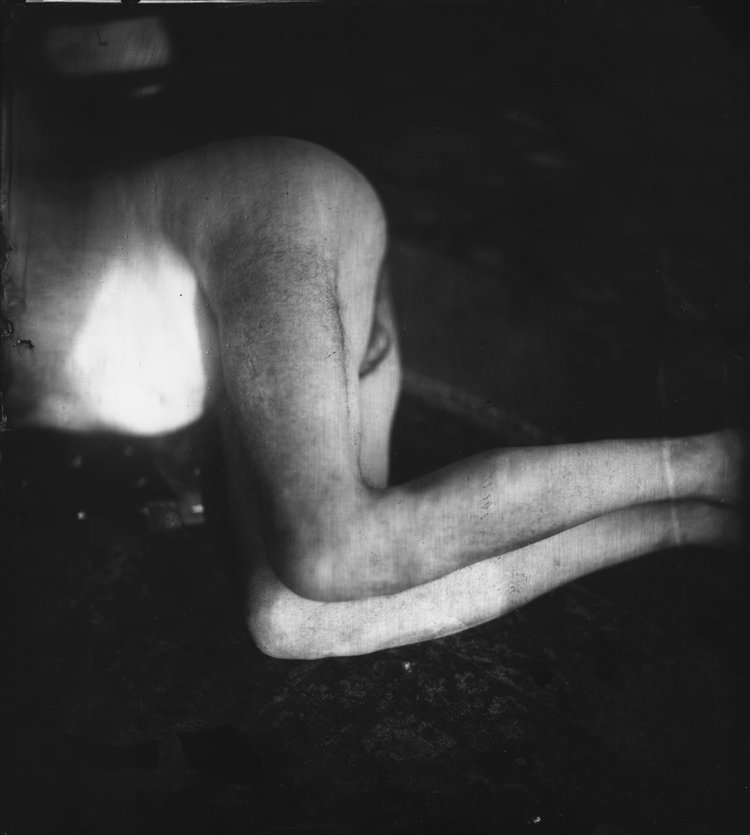
I really like the harsh spotlight here on the stomach of her subject, the bent knees and suffering muscles are so poignantly depicted. A tight drop and deep shadows finalise the frame with slightly exposed genitalia adding to the sense of vulnerability.
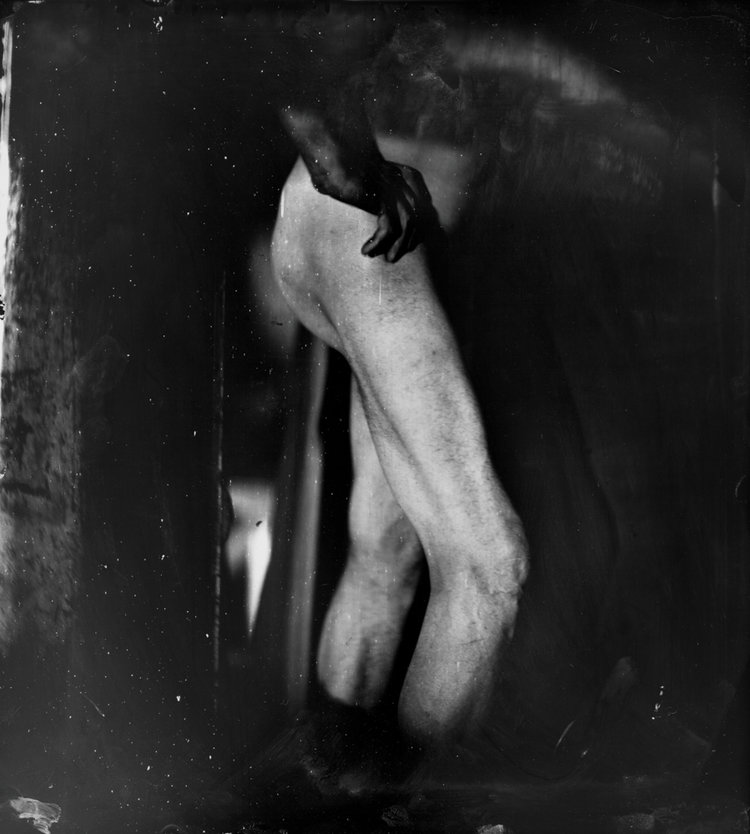
The candid use of a reflection here seems to add to the subtle aesthetics of form and the human body becoming intertwined. The sense of life seems to become blurred, yet a fast shutter seems to isolate and accentuate the movement of her husband deteriorating limbs.
References
(ONLINE) https://brooklynrail.org/2009/11/artseen/sally-mann-proud-flesh (accessed 23/6/20)
(ONLINE) https://www.sallymann.com/proud-flesh (accessed 23/6/20)
Planning
My planning for the scene of the shoot was stumbled upon when I began to look more closely at the work of Francesca Woodman. I was struck by the way she largely used desolated buildings for her most enigmatic images, a real sense of mysterious beauty coupled with deep, yet subtle connotations. Her images seemed much more suggestive than obviously apparent, using long exposures, movement and what seems to be fragments of the human form to signify her meaning. I felt that her images were trying to articulate repressed feelings and this was something I also wanted to examine. I have always admired the mysterious and Woodman certainly ticked that box. Combined with my research of Fay Godwin this led me to the initial idea of a series of images being created in a setting of sparse, dense landscape. Perhaps with some the remains of a historical building, castle or something uniquely similar. My initial thought was to stage the shoot at Calshot Spit, a sparse stretch of sand and shingle bank along the South coast, which is also home to Calshot Castle (King Henry VIII). I took the opportunity to take a look at the scene first and take some vernacular images in a bid to get a better understanding of the scene. A few are pictured below.
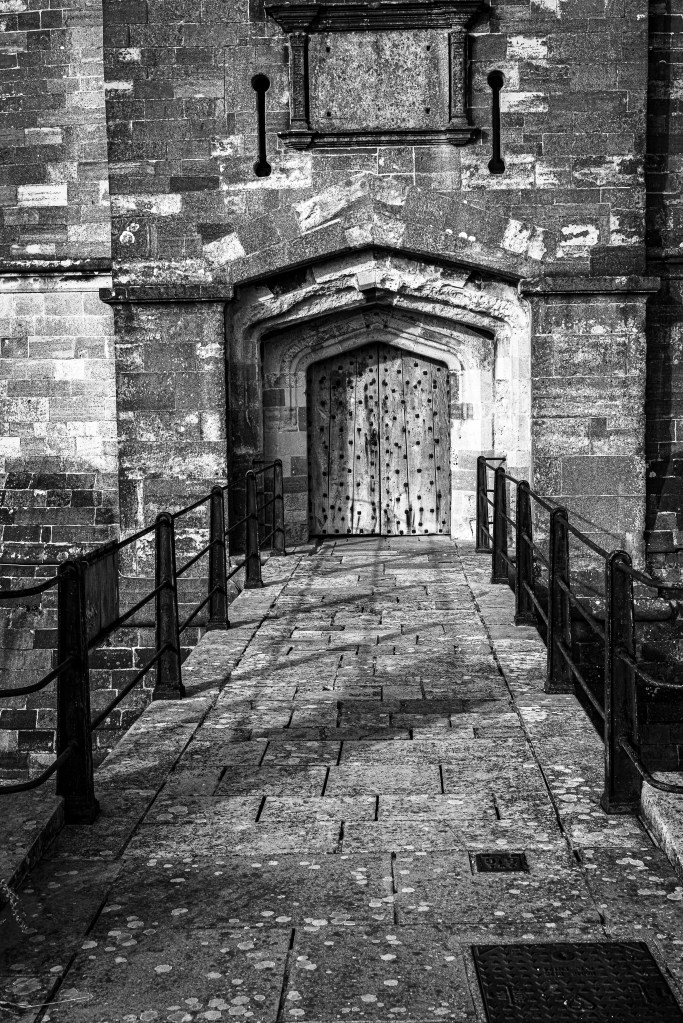
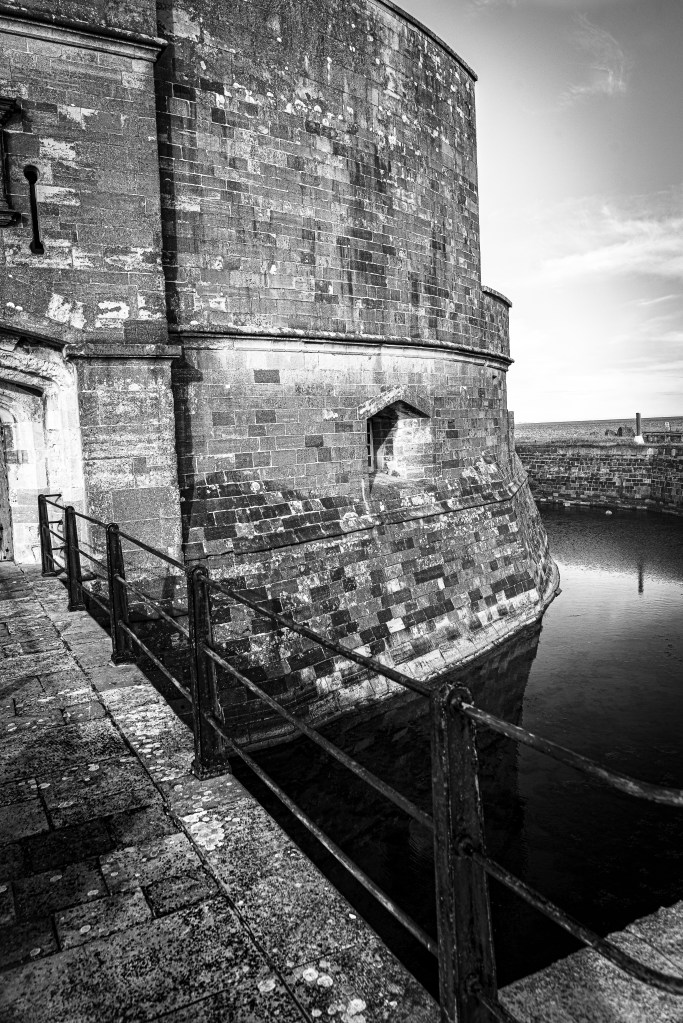
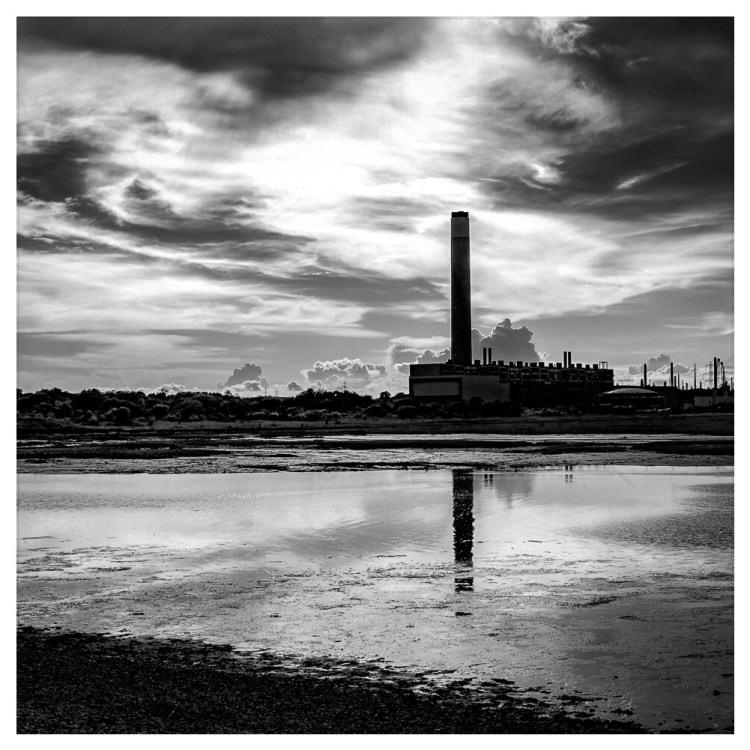
Although I liked the setting it just didn’t seem to fit with my intentions. Also the scene itself was quite “busy” with people and I wanted a more uninhabited space. I began to think of other locations, and being in the New Forest I began to think about some desolate woodland, I know a few from my not so long ago running days. I pondered and pondered some more, then I thought more about actually being inside the desolate building and how I could reproduce this. I then looked more closely (again) at the work of Francesca and realised how often she squeezes or pushes her “form” into corners of her “studio”. I then thought that this was something I could perhaps articulate in my garage, with the exposed brickwork and loose wiring presenting a very similar aesthetic. I then sketch booked some ideas, looking at how and what I would need to compose the scene, and also brainstorm my ideas. This is pictured below.
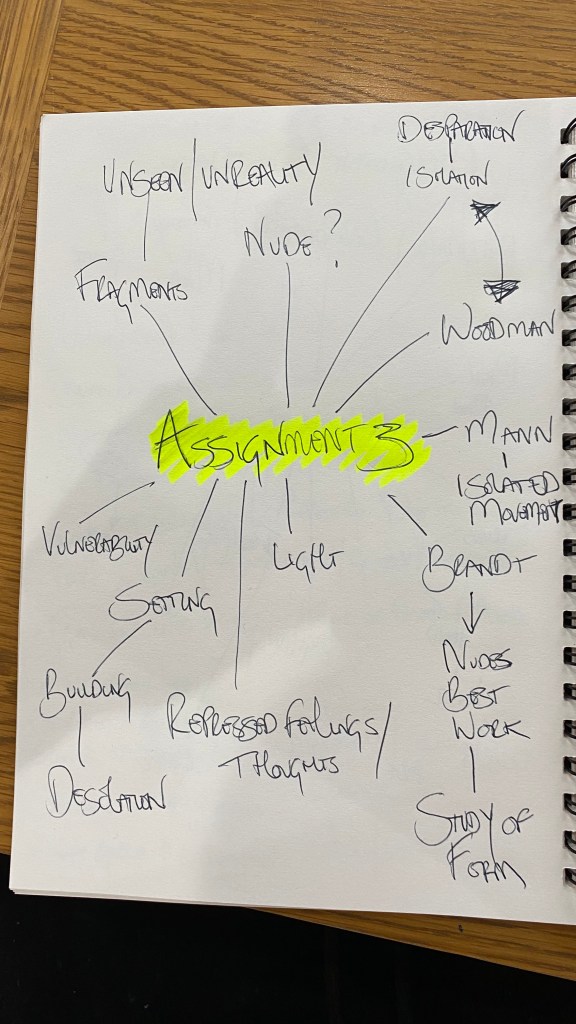
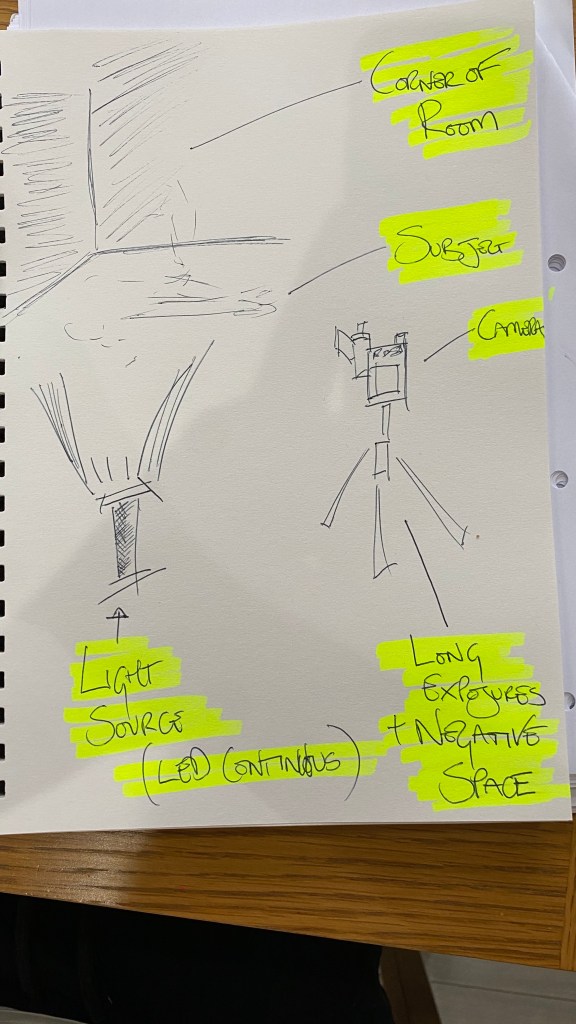
After some careful planning and research I felt I now had my idea in a more coherent form. I knew or at least felt my garage could provide the scene I wanted within the series. I wanted to explore and examine initially, going deeper into the realm of thought and emotion. A real sense of trying to experiment with myself as an artist and photographer. An exploration of the human form by use of longer exposures juxtaposed with the squeezed corners of an empty space. I want my self portraiture not to be a depiction of myself but rather an exploration of repressed feelings. I want a keen sense of isolation, vulnerability and desperation, connoted by the form of what appears to be a human being. I also want to use the harsh spotlight technique of Sally Mann to add to the contrast and enigma of my series. I feel I now have a vision of where I want to take my project.
 Dan Towell OCA Context and Narrative